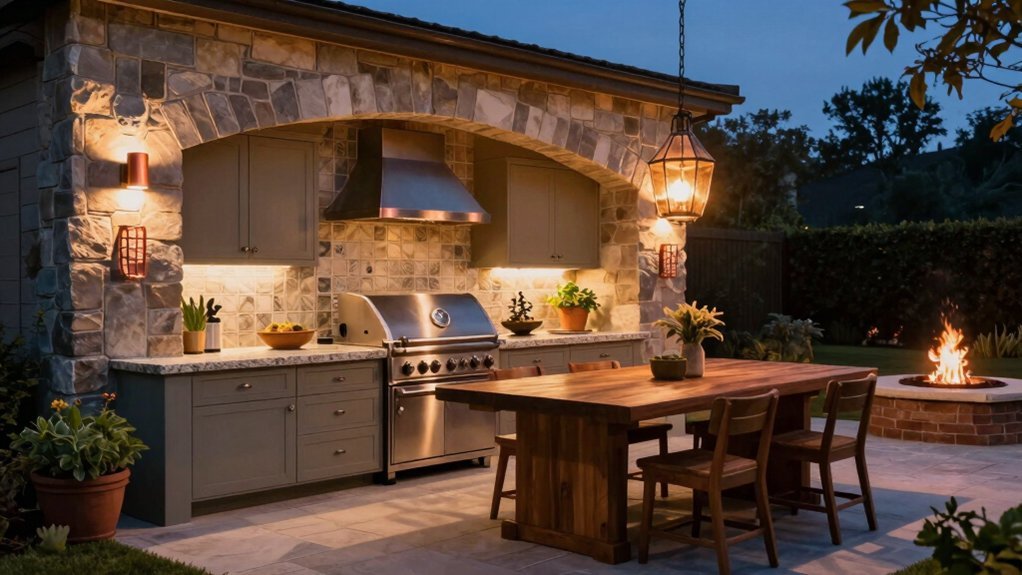
You can layer task, ambient, and accent lighting to transform your outdoor kitchen into a fully functional, inviting space. Install LED fixtures directly over prep zones and cooking areas for bright, focused illumination. Add string lights and wall sconces around dining spaces for warm ambiance. Use recessed ceiling fixtures spaced 18-24 inches apart for even coverage over islands. Include under-counter strips and pathway lights for safety and visual interest. Smart dimmers and weatherproof IP65-rated fixtures ensure durability and efficiency. Each lighting type serves a specific purpose, creating depth and cohesion throughout your space—discover how to strategically combine them.
Task Lighting for Food Preparation and Safety
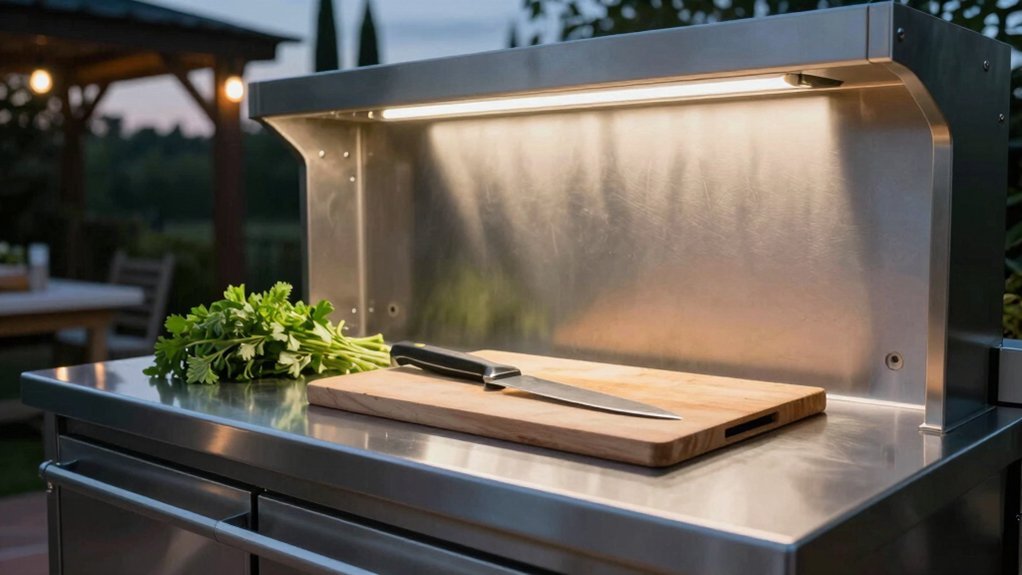
How can you safely prepare meals in your outdoor kitchen after sunset? Task lighting is essential for proper food preparation and safety. Install LED fixtures directly over cooking and prep zones to deliver bright, focused illumination with minimal heat emission. Space recessed ceiling lights 18 to 24 inches apart to provide even downlighting across countertops, grills, and sinks, reducing shadows that compromise visibility. Under-counter LED strip lighting enhances edge visibility on work surfaces, offering continuous glow without glare. Pendant lights suspended over islands or bar areas provide adjustable downlighting you can balance with other task lights to target specific prep spots. All fixtures must be wet-location rated or designed for outdoor use, featuring weatherproof housings and sealed connections to withstand outdoor conditions effectively.
Ambient Lighting for Dining and Seating Areas
Creating the right atmosphere in your outdoor dining and seating areas requires a thoughtful approach to ambient lighting that balances visibility with mood. You can layer multiple lighting types to achieve this balance effectively.
Install outdoor chandeliers or lanterns above tables to cast soft, warm glows that enhance comfort without overwhelming diners. String lights woven through structures or outlining perimeters provide a cozy baseline illumination perfect for evenings. Wall-mounted sconces along seating backdrops deliver indirect, decorative light that adds visibility without creating glare on food or faces.
For flexible ambiance control, incorporate recessed or strip lighting paired with dimmable LED options. This allows you to adjust intensity based on your needs and preferences throughout the evening.
Choose weather-rated fixtures with appropriate IP ratings for wet or damp conditions to ensure durability and consistent performance year-round.
Accent Lighting to Highlight Design Features
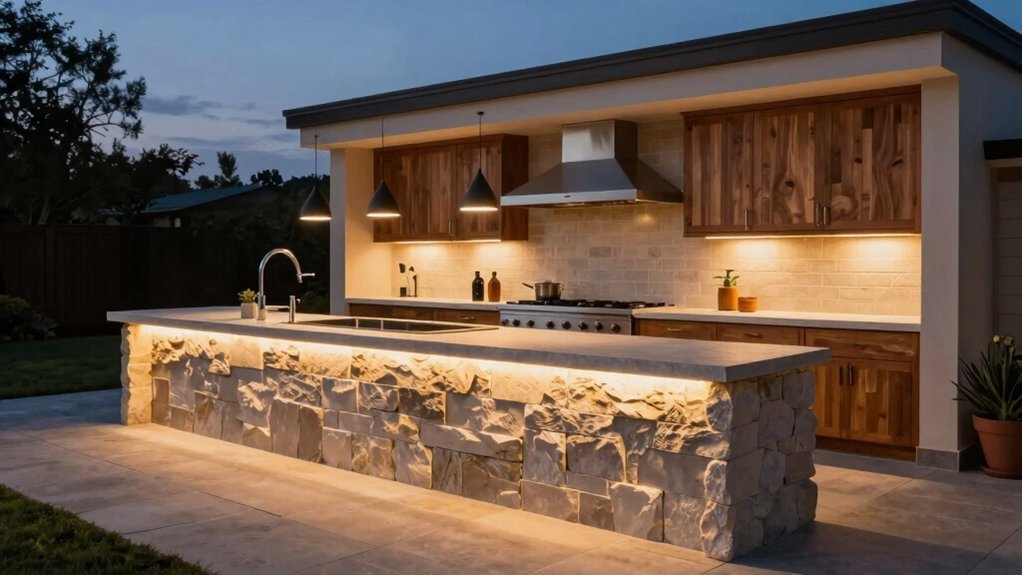
While ambient lighting sets the mood for your outdoor dining areas, accent lighting works to showcase the distinctive architectural and landscape elements that make your space unique. You’ll use strategically placed fixtures like uplights and spotlights to emphasize stone textures, pergola posts, and garden features.
| Feature Type | Fixture Option | Material Benefit |
|---|---|---|
| Stone Walls | Wall-mounted uplights | Powder-coated steel durability |
| Landscape Elements | Feature spotlights | Marine-grade stainless steel |
| Pathways | Lighted pathway fixtures | Weather-resistant construction |
LED-based accent lighting delivers energy efficiency and long lifespan while offering dimmable capabilities and adjustable color temperatures. You can layer accent lighting with ambient and task lighting to create visual depth without overwhelming your space. This approach transforms your outdoor kitchen into an inviting, well-defined entertainment area.
String Lights for Perimeter Illumination
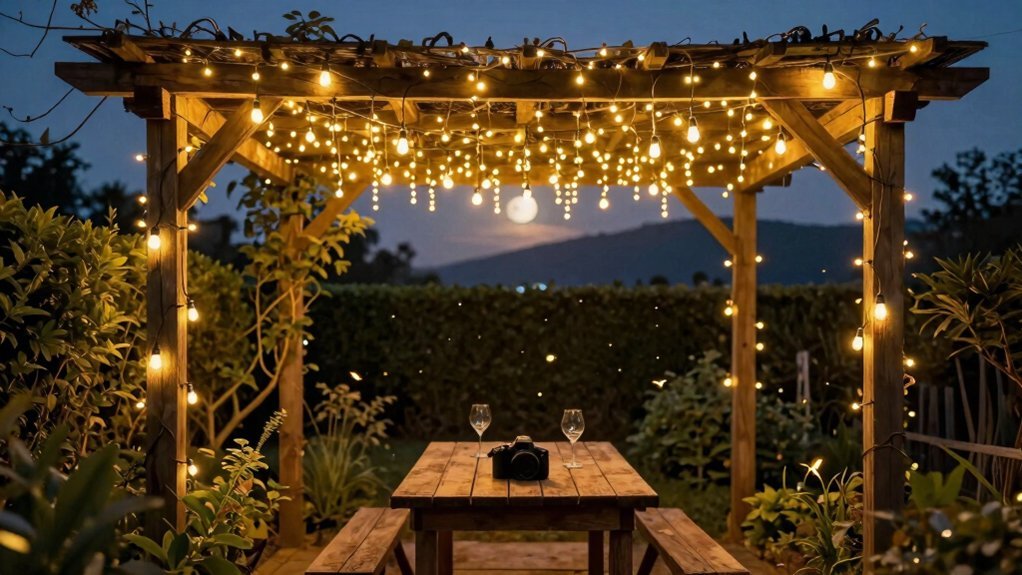
You can use string lights to define your outdoor kitchen’s boundaries while establishing a warm, inviting perimeter that guides guests through the space. When you layer string lights overhead with task lighting on work surfaces, you’ll create balanced illumination that serves both functional and atmospheric purposes. For a modern urban aesthetic, you’ll want to drape string lights along clean architectural lines like pergolas or rooflines rather than haphazardly, which elevates the entire space’s contemporary appeal.
Creating Visual Boundaries
How can you define an outdoor kitchen’s edges while establishing an inviting atmosphere? String lights strung along your perimeter accomplish both goals seamlessly. They’ll mark boundaries while creating welcoming ambiance for gatherings.
Consider these strategies for maximizing visual definition:
- Install lights along pergola posts or roof structures to frame your space naturally
- Choose LED fixtures rated IP65 or higher for durability against weather exposure
- Space lights evenly to ensure consistent illumination without dark gaps
- Combine string lights with wall sconces or post lamps for enhanced visual interest
- Layer ambient lighting with task fixtures to balance atmosphere and functional visibility
This approach lets you establish clear spatial definition without overwhelming your design. You’ll create distinct zones that feel purposeful and inviting, guiding guests naturally through your outdoor kitchen while maintaining the warm, welcoming glow you’re after.
Layering With Overhead Lighting
The key to balanced outdoor kitchen lighting lies in layering perimeter string lights with overhead fixtures to create both ambiance and functionality. You’ll want to install IP65-rated LED string lights around your kitchen’s perimeter, using weather-resistant rubber-molded sockets that withstand outdoor conditions. These strings establish a warm baseline glow that complements your cooking and dining areas without creating harsh shadows.
However, string lights alone won’t provide adequate brightness for food preparation. Pair them with stronger overhead fixtures or wall sconces mounted on roof posts to ensure practical illumination for safety and visibility. Consider dimmable LED options so you can adjust mood during gatherings while maintaining sufficient light for navigation and detail work. This layered approach delivers both aesthetic warmth and operational efficiency.
Modern Urban Aesthetic Applications
String lights become particularly effective in modern urban outdoor kitchens when you layer them strategically around your perimeter to establish a cohesive glow that complements sleeker, more contemporary design elements.
- LED options deliver energy efficiency and durability, making them ideal for year-round outdoor installations
- Weather-resistant materials ensure your lighting withstands urban environmental conditions without frequent maintenance
- Perimeter placement creates ambient baseline lighting that frames your cooking zone without overwhelming it
- Layered illumination combines string lights with recessed or wall-mounted fixtures for even coverage and minimal glare
- Focal points like central lanterns or chandeliers anchor your design while string lights maintain cohesive perimeter glow
This balanced approach merges practicality with contemporary charm, ensuring your outdoor kitchen remains both functional and visually striking.
Recessed Ceiling Fixtures for Covered Islands
Why settle for uneven shadows across your outdoor prep station when recessed ceiling fixtures can deliver consistent, flood lighting across your entire covered island? You’ll want wet-location rated fixtures (IP65 or higher) with corrosion-resistant aluminum or stainless steel housings to withstand moisture and coastal elements.
Space them 18 to 24 inches apart for even illumination without dark spots on your countertops. LED options are your best choice—they consume roughly 75% less energy than halogen equivalents while providing superior brightness.
When integrated with task and ambient layers, recessed fixtures create balanced, professional-quality lighting that enhances both functionality and aesthetics. You’ll prep meals efficiently while enjoying a well-lit outdoor kitchen that performs beautifully day and night.
Pendant Lights and Outdoor Chandeliers
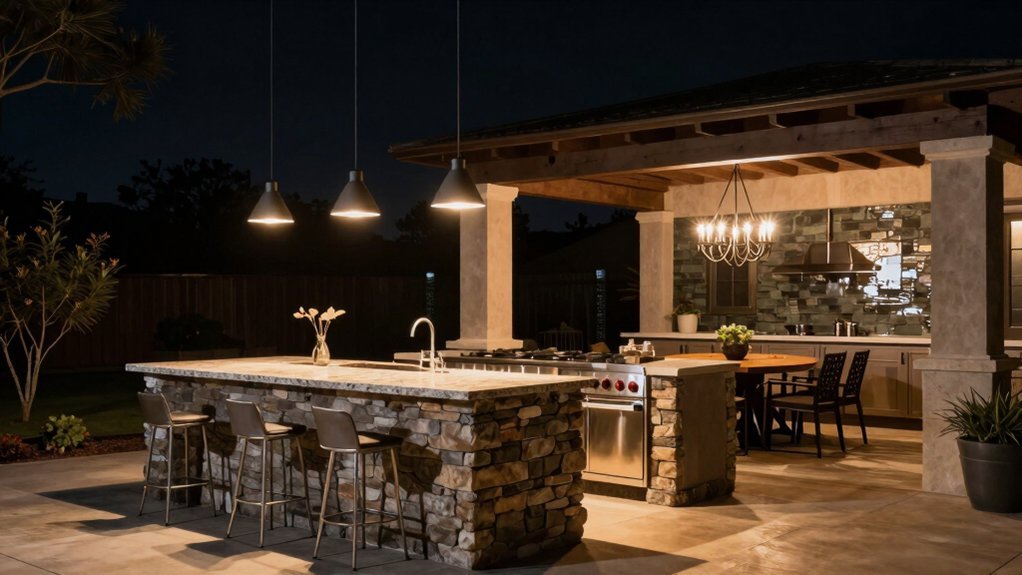
How do you elevate your outdoor kitchen from purely functional to genuinely inviting? Pendant lights and outdoor chandeliers transform your space with style and purpose. You’ll discover that these fixtures offer both aesthetic appeal and practical illumination for your entertaining area.
Pendant lights and outdoor chandeliers transform your kitchen from functional to inviting with style and practical illumination.
Consider these key advantages:
- Task lighting over islands: Pendants provide focused illumination for food prep and dining
- Weatherproof materials: Powder-coated aluminum and stainless steel withstand harsh outdoor conditions
- Dimmable LED options: Control mood and energy consumption with smart-enabled fixtures
- Professional installation: Sealed junction boxes protect against moisture and wind damage
- Layered design: Combine pendants with ceiling fans or chandeliers for cohesive ambiance
You’ll achieve optimal height adjustment to balance with other fixtures, creating a sophisticated outdoor kitchen environment that’s both functional and welcoming for gatherings.
Wall-Mounted Sconces and Downlighting
While pendant lights command attention overhead, wall-mounted sconces and downlighting work quietly behind the scenes to enhance your outdoor kitchen’s functionality and appeal. These fixtures provide layered illumination that balances ambient lighting with focused task visibility. You’ll appreciate how downlighting directs illumination onto countertops, reducing glare while improving visibility for prep work.
Install weather-rated sconces (UL/ETL wet or damp certified) with weatherproof finishes like powder-coated steel or marine-grade stainless to withstand outdoor conditions. Position them strategically to avoid shining directly into guests’ eyes while highlighting textures and surfaces throughout your space.
Pairing sconces with recessed or overhead fixtures creates comprehensive lighting coverage. This layered approach ensures your outdoor kitchen remains both practical and inviting, whether you’re cooking or entertaining.
Under-Cabinet and Strip Lighting Solutions
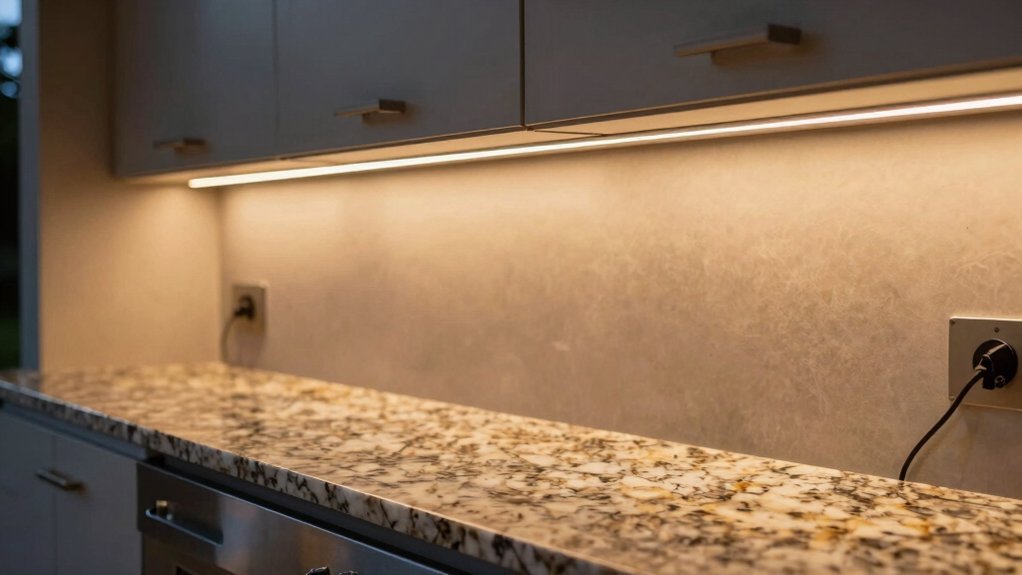
When you’re prepping meals or entertaining guests after sunset, under-cabinet and strip lighting fills the gaps that overhead fixtures miss. LED strips deliver practical illumination while enhancing your outdoor kitchen’s aesthetic appeal.
You’ll find these solutions offer distinct advantages:
- Energy efficiency reduces electricity costs compared to traditional lighting
- Flexible installation adapts to countertops, steps, and architectural features in tight spaces
- Plug-and-play or permanent options suit your preference and setup complexity
- Dimming and RGB capabilities let you adjust brightness and customize ambiance
- Weather-resistant silicone encasing (IP65 or higher) ensures durability in outdoor conditions
You should plan placement strategically to minimize glare and ensure even coverage. Coordinate strip lighting with your overhead and wall fixtures for balanced illumination throughout your outdoor kitchen space.
Pathway and Step Lighting for Navigation
You’ll want to strategically place pathway lights to guide guests safely through your outdoor kitchen while minimizing glare that strains the eyes.
Where elevation changes occur—like steps or slopes—combine pathway lighting with dedicated step fixtures to illuminate transitions and prevent trips.
Safety Through Strategic Placement
How do you keep guests moving confidently through your outdoor kitchen space after dark? Strategic pathway lighting placement ensures safety while enhancing your design’s visual appeal.
- Position lights along walkways at consistent intervals to eliminate dark spots and trip hazards on uneven terrain
- Install step lighting on risers and treads to clearly mark elevation changes and transition between levels
- Frame sightlines from seating areas so guests can navigate entrances and key zones without disorientation
- Choose LED fixtures that resist weather while minimizing glare that compromises vision and comfort
- Integrate lighting with landscape elements like borders and plantings to create cohesive aesthetics alongside functional safety
These placements guide foot traffic naturally while reducing accident risks. Your guests’ll move through multi-level spaces confidently, enjoying both security and ambiance
Elevation Changes and Transitions
While strategic placement keeps guests moving safely through flat areas, elevation changes demand targeted illumination to prevent missteps and disorientation.
You’ll want to install pathway lights and step lighting at transitions, creating visual clarity without glare or harsh shadows. Position fixtures to frame views and textures at different elevations, guiding guests naturally through your space. A layered approach combining practical task lighting with ambient elevation lighting enhances both safety and visual interest.
| Lighting Type | Purpose | Placement | Rating | Benefit |
|---|---|---|---|---|
| Step lights | Direct visibility | Stair risers | IP65+ | Prevents trips |
| Pathway fixtures | Navigation aid | Elevated walkways | IP65+ | Reduces disorientation |
| Accent lights | Texture framing | Level transitions | IP65+ | Visual interest |
| Edge markers | Safety definition | Deck perimeters | IP65+ | Establishes boundaries |
| Ambient uplighting | Atmospheric depth | Strategic corners | IP65+ | Reduces shadow zones |
Choose wet-location rated fixtures with corrosion-resistant housings for durability.
Navigation Without Glare Issues
When pathway lights cast harsh shadows or shine directly into guests’ eyes, they undermine the very safety they’re meant to provide. You’ll want to strategically position lights to guide movement without creating uncomfortable glare.
Consider these key approaches:
- Angle fixtures downward at 45 degrees to illuminate walkways while keeping light below eye level
- Choose LED pathway lights with diffusers that soften output and reduce bright spots
- Select IP65-rated, corrosion-resistant housings in aluminum or stainless steel for durability
- Space lights evenly along transitions and steps to maintain consistent visibility
- Integrate pathway lighting with your ambient and task lighting for cohesive coverage
This thoughtful placement ensures you’re directing guests safely through multi-level spaces while maintaining comfortable sight lines throughout your outdoor kitchen area.
Solar-Powered and Energy-Efficient Options
Why settle for high energy bills when you can light your outdoor kitchen with solar-powered and LED fixtures?
Solar lights offer hassle-free installation without wiring, though they work best for accent lighting in sunny areas. LEDs slash energy consumption by up to 75% versus halogen bulbs, delivering longer lifespans and minimal maintenance. You’ll find integrated solar-LED combinations rated IP65 or higher, perfect for walls and post mounting.
| Fixture Type | Energy Savings | Best Use | Features |
|---|---|---|---|
| Solar LED Lights | Up to 75% | Accent areas | No wiring needed |
| LED Strip Lighting | Up to 75% | Under-counter | Dimmable options |
| LED String Lights | Up to 75% | Ambiance | Weather-resistant |
| Smart Controls | Variable | All types | Scheduling, brightness |
Smart controls let you optimize schedules and adjust brightness across fixtures, coordinating ambiance while maximizing efficiency.
Smart Lighting Controls and Dimmers
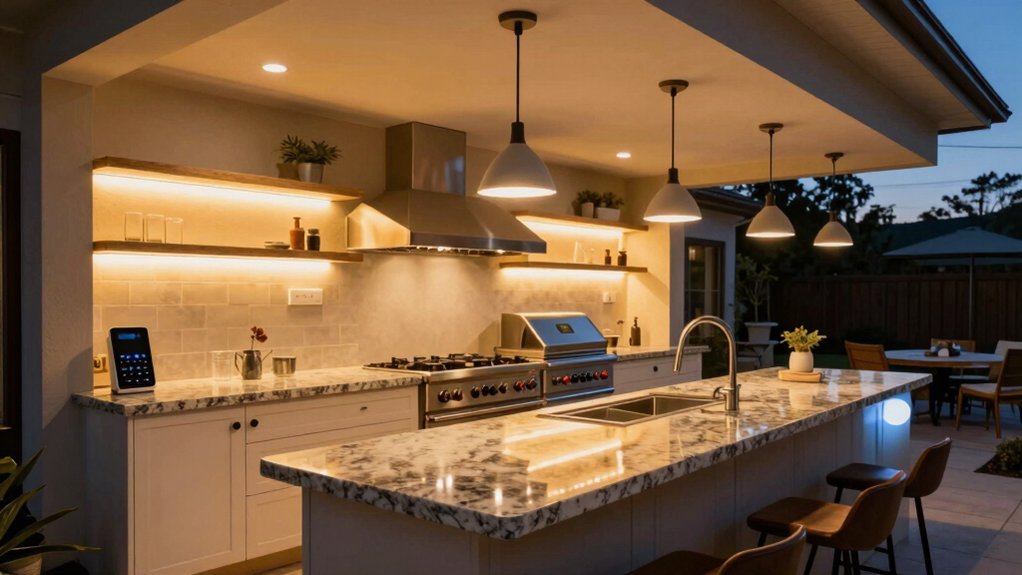
How much control do you really want over your outdoor kitchen’s ambiance? Smart lighting controls and dimmers give you the flexibility to adjust brightness, colors, and schedules through apps or voice assistants. You’ll coordinate multiple fixtures for a unified scheme and create different moods instantly.
Consider these key benefits:
- Adjust dimmers on string lights, pendants, and wall sconces from functional task lighting to intimate evening settings
- Use scheduling automation tied to sunrise, sunset, or occupancy to boost energy efficiency
- Create scene presets like “Cooking,” “Dining,” or “Security” to switch multiple fixtures simultaneously
- Ensure compatibility with your existing fixtures and networking setup before purchasing
- Centralize control so lighting’s ready when guests arrive
This approach transforms your outdoor kitchen into a responsive, efficient space tailored to your needs.
Layered Lighting Design for Complete Coverage
Proper outdoor kitchen lighting requires you to layer multiple lighting types across distinct zones. You’ll want task lighting—recessed ceiling lights or under-counter strips—over your grill and prep areas for precise visibility. Simultaneously, you should add ambient lighting like wall sconces or string lights around seating and dining spaces to create welcoming atmosphere.
Balance brightness across zones to eliminate harsh shadows and glare while keeping pathways and transition well-lit. Incorporate dimmer controls or smart lighting systems so you can shift between high-visibility cooking modes and low, intimate dining scenes.
Choose weather-rated fixtures rated IP65 or higher and LED options to ensure durability. Use a cohesive color temperature scheme—cooler task lighting paired with warmer ambient tones—to unify your outdoor kitchen’s visual environment and enhance comfort.
Frequently Asked Questions
What Is the Typical Cost Range for Professional Outdoor Kitchen Lighting Installation?
You’ll typically spend between $1,500 and $5,000 for professional outdoor kitchen lighting installation. Your exact costs depend on the number of fixtures you’re installing, their complexity, and your location. More advanced systems with smart controls cost more.
How Do I Protect Outdoor Lighting Fixtures From Harsh Weather and Corrosion?
You’ll protect your outdoor lighting fixtures by selecting corrosion-resistant materials like stainless steel or aluminum, applying weatherproof sealants regularly, installing proper drainage systems, and choosing IP-rated fixtures designed for harsh conditions. You should also perform routine maintenance and inspections.
What Permits or Regulations Apply to Outdoor Kitchen Electrical Installations?
You’ll need to check your local building codes and obtain electrical permits before installing outdoor kitchen wiring. Most jurisdictions require licensed electricians, GFCI protection, proper grounding, and inspection approval to guarantee you’re meeting safety standards for wet environments.
Can Existing Outdoor Lighting Be Retrofitted With Smart Controls and Dimmers?
Yes, you can retrofit your existing outdoor lighting with smart controls and dimmers. You’ll need compatible bulbs or modules, a smart hub, and wireless receivers. Professional installation ensures you’re meeting electrical codes and maximizing your system’s performance.
How Often Should Outdoor Lighting Fixtures Be Maintained or Replaced?
You should inspect your outdoor lighting fixtures annually and replace bulbs every 1-2 years depending on usage. Clean fixtures quarterly to prevent dirt buildup. Replace damaged fixtures immediately to maintain safety and aesthetic appeal in your outdoor kitchen space.