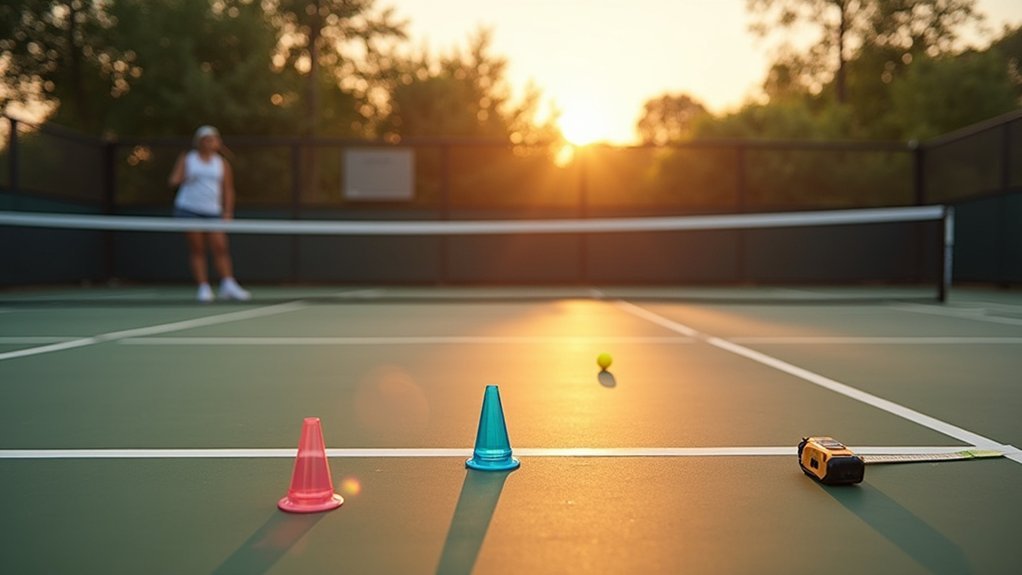
When planning your outdoor pickleball court, always account for a minimum 30′ x 60′ footprint rather than just the 20′ x 44′ playing area. Include safety buffers of at least 5 feet on the sides and 7 feet at baselines to accommodate wide shots and player movement. Choose the right surface material—acrylic-coated asphalt or post-tensioned concrete—for consistent bounce and durability. These foundational sizing decisions will determine your court’s safety, playability, and longevity.
The Standard Court Dimensions vs. Minimum Space Requirements
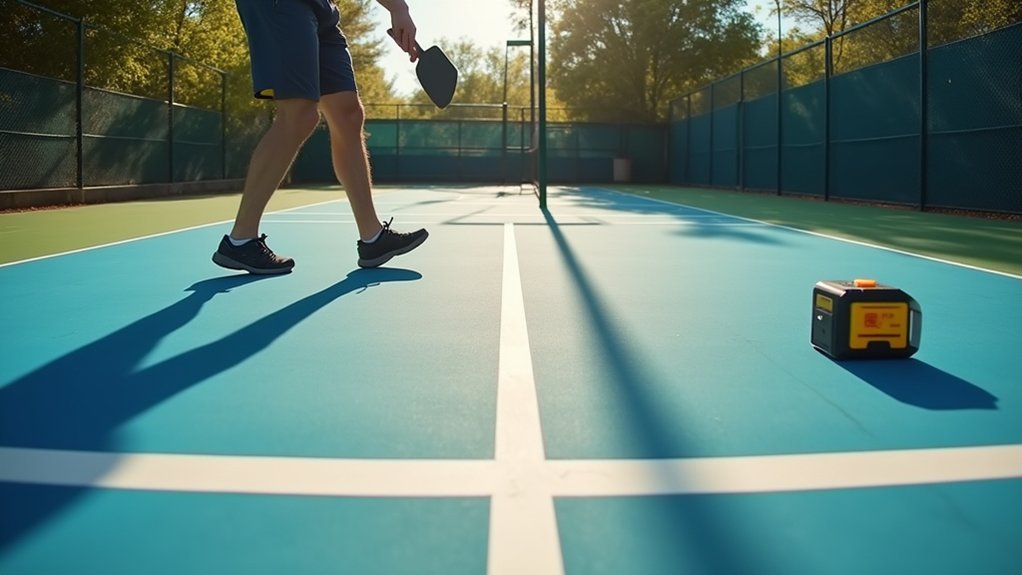
When planning your outdoor pickleball court, it’s essential to understand the difference between the actual playing area and the total space needed. The standard playing area measures 20 feet wide by 44 feet long, accommodating both singles and doubles play.
However, you’ll need more room than just the playing area. The minimum recommended footprint is 30 feet by 60 feet, which includes out-of-bounds space. For optimal player movement and safety, aim for the preferred dimensions of 34 feet by 64 feet.
Don’t forget about buffers—allow at least 5 feet on the sidelines and 7 feet behind baselines. If you’re working with limited space, remember that a standard tennis court can accommodate up to four pickleball courts with proper layout planning.
Planning for Perimeter Buffers and Safety Zones
Beyond the basic court dimensions, perimeter buffers and safety zones play a key role in creating a functional outdoor pickleball court. You’ll need at least 5 feet on the sides and 7 feet behind baselines, though 10 feet on all sides provides ideal clearance for player movement and safety.
When designing multi-court layouts, allocate 8-10 feet between courts to prevent interference between games. These spacing guidelines aren’t just suggestions—they directly impact gameplay quality and safety. Proper buffers help manage lobs and wide balls that would otherwise disrupt play.
Remember that net height (36 inches at sidelines, 34 inches at center) also influences necessary clearance around the net area. With adequate perimeter space, you’ll create a safer environment for both players and spectators.
Surface Selection and Site Preparation for Optimal Play
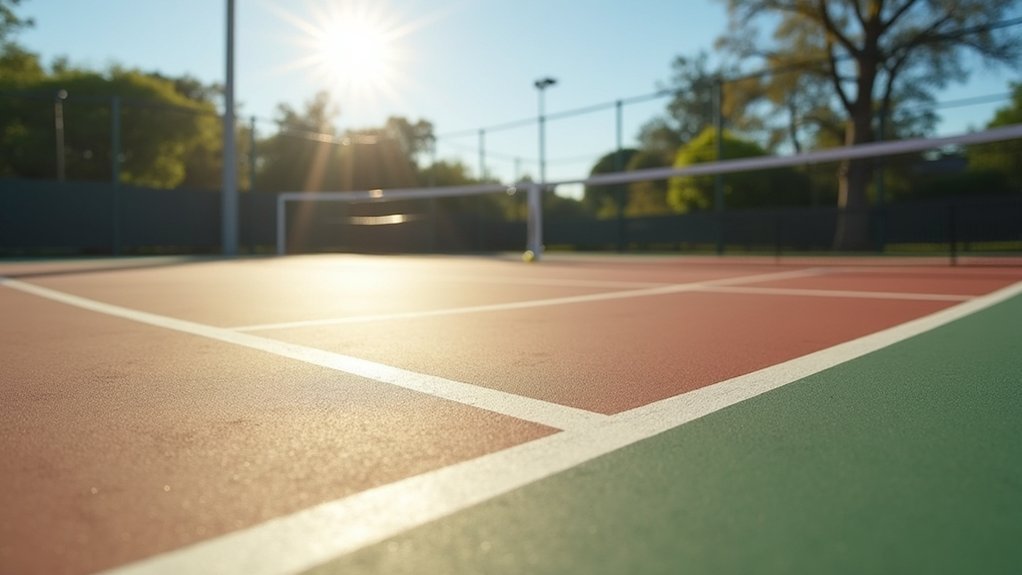
The foundation of any successful pickleball court lies in selecting the right surface and properly preparing the site. When building your outdoor court, you’ll need a concrete pad about 3.5 inches thick with 2500 psi strength, typically costing $9,000-$10,000 for prep, framing, and pouring.
For optimal outdoor play conditions:
- Choose between acrylic-coated asphalt or post-tensioned concrete surfaces—both provide excellent durability and consistent ball bounce
- Ensure proper drainage throughout your site to prevent water pooling and damage to your court surface
- Install windscreens and strategic fencing with well-placed gates to manage ball drift and maximize player safety
Remember to select high-contrast line colors with widths under 2 inches for best visibility in varying outdoor light conditions.
Frequently Asked Questions
How Does Wind Affect Court Orientation?
You’ll want to orient your court north-south to minimize crosswinds. This prevents the wind from considerably affecting ball trajectory during play, making your games more enjoyable and fair.
Can Multiple Courts Share Buffer Zones?
Yes, you can share buffer zones between courts. It’s efficient to place courts side-by-side with a shared buffer of 10-12 feet between them, though end-line buffers shouldn’t be compromised.
What’s the Best Court Spacing for Tournaments?
For tournaments, space your courts 15-20 feet apart. You’ll need this extra room for referees, scoreboards, player seating, and spectator movement between matches. Don’t skimp on these buffers.
How Much Additional Space Is Needed for Wheelchair Players?
You’ll need at least 5 additional feet on each side for wheelchair players. This extra space allows for easier mobility, turning, and maneuvering during competitive or recreational play.
Should Outdoor Courts Have Different Dimensions Than Indoor Courts?
No, you don’t need different dimensions. Keep your outdoor courts the same standard size of 20′ x 44′ as indoor courts, but consider wind and sun exposure during orientation.