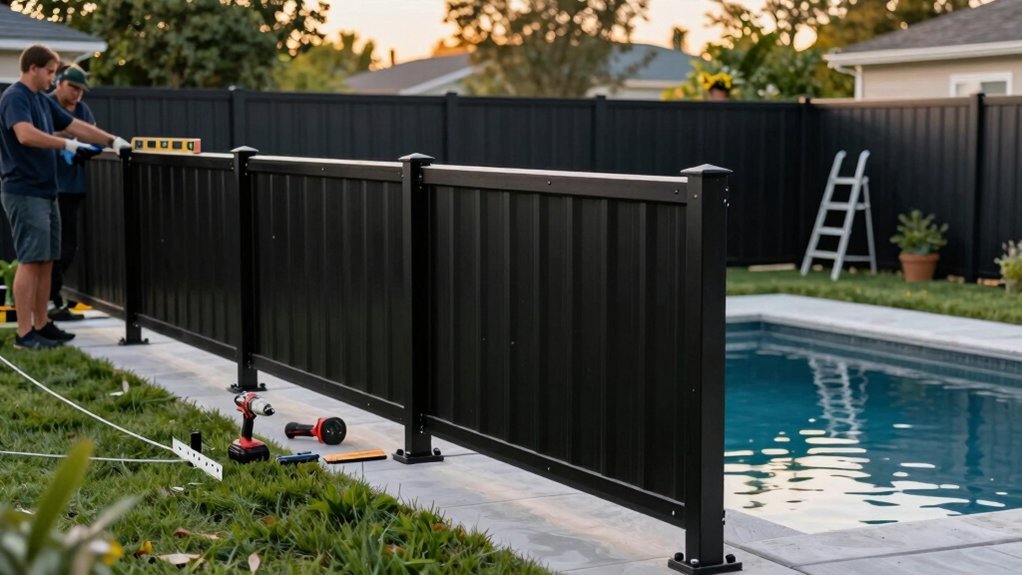
Installing aluminum privacy fencing around your pool requires careful planning and compliance with safety regulations. First, verify local codes, then mark your fence line and dig post holes 24-36 inches deep. Set posts in concrete, allowing 24-48 hours to cure before attaching panels. Install self-closing, outward-swinging gates with childproof latches positioned at least 54 inches high. The following steps will guide you through proper installation while ensuring both safety and privacy.
Understanding Pool Fence Safety Regulations
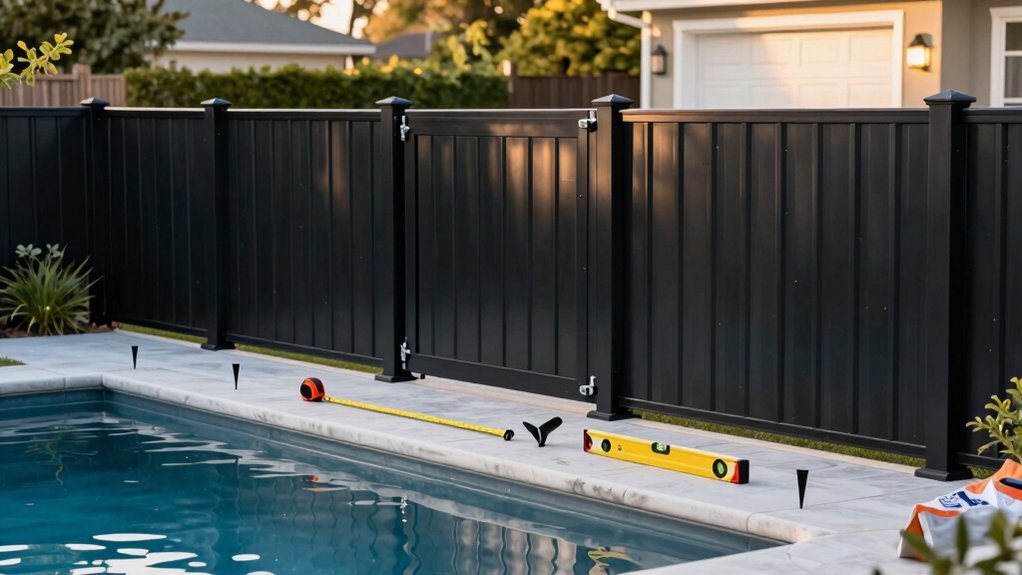
Why do pool fencing regulations exist? They’re designed to prevent drowning accidents, particularly among children.
When installing aluminum privacy fencing around your pool, you must comply with several critical safety standards.
Your fence gates should swing outward from the pool area and include self-closing and self-latching mechanisms.
Most local codes require a minimum fence height of 48 inches, though some areas mandate 54-60 inches for additional security.
Ensure picket spacing remains under 4 inches to prevent children from squeezing through.
The gap between the ground and fence bottom must be less than 2 inches on the pool side.
For gate latches, install them at least 54 inches above ground level on the pool side to keep them out of children’s reach.
Selecting the Right Aluminum Privacy Fence Components
Choosing high-quality, powder-coated aluminum materials ensures your privacy fence will withstand pool chemicals and weather conditions for years to come.
You’ll need to strategically place posts at least 6-8 feet apart, with additional reinforcement at corners and gate locations for alternative structural integrity.
For pool safety compliance, select panels that meet your local height requirements, typically ranging from 48 to 60 inches, with proper picket spacing that prevents climbing.
Material Quality Considerations
When selecting aluminum privacy fencing for your pool, material quality makes all the difference in longevity, safety, and appearance. Choose powder-coated aluminum with corrosion-resistant hardware to ensure your fence maintains its color and minimizes maintenance needs.
| Material Feature | Benefit |
|---|---|
| Rust/corrosion resistance | Durability in wet pool environments |
| Powder coating | Color longevity and weather protection |
| Proper picket spacing (<4") | Child safety and code compliance |
Remember that height requirements typically start at 48 inches, though local codes may require 54-60 inches. Always verify specific requirements with your local authorities before purchasing materials.
For privacy options, look for panels available in both solid and slatted designs. This allows you to balance visibility needs with privacy goals while maintaining the aesthetic appeal of your pool area.
Post Placement Options
Proper post placement forms the foundation of any successful aluminum privacy fence installation around your pool. You’ll need to space posts according to your panel sections, typically at 6-foot intervals measured center-to-center. Follow your layout plan precisely to maintain fence integrity throughout the perimeter.
When dealing with sloped areas around your pool, you have two primary options: racking the panels to keep them vertical while rails follow the contour, or stepping the installation for steeper grades. Dig holes 24-42 inches deep based on your local frost line, adding 6-12 inches of gravel for drainage before pouring concrete.
For gate posts, provide extra reinforcement as they’ll support self-closing, self-latching mechanisms. Install hinges approximately 6 inches from both top and bottom, ensuring gates swing outward for safety.
Panel Height Requirements
The right panel height for your aluminum privacy fence isn’t merely an aesthetic choice—it’s a critical safety requirement. When installing around pools, you’ll need to adhere to strict regulations designed to prevent accidents and unauthorized access.
Most jurisdictions require:
- Minimum fence height of 48 inches, with some areas mandating 54-60 inches for enhanced protection
- Picket gaps less than 4 inches wide to prevent children from squeezing through
- Ground clearance under 2 inches on the pool side to eliminate crawl spaces
- Middle rail placement at least 45 inches above the bottom rail in multi-rail designs
If your fence includes a gate, ensure it’s self-closing, self-latching, and swings outward with the latch at minimum 54 inches above ground level on the pool side.
Planning Your Pool Fence Layout and Measurements
Before installing your aluminum pool fence, you’ll need to carefully survey your property and stake out the fence line with string to confirm proper positioning. Measure your perimeter and calculate post spacing based on your panel lengths, making adjustments for any sections not divisible by standard panel sizes. Always verify that your measurements comply with local pool safety codes, particularly regarding ground clearance and gate placement.
Site Survey First
Planning your aluminum privacy fence begins with a comprehensive site survey that can save you countless headaches later. Before you dig the first hole for your pool fence, you’ll need to carefully evaluate your property and create a detailed installation plan.
- Verify property boundaries to prevent encroachment issues with neighbors and check for any utility easements that might affect fence placement
- Call 811 to have underground utilities marked – this is legally required and prevents dangerous encounters with gas or electric lines
- Outline the fence line using stakes and string, planning post spacing based on your aluminum panel lengths
- Account for elevation changes by determining whether you’ll need to rack (angle) or step your fence panels to maintain proper safety clearances around the pool
Code-Compliant Measurements
Understanding code-compliant measurements represents the critical foundation of your aluminum privacy fence installation around a pool. Most local codes mandate a minimum height of 48 inches, though some jurisdictions require 54-60 inches for enhanced safety.
When installing your aluminum privacy fence, ensure picket spacing remains under 4 inches to prevent children from squeezing through. Maintain less than 2 inches of ground clearance on the pool side to eliminate crawl-under hazards. For multi-rail fences, position the middle rail at least 45 inches above the bottom rail.
Gates require special attention—they must swing outward (away from the pool), feature self-closing hinges, and include latches positioned at or above 54 inches on the pool side. Always verify your specific local requirements before purchasing materials, as codes can vary by municipality.
Proper Tools and Materials for Installation
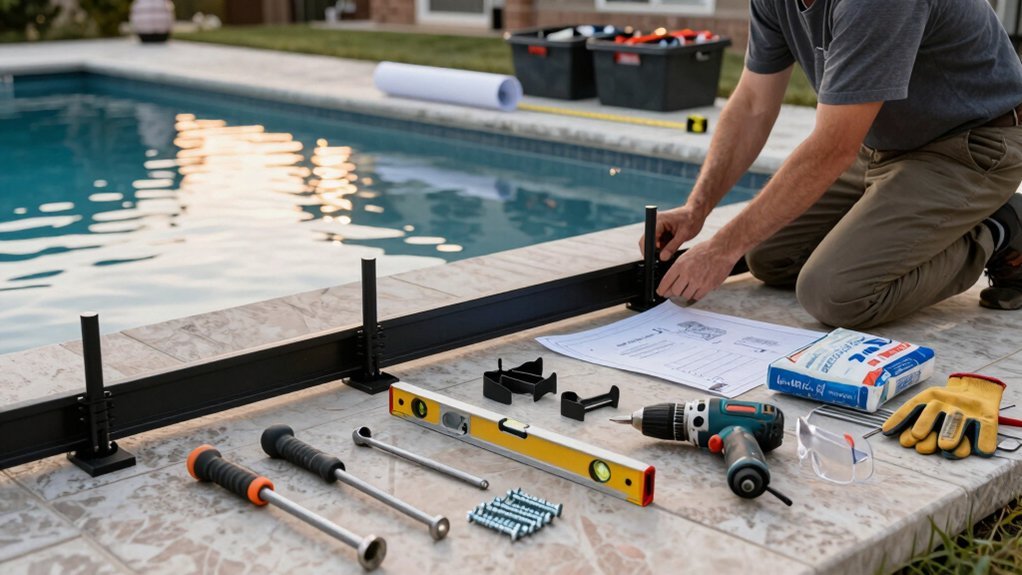
What tools do you need to successfully install an aluminum privacy fence around your pool? Gathering the right equipment before you begin will save you time and ensure professional results. Your essential toolkit should include string lines for perfect alignment, wooden stakes for marking post positions, and post hole diggers or augers for creating precise holes.
Proper preparation with quality tools makes the difference between a wobbly fence and a professional installation that lasts for years.
To complete your installation successfully, follow these key steps:
- Use a level to ensure each post stands perfectly plumb
- Mix concrete properly to secure posts firmly in place
- Have 1-inch self-tapping screws ready for panel attachment
- Prepare gravel (6-12 inches) for proper drainage at the bottom of each hole
Remember to allow 24-48 hours of curing time after setting posts before mounting hinges and gates.
Setting Posts and Installing Fence Panels
The foundation of a sturdy aluminum privacy fence begins with properly setting posts and installing panels. Dig holes 24-42 inches deep based on your local frost line, then add 6-12 inches of gravel for drainage before setting posts in high-strength concrete.
Mark your fence line using stakes at corners and gate locations. Ensure each post is plumb using a level and align them with string lines for perfect straightness.
| Step | Action | Time Required | Difficulty |
|---|---|---|---|
| 1 | Dig post holes | 3-5 hours | Moderate |
| 2 | Set posts in concrete | 2-3 hours | Easy |
| 3 | Allow concrete to cure | 24-48 hours | None |
| 4 | Install panels between posts | 4-6 hours | Moderate |
Leave the top 2 inches unfilled when backfilling to allow for final adjustments. Attach rails with self-tapping screws, ensuring panels are level and snug.
Gate Installation and Safety Features
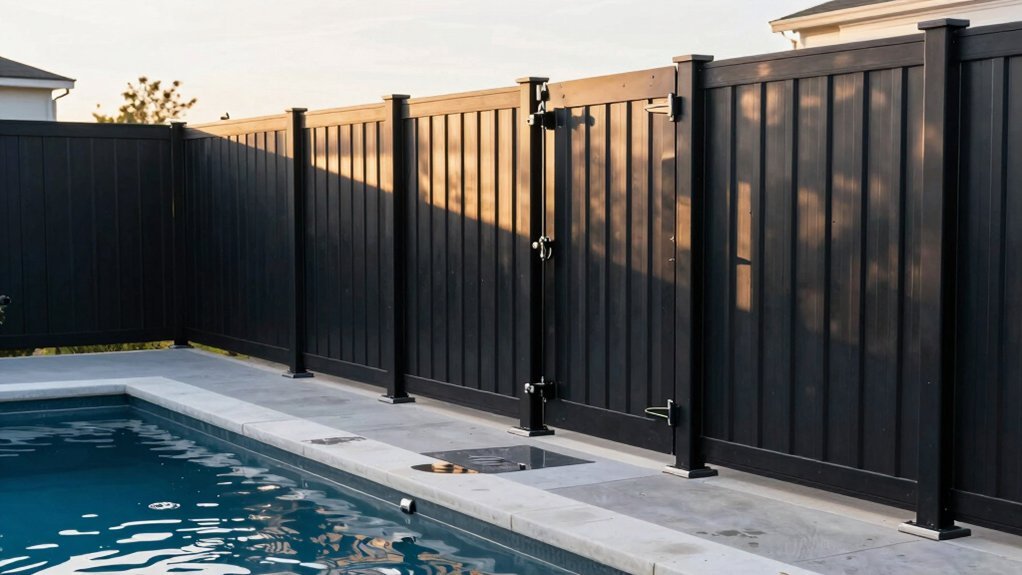
With your fence panels properly installed, it’s time to add the gates—arguably the most important safety component of your pool enclosure. Gates must be self-closing and self-latching, always swinging outward away from the pool area for maximum safety.
Install your gate following these critical safety guidelines:
- Position the latch at least 54 inches from the bottom on the pool side, ensuring no more than a ½-inch opening within 18 inches of the release mechanism
- Install reliable hardware that prevents easy child access while ensuring consistent operation
- Align the gate properly with no drag, maintaining consistent clearance around the entire enclosure
- Test thoroughly after installation to confirm the gate closes and latches automatically every time
Complete a final inspection to verify compliance with all local safety codes before using your pool.
Navigating Slopes and Terrain Challenges
Perfectly flat terrain rarely exists in backyard pool installations, which is why aluminum privacy fencing systems offer adaptable solutions for uneven ground. You’ll need to choose the right installation method based on your yard’s specific contours.
| Terrain Type | Method | Clearance | Compliance Note |
|---|---|---|---|
| Gradual Slopes | Rack-Mounting | Under 2″ | Panels remain vertical |
| Steep Grades | Stepped Installation | Under 2″ | Stair-like arrangement |
| Curved Areas | Short Section Transfer | Under 2″ | Angle at posts |
| Irregular Terrain | Swivel Brackets | Under 2″ | May require taller panels |
For curves or irregular layouts, transfer panels in short sections, angling each at its post. When slopes are significant, maintain safety by using taller adjacent panels or special hardware while keeping ground clearance below 2 inches on the pool’s exterior side.
Maintenance and Long-Term Care for Aluminum Pool Fencing
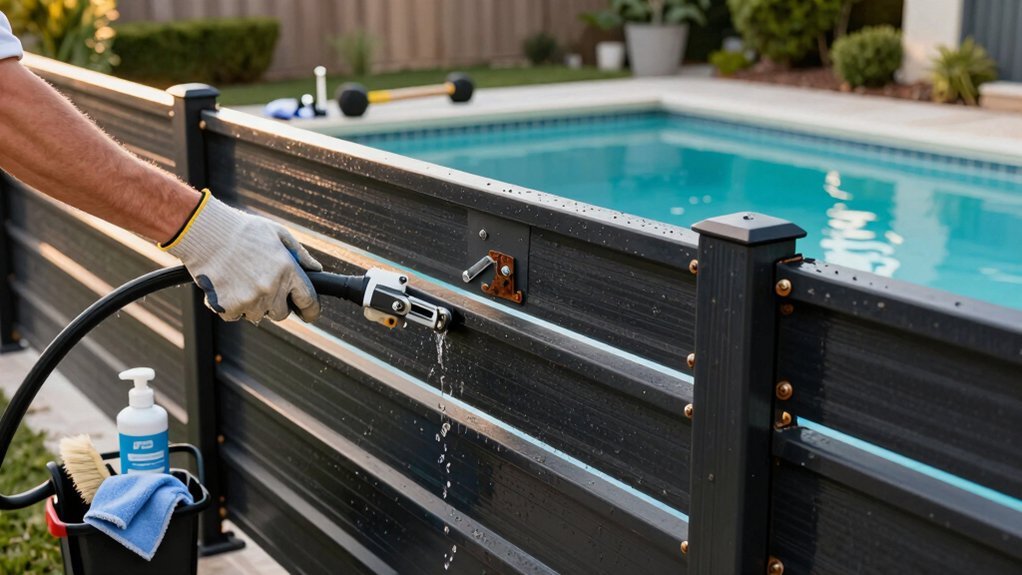
Unlike wood or chain-link alternatives, aluminum privacy fencing provides pool owners with exceptional durability that translates to minimal upkeep requirements over its lifetime. To keep your fence in optimal condition, follow these simple maintenance practices:
Aluminum fencing: exceptional durability with minimal maintenance for pool owners seeking long-term protection without the hassle.
- Clean panels regularly with mild soap and water, avoiding harsh chemicals that could damage the protective finish.
- Inspect gates and self-latching mechanisms twice yearly to ensure they’re functioning properly and maintaining safety standards.
- Check for loose screws or signs of corrosion at posts and fittings after severe weather events, tightening or replacing hardware as needed.
- Schedule professional inspections if you notice sagging panels, misaligned gates, or unusual gaps to maintain code compliance and structural integrity.
Frequently Asked Questions
Can You Install an Aluminum Fence Yourself?
Yes, you can install aluminum fencing yourself. Use pre-assembled sections, mark post locations with stakes, dig proper holes, pour concrete, and attach panels using the manufacturer’s hardware.
Should Aluminum Fence Posts Be Set in Concrete?
Yes, you should set aluminum fence posts in concrete. It guarantees stability, prevents loosening and leaning, especially around pools where safety is critical. Don’t skip this essential step.
Should an Aluminum Fence Touch the Ground?
Your aluminum fence shouldn’t touch the ground but should maintain less than 2 inches of clearance on the pool side. You’ll need to check your local codes for specific requirements.
What Are the Disadvantages of Aluminum Fences?
You’ll find aluminum fencing offers less privacy, can dent under impact, costs more upfront, may expand in extreme temperatures, and might be restricted by HOA rules or local codes.