

For effective backyard sports lighting, first assess your space dimensions and power capacity. Choose LED fixtures with 80+ CRI and 5000K temperature, mounting them on 15-20 foot poles for overlapping coverage. Position lights around the perimeter with proper downward angles to eliminate dark spots. Install dedicated circuits to handle the load safely. Add motion sensors and timers to reduce energy consumption. These fundamentals will transform your nighttime play experience.
Planning Your Backyard Sports Lighting Layout

A successful backyard sports lighting installation begins with thorough planning of your layout. Start by conducting a field assessment to determine your exact dimensions and surface type. Measure the playing area and note any trees, structures, or obstacles that could affect light distribution.
Evaluate your power situation next. Check if your main electrical panel can handle additional load and identify potential routes for running conduit to your pole locations. You’ll need dedicated circuits for a reliable setup.
Use photometric planning to calculate proper lighting levels. For most backyard sports, you’ll want fixtures that provide 4000-5000K color temperature with CRI ≥ 80. Position lights to create uniform coverage without harsh shadows or glare spots. Consider incorporating zones that can be controlled separately for flexibility.
Choosing the Right Fixtures and Light Quality
When selecting fixtures for your backyard sports area, LED options clearly outperform traditional metal halide systems in every category that matters. Look for fixtures with CRI ratings of 80+ and 5000K color temperature for optimal visibility of players and equipment.
Consider Dominator-style 150W LED fixtures that deliver approximately 19,500 lumens and can illuminate a 30×30 ft area. Mount these on 16 ft poles to achieve uniform coverage with overlapping light zones.
Evaluate fixtures based on lumen output, beam pattern, and mounting flexibility. Slip mounts or adjustable yokes allow precise aiming to minimize glare and eliminate shadows. For competitive play, aim for 200-500 lux of consistent illumination across your playing surface, with fixtures positioned to create uniform foot-candle readings throughout the area.
Proper Mounting and Fixture Positioning
Proper pole height and fixture positioning form the foundation of effective sports lighting. For residential courts, mount fixtures on 15-20 foot poles to ensure even coverage while minimizing glare. Higher mounting helps reduce light spill beyond your playing surface.
Position poles around the court’s perimeter with fixtures angled downward and properly shielded. Each fixture should create overlapping 30 × 30 foot coverage zones to eliminate dark spots and shadows. Use weather-rated fixtures with slip-fit or knuckle mounting options for precise aiming adjustments.
Don’t overlook hardware specifications—ensure all mounting components and poles are rated for outdoor exposure with proper grounding. This preparation helps your installation withstand wind and weather while delivering consistent illumination across your entire playing area.
Power Requirements and Electrical Considerations
Ensuring your backyard sports lighting has adequate power begins with a realistic assessment of your electrical capacity. Calculate your total wattage needs and plan for dedicated circuits that can handle the combined load of lights, controllers, and sensors.
| Component | Typical Wattage | Circuit Recommendation |
|---|---|---|
| LED Fixtures | 50-300W each | 15-20A dedicated |
| Controllers | 25-100W | Share with sensors |
| Motion Sensors | 5-25W | Share with controllers |
Don’t forget to account for voltage drop on long runs—you’ll need larger gauge wiring as distance increases. Always use outdoor-rated materials including weatherproof conduit and NEMA junction boxes. For safety, install GFCIs at all outdoor outlets and size circuit breakers appropriately to prevent electrical fires.
Controls and Energy-Efficient Operation
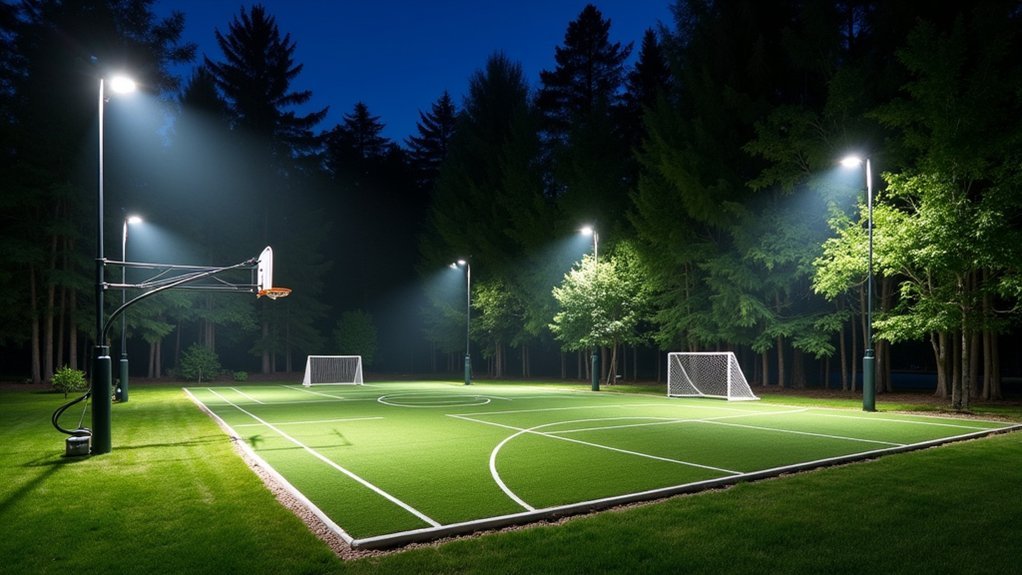
The right controls transform your backyard lighting system from an energy drain into an efficient, customizable solution. Install timers and motion sensors to ensure lights operate only when needed, significantly reducing unnecessary runtime.
Implement dimming capabilities to adjust brightness based on activity—full illumination for competitive games, reduced levels for casual practice. Divide your lighting into zones, allowing you to illuminate only specific areas of your court or field.
Consider remote operation through smartphone apps or voice controls, which provide convenience while enabling real-time monitoring of energy consumption. You can schedule lighting patterns based on your regular usage habits.
Don’t overlook compliance requirements—ensure all components are properly grounded and weatherproof for safe, efficient operation in outdoor conditions. These control strategies will maximize your system’s efficiency while extending equipment lifespan.
Frequently Asked Questions
How Do I Prevent Light Spillage Into My Neighbor’s Yard?
Install directional fixtures with shields, position lights downward, use lower wattage bulbs, add tall plants as barriers, and set timers. You’ll minimize light intrusion while still enjoying your space.
Can I Install Sports Lighting in Areas With HOA Restrictions?
You’ll need to check your HOA bylaws carefully. Many allow lighting with specific restrictions on height, brightness, and hours of operation. Consider shielded fixtures to minimize impact.
How Often Should Backyard Lighting Systems Be Professionally Inspected?
You should have your backyard lighting system professionally inspected annually. Schedule additional checks after severe weather events or if you notice any flickering, dimming, or exposed wiring issues.
Will Sports Lighting Attract Insects to My Playing Area?
Yes, sports lighting will attract insects. You’ll see more bugs with traditional bulbs. Choose yellow “bug lights,” LED fixtures, or sodium vapor lamps to minimize this issue in your playing area.
Can Extreme Weather Damage My Backyard Lighting Investment?
Yes, extreme weather can damage your lighting. You’ll need weather-resistant fixtures, proper sealing, adequate drainage, and surge protectors. Consider removing portable lights during severe storms to protect your investment.

Leave a Reply