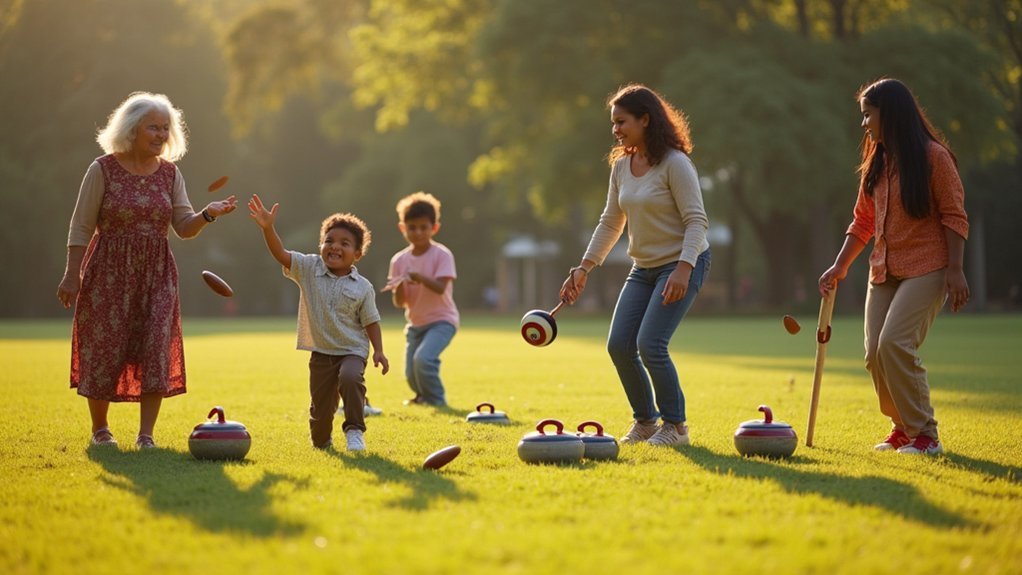
You can bring centuries of global tradition to your backyard with these five iconic lawn games. Italy’s bocce ball and France’s pétanque both involve tossing balls toward a target, while Britain’s croquet challenges you to navigate hoops in sequence. Finland’s mölkky tests your aim with numbered pins, and India’s gilli-danda offers an ancient stick-and-peg experience. Each game has unique equipment, rules, and techniques you’ll want to explore further below.
Discover the Ancient Art of Bocce Ball From Italy
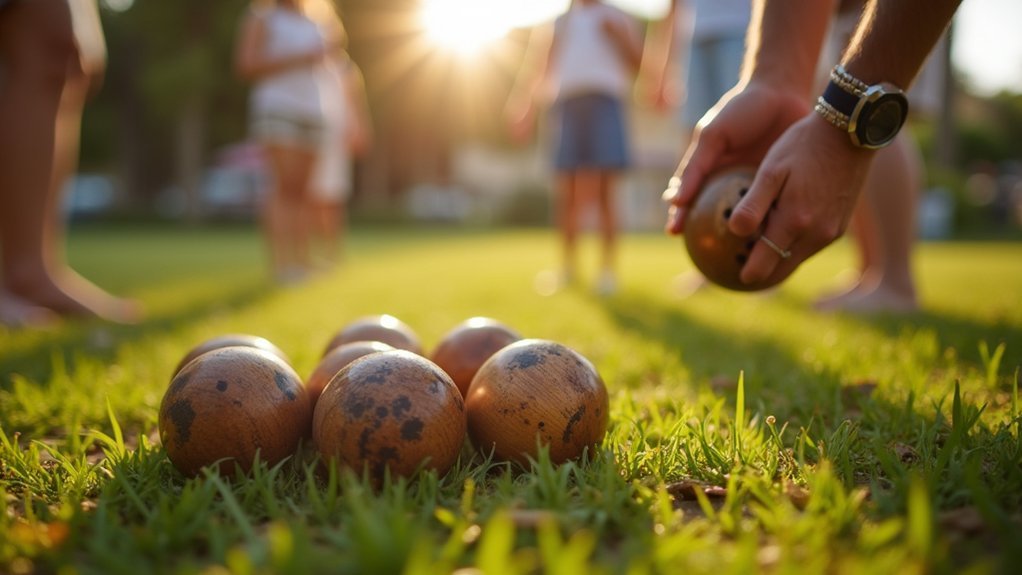
When you roll a bocce ball across a sun-dappled lawn, you’re participating in a tradition that stretches back over two thousand years to ancient Rome. Italian immigrants brought this beloved game to communities worldwide, transforming backyards into competitive arenas.
To play, you’ll need eight large balls and one smaller target ball called the pallino. Toss the pallino first, then take turns throwing your balls as close to it as possible. The team with the nearest ball scores points.
You don’t need a professional court—any flat grass surface works perfectly. Focus on your grip and release angle to control distance. Practice the underhand roll until it becomes instinctive. Gather friends, pour some wine, and let this timeless Italian tradition transform your afternoon.
Master the Techniques of French Pétanque for Your Backyard
From the rolling fields of Italy to the gravel squares of Provence, lawn games have united communities for centuries—and pétanque stands as France’s beloved answer to bocce.
To play, you’ll toss a small wooden target ball called a cochonnet, then throw hollow metal boules to land closest to it. Unlike bocce, you must keep both feet planted within a small circle when throwing.
Master the point technique first—a high, arcing lob that drops your boule near the cochonnet. Once comfortable, practice the tire, a strategic shot that knocks opponents’ boules away.
Create your backyard terrain using fine gravel or packed dirt. Gather six boules and one cochonnet for two players. You’ll score points for each boule closer than your opponent’s nearest throw.
Learn the Rules of Traditional British Croquet
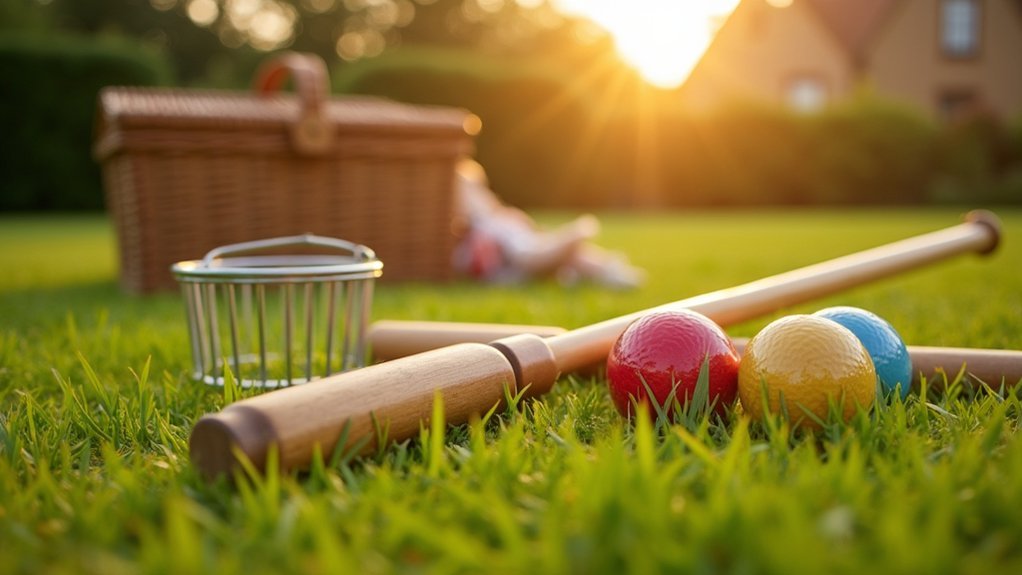
British croquet sets itself apart from casual backyard versions with precise rules that have governed play since the 1860s. You’ll play on a rectangular lawn measuring 35 by 28 yards, negotiating six hoops and a center peg in a specific sequence.
You strike your ball with a mallet, earning extra shots when you pass through hoops or hit opponent balls. When you “roquet” another ball, you place yours beside it and execute a “croquet shot,” sending both balls moving. This tactical element lets you advance your position while disrupting opponents.
Each turn continues until you fail to score or hit another ball. The winner first runs all hoops in order and strikes the center peg. Master these fundamentals before exploring advanced strategies.
Explore the Finnish Throwing Game Mölkky for Family Fun
Although croquet demands precision and strategy, Mölkky offers a pleasantly simple alternative that’s captured hearts across Finland since 1996. You’ll find this wooden throwing game perfect for backyard gatherings and family reunions.
Here’s what you need to know about Mölkky:
- Twelve numbered wooden pins stand in a tight formation, and you’ll toss a wooden baton called the “mölkky” to knock them down
- You score points by either hitting one pin (earning its number value) or multiple pins (earning the count of pins toppled)
- Your goal is reaching exactly 50 points—go over, and you’re reset to 25
- Pins stay where they fall, making the playing field increasingly challenging
You’ll master the basics within minutes, yet strategic depth keeps everyone engaged.
Set Up an Authentic Indian Gilli-Danda Playing Area

Strike up a game that’s entertained South Asian children for over 2,500 years by setting up your own Gilli-Danda playing area. You’ll need a flat, open space roughly 50 feet in diameter, free from obstacles and bystanders.
Carve your gilli—a small wooden peg about 3 inches long, tapered at both ends. Your danda should measure approximately 2 feet long and function as your striking stick. Dig a small oval pit in the ground’s center where you’ll place the gilli for launching.
Mark distance lines at intervals from the pit to score points based on how far you hit the gilli. Keep spectators behind these boundaries for safety. Traditional games use natural terrain, so don’t worry about perfectly manicured grass—packed earth works authentically.
Frequently Asked Questions
What Lawn Games Are Popular in South American Traditional Cultures?
You’ll find tejo popular in Colombia, where you throw metal discs at targets packed with gunpowder. In Argentina and Chile, you can play bochas, their version of lawn bowling that’s enjoyed at family gatherings.
Are There Any Traditional Japanese Lawn Games Suitable for Beginners?
You can try Kemari, a cooperative ball-kicking game where you’ll keep a leather ball airborne using your feet. It’s beginner-friendly since there’s no competition—you’re simply working together to prevent the ball from touching the ground.
How Do Weather Conditions Affect Gameplay in Different Cultural Lawn Games?
Weather markedly impacts your gameplay across cultures. Rain makes French pétanque courts slippery, wind affects your Finnish mölkky throws, and heat softens Italian bocce balls. You’ll need to adjust your strategy based on conditions.
What Traditional African Throwing Games Can Be Played on Grass?
You can play Mlabalaba, a South African throwing game using stones on grass. You’ll also enjoy Jukskei from South Africa, where you’re tossing wooden pegs at a target stake planted in the ground.
Which Traditional Lawn Games Are Best Suited for Elderly Players?
You’ll enjoy bocce, croquet, and lawn bowls since they require minimal physical strain. These games let you stay active while socializing, and you don’t need to run or make sudden movements that could cause injury.