
Wooden swing sets offer natural beauty, better resale value, and can last 10-15+ years with proper maintenance, while metal sets excel in weather resistance and require less upkeep. Wood stays cooler in summer but needs regular sealing, while metal resists elements but can heat up. Your choice depends on your climate, budget, and aesthetic preferences. The following comparison will help you make the right investment for your family’s outdoor adventures.
Durability Showdown: How Each Material Stands the Test of Time

When investing in a swing set that will withstand years of family fun, the material choice markedly impacts its longevity. Metal sets excel in harsh weather conditions and require less routine maintenance, but they’re vulnerable to heating up under summer sun and developing rust without proper protective coating.
Wood sets won’t scorch little hands on hot days and offer a natural aesthetic, but you’ll need to commit to regular sealing, staining, and rot prevention. Surprisingly, high-quality wooden models can support impressive weight capacities—up to 2,000 pounds in premium sets, outperforming many residential metal options that max out around 250 pounds.
Your maintenance commitment ultimately determines lifespan. With proper care, metal resists deterioration when rust is prevented, while well-treated cedar or redwood structures can serve your family for 10-15+ years.
Weather Resistance: Which Material Braves the Elements Better?
How effectively will your swing set withstand years of environmental exposure? Your climate should heavily influence your choice between wood and metal frames.
| Weather Condition | Metal Performance | Wood Performance |
|---|---|---|
| Rain & Moisture | Excellent (rust-resistant metals) | Fair (requires regular sealing) |
| Heat & Sun | Good (durability) but hot to touch | Excellent (stays cooler) |
| Snow & Ice | Excellent (minimal warping) | Good with maintenance |
| Humidity | Excellent (no swelling) | Fair (can warp without treatment) |
| Insects & Pests | Excellent (immune) | Poor (vulnerable without treatment) |
Metal swing sets generally offer superior all-weather performance with minimal maintenance, making them ideal for harsh environments. Wood requires vigilant upkeep but provides cooler surfaces in hot climates. Your maintenance commitment and local weather patterns should guide your final decision.
The Cost Factor: Initial Investment vs. Long-Term Value
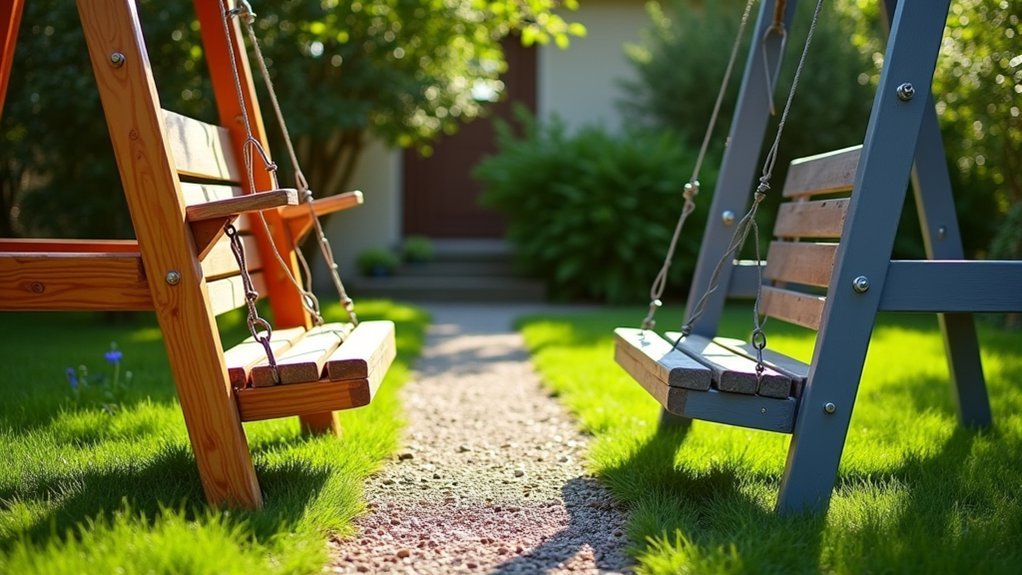
Why do so many families struggle with the wood versus metal decision? It often comes down to balancing your budget with long-term value expectations.
Metal swing sets deliver on affordability upfront, typically costing between $100-$600+, with minimal maintenance expenses over time. You’ll never need to paint or stain them.
Wooden sets require a higher initial investment but can deliver superior long-term value through durability and better resale potential. Premium woods like cedar and redwood resist rot and decay effectively. Rainbow Play emphasizes this advantage with their exclusive lifetime warranty on cedar playsets.
Your decision ultimately depends on your timeline. If you’re budget-conscious and need something immediately, metal makes sense. For families planning years of use, wooden sets often provide better total value despite the higher upfront cost.
Maintenance Requirements for Wooden and Metal Sets
Beyond the initial price tag, your swing set’s ongoing care needs will impact your satisfaction for years. Wooden sets demand regular sealing or staining to protect against moisture, UV damage, and decay—a time commitment you’ll need to budget for annually.
Metal sets skip the painting routine but require vigilance for rust and chipped areas. When problems arise, wood maintenance often proves simpler; replacing a damaged board is straightforward compared to addressing rust spots on metal, which require sanding and recoating.
Cost-wise, you’ll invest in stains and sealants for wooden sets over time. Premium woods like cedar or redwood offer better rot resistance and longevity with proper care. Metal sets generally have lower ongoing costs, though rust prevention remains essential for extending their lifespan.
Aesthetic Appeal: How Each Material Complements Your Backyard

When choosing a swing set, you’ll find wooden models offer a natural, warm aesthetic that seamlessly blends with trees and landscaping, while metal sets provide a contemporary industrial look with vibrant color options.
Your color preferences matter considerably—wood can be customized with stains or paints to match your backyard’s palette, whereas metal sets typically come with predetermined, glossy finishes that make bold statements.
Consider how each material harmonizes with your existing landscape elements—wooden structures create a timeless, organic feel that enhances garden settings, while metal designs contribute a clean, modern presence that works well in more structured outdoor spaces.
Natural vs. Industrial Look
How you want your backyard to feel visually can greatly influence your swing set material choice. Wooden structures bring a natural, rustic aesthetic that harmonizes with trees, gardens, and landscaping. Their warm tones and grain patterns create a timeless fixture that feels like an extension of your outdoor space.
Metal sets, by contrast, deliver a contemporary industrial appearance with glossy finishes and defined lines that make a bold statement as a yard centerpiece.
- Wood can be stained or painted in countless colors to match your home’s exterior or personal style preferences
- Cedar and redwood offer distinctive natural warmth that softens the landscape’s overall look
- Metal frames provide sleek, modern silhouettes with bright colors that create a playful focal point
Color Options Matter
The palette you choose for your swing set dramatically affects your yard’s overall aesthetic appeal. Wood offers exceptional versatility, allowing you to stain or paint it to perfectly complement your home exterior and landscaping vision. Cedar and redwood naturally weather to a beautiful silver-gray patina over time if left untreated.
Metal sets provide fewer customization options, typically coming in pre-finished powder-coated colors that remain consistent unless you decide to repaint them. Remember that darker metal colors absorb more heat, potentially making equipment too hot for little hands during summer months.
Wood’s multi-tone capabilities support themed designs like castles or pirate ships, enhancing your property’s visual interest. Metal sets generally feature uniform, single-tone appearances that can stand out rather than blend with your natural surroundings.
Landscaping Harmony Considerations
Seamlessly integrating your swing set with your property’s overall design transforms an ordinary play structure into a cornerstone of your outdoor living space. Wood swing sets offer a natural aesthetic that blends with your landscape, while metal sets provide a more contemporary contrast.
When considering which material harmonizes with your yard:
- Wood swing sets can be stained or painted to match your deck or home siding, creating visual continuity throughout your property
- Metal sets require less maintenance, preventing the eyesore of weathered materials that can detract from your carefully planned landscape
- Your yard’s existing style matters – wood creates a warm, integrated look in traditional settings, while metal can add a modern accent in contemporary designs
Your choice ultimately affects how the play area contributes to your overall landscape vision.
Safety Considerations for Children of All Ages
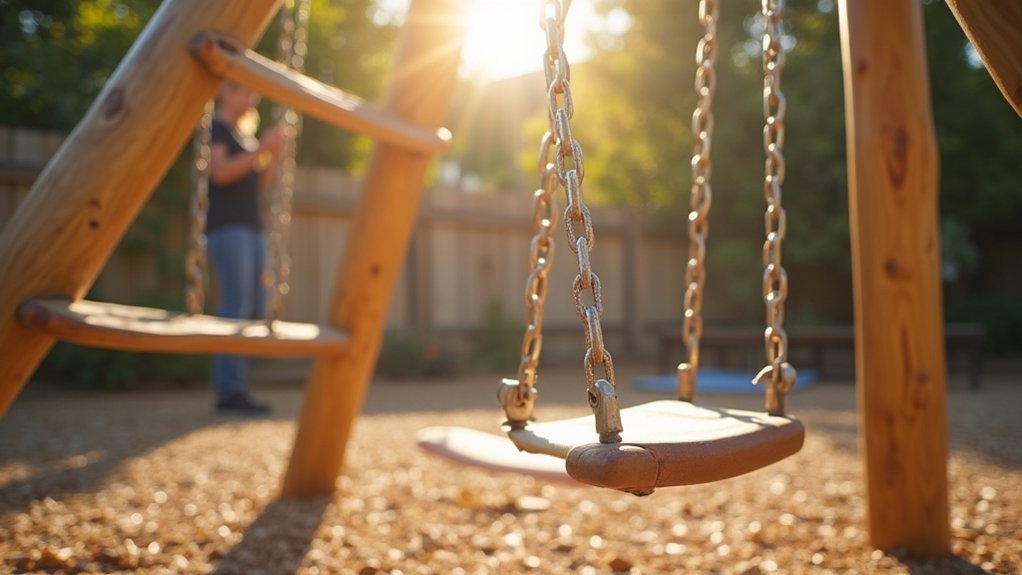
When selecting a swing set for your backyard, safety should always be your primary concern. Both wooden and metal options can be safe choices when properly installed according to manufacturer guidelines.
Wood offers a natural advantage in hot weather as it doesn’t heat up like metal surfaces, which can cause burns on sunny days. However, regardless of material, you’ll need to perform regular safety checks. Inspect wooden sets for splinters and metal frames for rust spots.
Wood stays cooler than metal in hot weather, but both require regular checks for splinters or rust.
Always follow the weight capacity recommendations and choose age-appropriate designs for your children. Secure anchoring is essential for both types of sets to prevent tipping. Make sure all edges are rounded and hardware is tightened regularly.
Remember that proper installation and maintenance are ultimately more important than the material itself.
Customization and Design Options for Both Materials
When you’re choosing between swing set materials, wood offers superior design flexibility with options for custom forts, climbing walls, and playhouses that can evolve as your children grow.
Metal sets provide more straightforward designs with modular pieces and height adjustments, but typically can’t match wooden sets’ extensive personalization potential.
Your backyard vision matters—wooden sets allow for DIY modifications, painting, and significant expansions, while metal sets favor manufacturer-determined configurations with fewer decorative possibilities.
Design Flexibility Comparison
How much customization do you envision for your backyard play space? Wood swing sets excel with nearly unlimited design potential. You’ll enjoy the freedom to create multi-level structures with forts, playhouses, and themed elements that grow with your children’s imaginations.
Metal sets offer practical flexibility with quicker assembly and adjustable features, though with fewer expansion possibilities.
- Wood allows for DIY customization including climbing walls, tunnels, and creative painting that integrates naturally with your landscape
- Metal provides standardized configurations with simpler, tool-free accessory integration
- Wood supports ongoing modifications and expansions, while metal emphasizes ready-to-build efficiency
Your choice ultimately depends on whether you value creative design freedom or straightforward, maintenance-friendly configurations for your family’s outdoor play needs.
Personalization Possibilities
Countless families dream of creating that perfect backyard play space that reflects their children’s personalities and needs.
When it comes to personalization, wooden swing sets offer significant advantages over their metal counterparts.
With wood, you’ll enjoy extensive customization options including forts, playhouses, climbing walls, sandboxes, and themed features.
You can easily paint or stain wooden sets to complement your outdoor décor or your child’s favorite colors.
As your children grow, you can modify existing features or add new accessories—something that’s particularly difficult with metal sets.
Metal swing sets provide simpler design flexibility with adjustable heights and some modular add-ons, but they’re generally limited to the manufacturer’s powder-coated finishes.
While easier to assemble, metal sets offer fewer expansion possibilities compared to wooden structures that can grow with additional decks, towers, or climbing elements.
Assembly Complexity: What to Expect During Setup
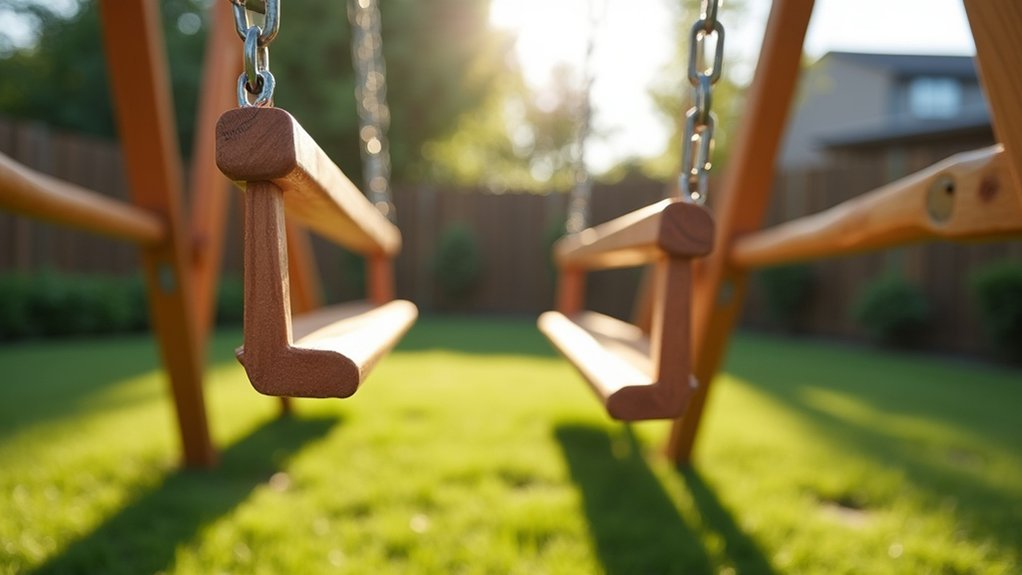
Why do some parents dread swing set assembly day while others breeze through it? The answer often lies in your choice between wood and metal sets. Metal swing sets typically offer a more straightforward experience with clearer instructions and faster completion times.
The assembly experience can make or break your swing set purchase—metal options save time while wooden sets demand patience.
When comparing assembly experiences:
- Metal frames feature lighter components you can position alone, whereas wooden sets often require two people to lift and align the bulkier parts
- Wood sets demand more tools and precise alignment of pre-drilled holes to prevent warping issues
- Metal installations generally follow standardized assembly steps, while wooden sets may need professional installation due to their complex multi-piece construction
Though wooden sets require more time and assistance, they do provide greater on-site customization possibilities through modular add-ons—a worthwhile trade-off for many families seeking personalization.
Weight Capacity and Structural Stability Comparison
Wooden swing sets typically offer substantially higher weight limits than their metal counterparts, with premium wooden models supporting up to 2,000 pounds while metal sets generally max out around 250 pounds per component.
You’ll notice wooden frames feel more robust during multi-user play, though both materials require proper anchoring to maintain stability and prevent tipping during active use.
Your installation method matters significantly for either material choice, as proper anchoring into suitable ground conditions ultimately determines how well your swing set will handle the inevitable jumping, swinging, and climbing of excited children.
Weight Capacity Differences
When selecting between wooden and metal swing sets, weight capacity emerges as a pivotal differentiator that directly impacts safety and usability. High-quality wooden sets generally offer superior load-bearing capabilities, with some models supporting up to 2,000 pounds across the structure.
- Premium wood sets can accommodate multiple children or adults simultaneously, making them ideal for families with several children or those who entertain frequently.
- Metal swing sets typically max out around 250 pounds per component, which may restrict how many people can use different features at once.
- Regardless of material choice, proper installation, anchoring, and ground conditions significantly affect whether your set will actually achieve its rated capacity.
Always check manufacturer specifications for individual component weight limits rather than assuming the entire set shares a uniform capacity.
Stability During Active Play
While weight capacity tells you how much load a swing set can theoretically handle, stability during active play reveals how the structure actually performs when children are swinging, climbing, and jumping. Wooden sets offer inherent advantages due to their heavier mass and robust multi-point connections, reducing movement during energetic play.
| Feature | Wooden Sets | Metal Sets |
|---|---|---|
| Weight | Heavier (more stable) | Lighter (needs anchoring) |
| Tipping Risk | Lower when properly installed | Higher without proper anchoring |
| Movement During Play | Minimal flexing | More noticeable wobbling |
| Anchoring Requirements | Benefits from it | Absolutely requires it |
Your installation quality substantially impacts stability regardless of material. Metal sets need proper anchoring to compensate for their lighter weight, while wood sets rely on their mass advantage to maintain stability during active use.
Anchoring Requirements Compared
How securely your swing set stays in place directly impacts both its safety and longevity. Wooden sets typically offer superior weight capacity, handling up to 2,000 pounds when properly constructed, compared to metal sets that generally max out around 250 pounds per component.
Your anchoring approach differs significantly between materials:
- Metal sets require precise ground anchors and careful installation on level surfaces to prevent tipping, especially on soft or uneven ground
- Wooden sets distribute weight more effectively but demand proper hardware installation due to their heavier components
- Professional installation is recommended for wooden sets, while dealer assistance might suffice for metal options
Remember that weight capacity spreads across all play elements, so check manufacturer specifications for exact component limits before making your final decision.
Environmental Impact of Wood vs. Metal Swing Sets
Why does the environmental footprint of your swing set matter? Your choice affects both durability and ecological impact over years of use.
Wood sets made from cedar or redwood offer natural rot resistance and biodegradability, but require periodic sealing to maximize lifespan. Look for responsibly sourced lumber to ensure sustainability. These materials weather gracefully with proper maintenance.
Metal swing sets involve energy-intensive manufacturing processes and chemical coatings, but their longevity can offset this initial impact. They resist environmental damage with minimal maintenance, though powder-coating deterioration may occur in harsh conditions.
Your location matters too—humid coastal areas accelerate metal rusting, while high-UV regions demand more frequent wood treatment. Consider both the production footprint and long-term durability when making your environmentally conscious choice.
Resale Value and Longevity Expectations
When considering your investment in a backyard play structure, understanding resale value and longevity becomes essential to maximizing your return. Wooden sets, particularly those made of cedar or redwood, typically offer better resale potential than their metal counterparts. With proper maintenance, wood swing sets can serve your family for over a decade before finding a second home.
- Cedar and redwood sets naturally resist rot and insects, preserving their structural integrity and aesthetic appeal for 10-15+ years
- Metal sets generally cost less initially but depreciate faster due to concerns about rust, heat absorption, and their less premium appearance
- Your maintenance routine significantly impacts value retention—sealed and well-cared-for wooden sets command higher resale prices, especially when documentation of professional installation or warranties is available
Climate Considerations: Choosing the Right Material for Your Region
Your geographical location plays a significant role in determining which swing set material will perform best over time. Metal sets typically withstand harsh weather conditions with minimal maintenance, making them ideal for regions with extreme temperatures or precipitation.
| Climate Type | Metal Performance | Wood Performance |
|---|---|---|
| Hot & Sunny | Good with coating | Requires UV protection |
| Humid & Rainy | Risk of rust | Prone to rot without sealing |
| Coastal | Needs galvanization | Struggles without treatment |
While metal frames resist weather elements naturally, they can develop rust in humid coastal areas without proper protective coatings. Wooden sets offer excellent durability in moderate climates but demand regular sealing or staining to prevent decay, particularly in wet environments. Consider your region’s specific weather patterns when making your decision to minimize long-term maintenance requirements.
Frequently Asked Questions
Are Metal or Wood Swing Sets Better?
You’ll find both options have merits. Metal swing sets cost less initially and need minimal maintenance, while wooden sets offer better aesthetics, customization, and expansion potential despite requiring more upkeep and investment.
What Is the Best Material for a Swing Set?
Cedar wood is the best swing set material. You’ll appreciate its natural look, durability, and cooler surface temperature. While it requires regular maintenance, it offers higher weight capacity than metal alternatives.
What Type of Swing Set Lasts the Longest?
Cedar or redwood swing sets last longest if you maintain them properly. You’ll get 10-15+ years from these wooden sets with regular sealing and staining, outlasting metal sets that may develop rust issues.
What Lasts Longer, Metal or Wood?
With proper maintenance, high-quality wood (especially cedar or redwood) typically outlasts metal swing sets. You’ll need to treat and seal wooden sets regularly, while metal may rust in humid environments despite requiring less upkeep.