
Backyard basketball court costs vary widely based on several key factors. Your court size (half vs. full) creates the biggest price difference, potentially tripling expenses. Site conditions like sloped terrain demand extensive excavation work. Material choices (concrete, asphalt, or crushed stone) significantly impact durability and cost. Additional features such as premium surfaces, fencing, and lighting further influence the final price. Understanding these variables helps you plan a court that fits your specific budget and needs.
Court Size and Dimensions: Half-Court vs. Full-Court Options
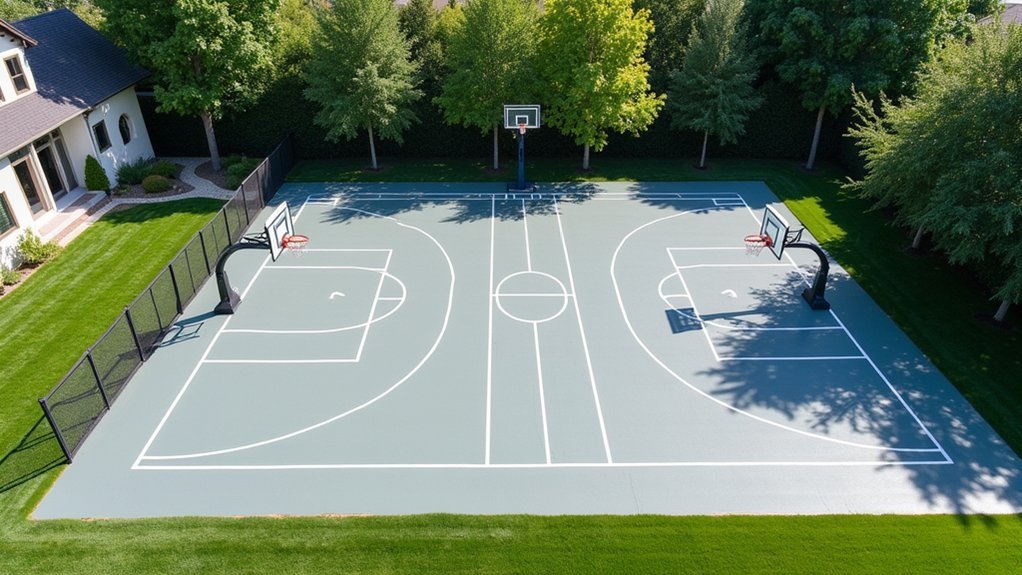
When planning your backyard basketball court, size becomes the primary consideration that impacts your overall investment.
Most homeowners opt for half-courts (approximately 30×30 feet) rather than regulation-sized courts (94×50 feet) due to significant cost differences.
Each additional square foot multiplies expenses across multiple categories: materials, labor, foundation work, surfacing, fencing, and lighting.
The jump from half to full court doesn’t simply double costs—it can triple or quadruple your budget.
Your initial size decision will cascade through every aspect of the project.
By clearly defining your court dimensions early, you’ll gain more accurate budget estimates and better guide subsequent design choices.
Consider your available space and how you’ll actually use the court before committing to dimensions.
Site Preparation Requirements and Property Challenges
Your backyard’s unique topography directly impacts your basketball court’s preparation costs, with hilly or uneven terrain requiring more extensive excavation and leveling work.
Equipment access challenges, such as narrow gates or tree obstructions, can noticeably increase labor costs when specialized machinery can’t reach your installation site.
Proper drainage and ground stabilization systems must be integrated during site preparation to prevent water accumulation and surface shifting that could damage your court over time.
Topography Impacts Costs
The topography of your property fundamentally shapes both the complexity and cost of installing a backyard basketball court. A perfectly level backyard requires minimal excavation and grading, whereas sloped or hilly terrain demands extensive earth movement.
Significant slopes necessitate larger equipment and create additional drainage considerations, substantially increasing your preparation costs. The accessibility factor compounds these challenges – if your backyard has narrow gates, established fencing, or limited equipment access, you’ll face higher labor costs as work may need to be completed by hand.
Remember that site preparation isn’t one-size-fits-all. Even two courts of identical dimensions can have dramatically different preparation costs based on your property’s unique characteristics. Temporary fence removal or creating equipment pathways adds further expenses that contractors must factor into your final quote.
Equipment Access Challenges
How does your contractor reach the installation site? Limited access can significantly drive up your court’s cost. Gates that are too narrow, problematic fencing, or obstructed pathways force contractors to either temporarily dismantle barriers or rely on labor-intensive hand methods. Both options increase labor hours and extend your project timeline.
When heavy machinery can’t reach your backyard, contractors must use smaller equipment or manual techniques, substantially increasing labor costs. Some sites might require specialized equipment rentals to navigate tight spaces or steep terrain.
Before finalizing your basketball court budget, have contractors evaluate access points during their site visit. They’ll determine if temporary fence removal is necessary or if specialized access solutions are required. Planning for these challenges upfront helps avoid unexpected cost increases during installation.
Drainage and Leveling
Moving from access concerns to what lies beneath, proper drainage and leveling form the foundation of every successful court installation. Your property’s natural topography dramatically impacts costs – a flat backyard requires minimal preparation, while sloped or uneven terrain demands significant earthwork and specialized equipment.
When estimating your project’s site preparation costs, consider:
- Topographical challenges – Steep slopes can increase expenses by 25-40% due to additional grading and earth movement requirements.
- Existing drainage issues – Poor water management may necessitate installation of French drains or regrading to prevent future court damage.
- Site-specific obstacles – Sprinkler systems, tree roots, and underground utilities often require relocation or removal, adding unexpected costs.
The more complex your terrain, the more extensive the preparatory work required before construction can begin.
Base Material Selection: Concrete, Asphalt, or Crushed Stone
When selecting a base material for your backyard basketball court, you’ll face different durability profiles with concrete offering lowest maintenance at premium costs while asphalt provides flexibility at lower initial investment.
The installation complexity varies substantially, with concrete requiring specialized equipment and reinforcement whereas crushed stone bases demand meticulous drainage planning and compaction.
Your location will influence material availability and pricing, with concrete costing $4-8 per square foot in most regions while alternative materials like SportBase might offer cost advantages in areas with limited heavy equipment access.
Material Durability Differences
Selecting the right base material for your backyard basketball court fundamentally impacts both its initial cost and long-term performance. While concrete offers superior durability with 15-20+ years of minimal maintenance, you’ll pay premium upfront costs for this peace of mind. Asphalt delivers a middle-ground option that balances reasonable upfront pricing with 7-12 years of serviceable life before significant repairs.
- Concrete (4-5 inches, 3500+ psi) – Withstands freeze-thaw cycles, heavy use, and weather extremes without cracking or settling, virtually eliminating annual maintenance costs
- Asphalt – Requires periodic resealing and eventual resurfacing, adding maintenance costs that offset initial savings
- Crushed Stone – Most affordable initially but demands meticulous installation and may develop uneven areas that affect gameplay and safety
Your durability needs should align with your budget expectations and intended usage frequency.
Installation Complexity Factors
Installation complexity varies dramatically based on your chosen basketball court foundation, directly impacting both timeline and budget. When selecting between concrete, asphalt, or crushed stone bases, you’re balancing strength, cost, and installation difficulty.
| Base Material | Installation Complexity | Equipment Needed | Timeline | Long-Term Maintenance |
|---|---|---|---|---|
| Concrete | High | Trucks, pumps | 3-4 weeks | Minimal |
| Post-Tension | Very High | Specialized crews | 4+ weeks | Minimal |
| Asphalt | Medium | Rollers, pavers | 1-2 weeks | Periodic resurfacing |
| Crushed Stone | Low | Minimal | 2-3 days | Regular leveling |
| SportBase | Low-Medium | Manual labor | 3-5 days | Occasional adjustments |
Your soil conditions, local regulations, and site access will further complicate installation. Post-tension concrete offers superior crack resistance but requires specialized contractors, while modular options provide quicker, more environmentally friendly alternatives with different stability profiles.
Regional Cost Variations
Where you live significantly impacts how much you’ll pay for your backyard basketball court’s foundation materials. Regional availability of concrete, asphalt, and crushed stone drives price variations, with urban areas often having better access but higher labor costs than rural locations. Local soil conditions and drainage requirements further influence your base material decision.
- Concrete bases provide peace of mind with superior strength and minimal long-term maintenance, though you’ll face the highest upfront investment
- Asphalt options offer a middle-ground solution that balances initial cost savings against eventual resurfacing expenses
- Crushed stone or modular bases can slash your initial investment by up to 40% while providing eco-friendly alternatives that avoid heavy equipment access issues
Consider these regional factors when selecting your court’s foundation to maximize value and performance.
Surface Type Options: Modular Tiles vs. Acrylic Coatings
When considering your backyard basketball court, the surface you choose will dramatically impact both playability and your budget. Modular tiles offer quick installation, cushioning, and color variety for both indoor and outdoor use, while acrylic-coated concrete provides professional-grade traction and vibrant finishes specifically for outdoor courts.
The cost difference is significant. Sport Court’s premium PowerGame and PowerGame+ surfaces deliver superior performance and head-impact protection but at a higher price point. Concrete with acrylic surfacing typically offers the best balance of durability and cost-effectiveness, though modular tiles can reduce installation time.
Remember that add-ons like custom logos, multi-sport striping, and UV protective coatings will increase your total investment beyond the base surface price, regardless of which option you select.
Accessibility and Equipment Limitations
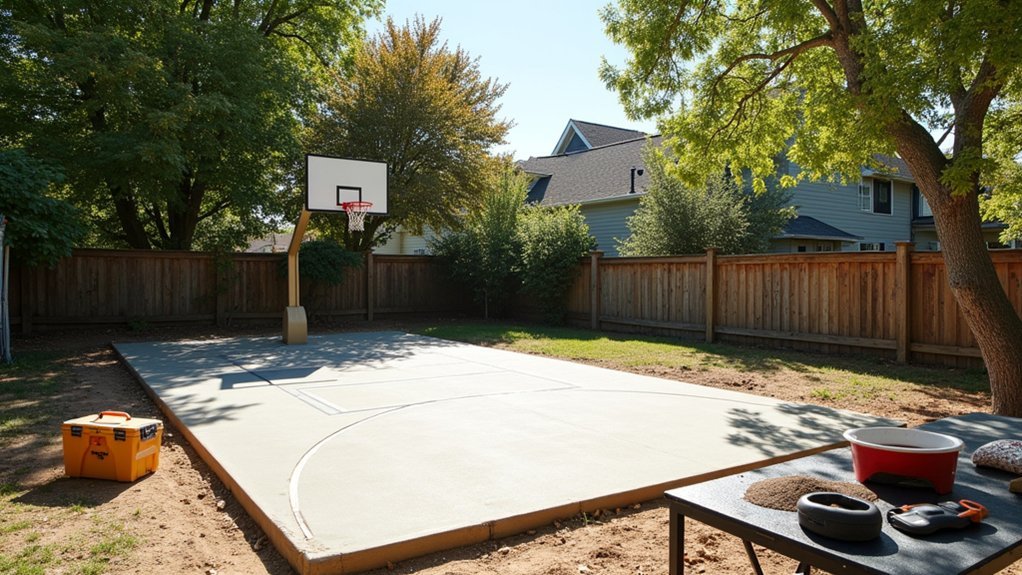
How easily equipment can reach your property considerably impacts your basketball court installation costs. Limited access often requires contractors to use smaller machinery or resort to manual labor, extending your project timeline and increasing labor expenses. When your yard has obstacles like trees or sprinklers, you’ll face additional costs for grading, drainage work, or custom engineering solutions.
Site access limitations can dramatically increase your court installation costs through equipment constraints and longer project timelines.
Three ways accessibility affects your court costs:
- Narrow gates or challenging terrain may force contractors to disassemble fencing or use specialized equipment, adding unexpected expenses
- Tight spaces requiring cranes or specialized placement equipment can double your equipment rental costs
- Site constraints that disrupt normal work sequencing often lead to delays and extended labor charges
Remember that accessibility issues aren’t just inconveniences—they’re significant cost drivers for your basketball court project.
Basketball Hoop Systems and Goal Installations
Why do basketball hoop systems account for such a significant portion of your court installation budget? Quality hoops range from $1,000 to $5,000 depending on features and adjustability. The tempered-glass adjustable systems recommended for residential courts represent a worthwhile investment in durability and performance.
| System Type | Price Range | Features |
|---|---|---|
| Standard Residential | $1,000-$2,000 | Tempered glass, basic adjustability |
| Premium Residential | $2,000-$3,500 | Enhanced adjustability, superior backboard |
| Professional Grade | $3,500-$5,000 | Maximum stability, pro-level features |
You’ll face additional costs if you’re planning a multi-sport court configuration requiring extra net poles and equipment. Optional containment netting systems further increase your investment. Installation complexity and site access challenges can also drive up labor costs, varying significantly by location.
Additional Sport Features for Multi-Use Courts
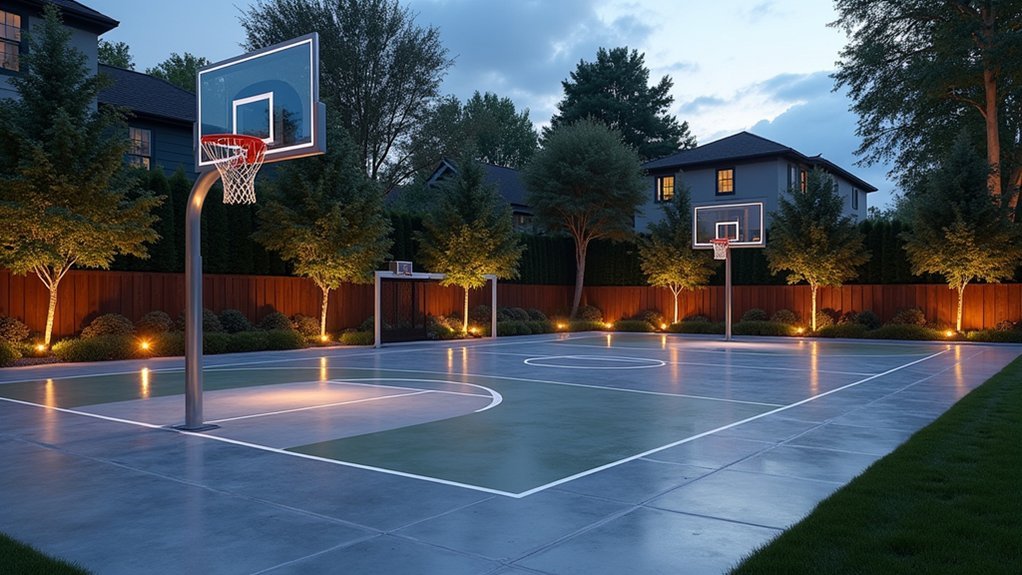
Multi-sport court configurations boost your investment’s value with versatile net systems for tennis, pickleball, or volleyball that can be added to your basketball court’s framework.
Strategic LED lighting installations extend your playing time into evening hours while increasing the overall utility of your backyard court space.
Multiple sport-specific court lines, painted in contrasting colors, maximize your court’s functionality and allow you to switch between different games without needing separate playing areas.
Net Systems Add Versatility
When transforming your backyard court into a multi-functional space, net systems offer remarkable versatility beyond basic basketball play. While optional, these components dramatically impact your total investment when added to create a multi-sport environment. Custom configurations typically require additional nets, poles, and containment features that extend beyond standard basketball setups.
Your options range from standard to premium quality, with each tier affecting both materials and installation complexity:
- Basic removable nets – allowing weekend volleyball games without permanent commitment
- Premium convertible systems – featuring quick-change mechanisms that transform your space in minutes
- Professional-grade net installations – delivering tournament-quality play for multiple sports
Though net systems increase your project’s scope and budget, they greatly enhance your court’s usability and long-term value, making your investment serve multiple sporting passions.
Lighting Extends Play
Proper lighting transforms your backyard court from a daytime-only venue into a round-the-clock recreational space. You’ll typically invest between $2,000 and $10,000 for lighting that extends your playing hours significantly.
LED fixtures represent the premium option, driving costs higher based on quantity and configuration, but offering superior energy efficiency and longevity. When planning a multi-sport court, your lighting design must accommodate different activities with appropriate coverage and intensity.
Don’t overlook important considerations like glare control and weather-resistant fixtures designed for outdoor conditions. Your lighting choices will interact with other features including net systems, seating areas, and perimeter fencing—affecting both your final budget and installation timeline. Thoughtful lighting design balances upfront costs against the value of extended play hours throughout the year.
Court Lines Maximize Use
Transforming your backyard court into a multi-use recreational space starts with strategic line markings. While VersaCourt and other providers offer pre-painted lines for standard basketball courts, adding configurations for pickleball, tennis, or volleyball considerably increases both design complexity and cost.
Multi-sport features impact your project budget in three key ways:
- Additional court lines and logos – Each sport requires specific dimensions and markings, with custom designs commanding premium prices
- Specialized equipment requirements – Adjustable net systems and sport-specific components add material expenses
- Enhanced surface durability – Multi-use courts need stronger surfaces to withstand varied activities, increasing material costs
While these features expand your court’s functionality and improve your investment’s value, they’ll amplify your overall project scope and final price tag.
Drainage Solutions and Water Management
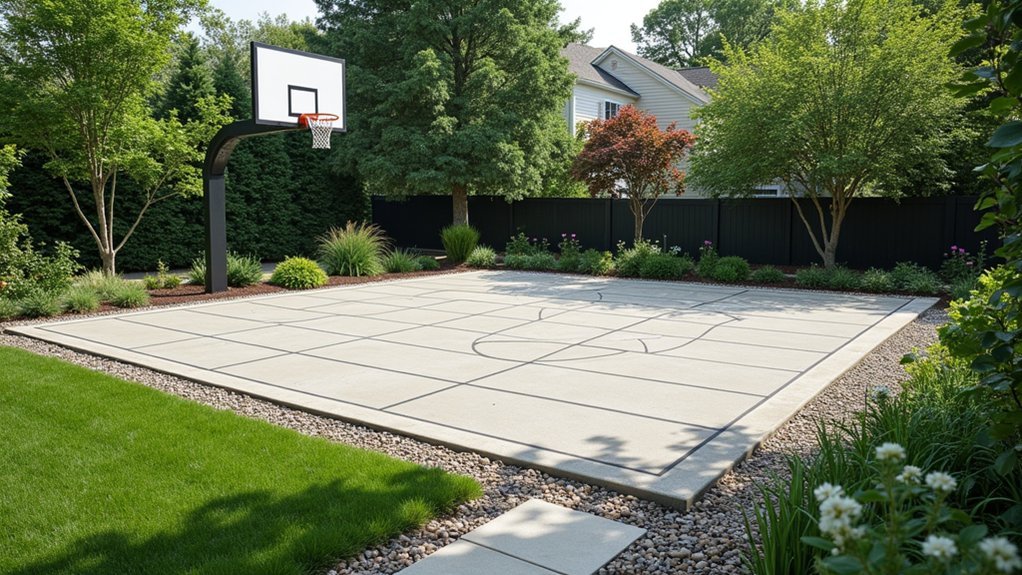
Because standing water can quickly deteriorate even the most expertly installed court surface, effective drainage solutions represent a critical investment in your backyard basketball court project. Your site’s natural topography and soil composition significantly impact drainage requirements and costs.
Proper drainage isn’t optional—it’s essential protection for your court investment against water damage.
You’ll face different drainage challenges depending on whether you choose concrete, asphalt, or modular tile surfaces. Clay-heavy soils often require more extensive drainage systems than sandy soils, potentially adding thousands to your budget.
Local regulations may mandate specific drainage approaches, particularly in environmentally sensitive areas. If your property needs significant grading or retaining walls to manage water flow, expect higher costs.
Remember that skimping on drainage solutions typically leads to expensive repairs later. Professional installers will factor in proper slopes, perimeter drains, and subsurface preparation to ensure your court remains playable for years.
Fencing, Containment, and Rebound Systems
When planning your backyard basketball court, fencing and containment systems represent substantial but often necessary investments that impact both functionality and final costs. Weather-resistant enclosures typically range from $3,000 to $8,000 depending on your chosen materials and court dimensions.
You’ll need to consider these key components in your budget:
- Protective fencing – prevents balls from damaging property while creating a dedicated sports space
- Containment netting – keeps gameplay flowing smoothly without constant ball retrieval from neighboring yards
- Rebounder systems – transforms your court into a versatile training facility for solo practice sessions
Optional lighting installations can further increase your investment, with outdoor setups ranging from a few thousand dollars to over $10,000 when combined with these containment features.
Lighting Installations for Night Play
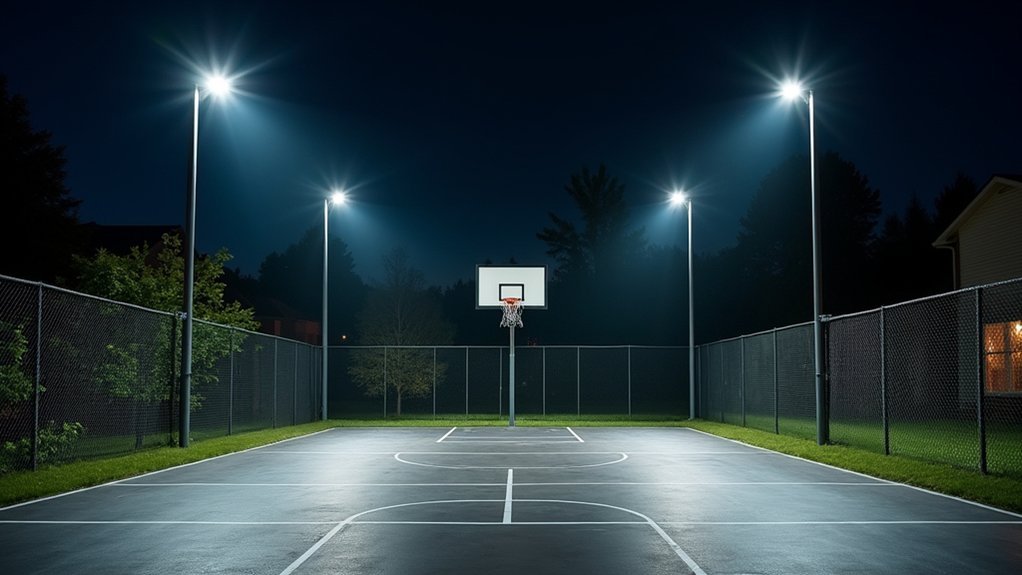
How much are you willing to invest to extend your court’s usable hours into the evening?
Lighting installations typically range from $2,000 for basic ambient illumination to $10,000 for professional-grade night play systems. Your final costs depend on several key factors.
LED fixtures offer greater energy efficiency and durability than traditional options, offsetting higher initial costs through long-term savings. You’ll pay more for uniform brightness across the entire court versus focused lighting in key areas. Site access challenges and extensive electrical work can notably increase your budget.
Don’t forget to consider add-ons like timers, dimmers, and color temperature controls that enhance functionality but add expense. An electrician’s expertise for trenching and wiring represents another substantial cost factor in your lighting plan.
Regional Price Variations and Labor Costs
Where you live noticeably impacts what you’ll pay for your backyard basketball court. Labor rates vary significantly across regions, with urban areas typically commanding premium installation costs compared to rural locations. The availability of qualified contractors in your area directly affects pricing and scheduling flexibility.
Your location influences costs through:
- Permit requirements – Some municipalities charge substantial fees and require multiple inspections, adding weeks to your timeline
- Terrain challenges – Hillside properties or areas with poor drainage may require extensive site preparation
- Material transportation – Remote locations face higher delivery charges for concrete, acrylic surfaces, and equipment
Site accessibility also plays a crucial role – narrow pathways or limited equipment access will increase labor hours and ultimately your bottom line.
Permit Requirements and Local Regulations
Why do so many homeowners underestimate the impact of permits and regulations on their basketball court projects? Often, they’re simply unaware of how significantly these requirements affect both timeline and budget.
You’ll need various approvals for grading, drainage, and access improvements in most jurisdictions. Permanent foundations and retaining walls typically require permits and sometimes engineering reports. Your local zoning codes will dictate crucial elements like setbacks, lot coverage limitations, and maximum fencing height.
Environmental regulations might demand specialized drainage solutions or erosion control measures during construction. Remember that permitting complexity varies dramatically between municipalities—what’s simple in one location might require extensive documentation and lengthy review in another. These differences directly impact your project’s duration and final cost, making location-specific research essential before committing to your court installation.
Frequently Asked Questions
How Much Does It Cost to Install a Backyard Basketball Court?
You’ll spend $8,000-$30,000 for a half-court or $20,000-$75,000+ for a full court. Costs vary based on size, surface type, base materials, and additional features you choose.
What Is the Cheapest Way to Build a Basketball Court in Your Backyard?
The cheapest backyard basketball court is asphalt with acrylic coating. You’ll save money by choosing a half-court design, doing site preparation yourself, and installing minimal features like a single hoop.
Do You Need a Permit to Put a Basketball Court on Your Property?
Yes, you’ll likely need permits for your basketball court depending on your location, especially if it includes lighting, drainage work, or permanent structures. Check with your local building department early.
How Much Does It Cost to Renovate an Outdoor Basketball Court?
Renovating an outdoor basketball court typically costs $5,000-$35,000 depending on your court’s size, required repairs, surface material choice, and additional features you’re updating like hoops or lighting.