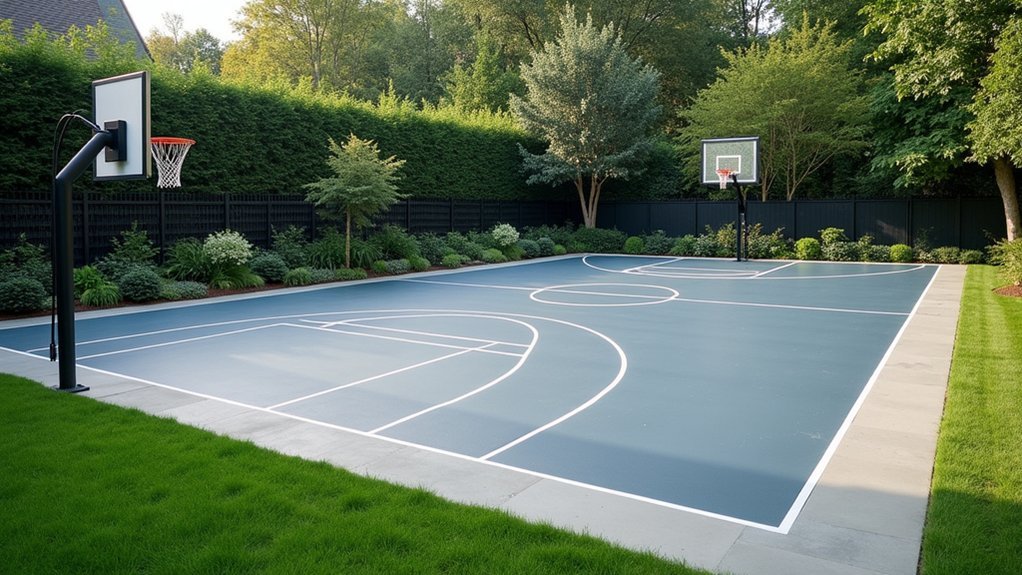
To design a small backyard sports court, start by measuring your available space and identifying obstacles. Choose compatible sports like pickleball (20’x44′) or half-court basketball (30’x50′) that fit your dimensions. Use multi-colored lines on durable surfaces like VersaCourt tiles to designate different playing areas. Install adjustable equipment and removable nets to quickly transition between games. Create a 1-2% slope for drainage and include adequate lighting for evening play. The right planning transforms even the smallest yard into a versatile athletic space.
Measuring and Assessing Your Backyard Space
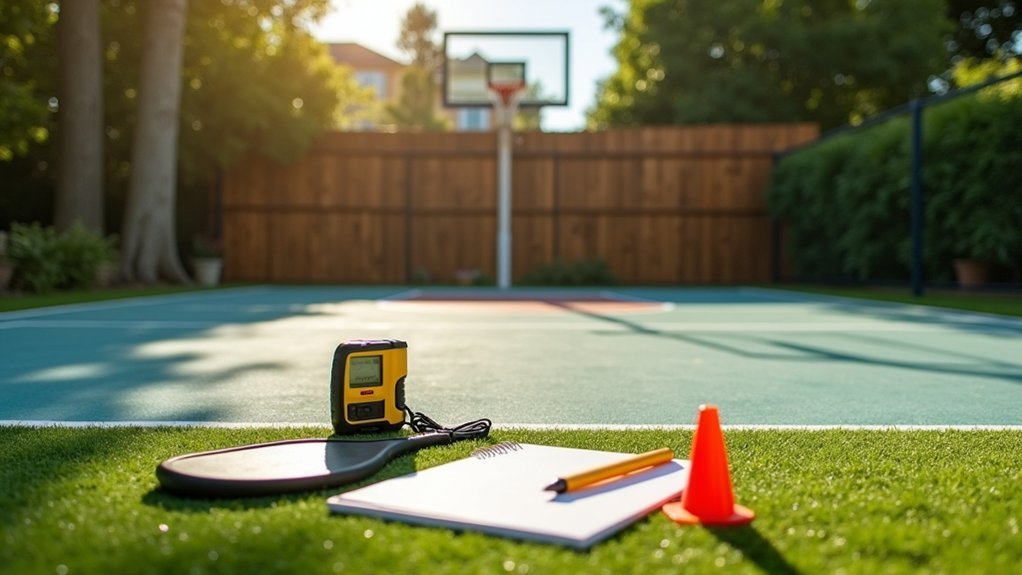
Why rush into building a sports court without proper planning? Start by measuring your backyard’s exact dimensions in feet, including length, width, and any slope. Note existing obstacles like trees, sheds, or utilities that might affect your layout.
Consider clearance requirements around your court—tennis needs 7-10 feet of free space while basketball requires 4-6 feet on the sides for safe play. Study sun patterns throughout the day to determine optimal court orientation and potential shade needs.
Evaluate your current ground surface to decide between leveling, paving, or installing modular tiles. Don’t forget drainage considerations to prevent water pooling. Finally, check for local restrictions and create a scaled drawing to test different multi-sport configurations before investing in equipment.
Selecting the Right Sports for Limited Areas
When faced with a small backyard, how do you maximize your recreational possibilities? The key is choosing sports that thrive in compact spaces while delivering maximum enjoyment. Pickleball stands out as the space-saving champion, requiring just 20 by 44 feet—perfect for even the smallest yards.
- Pickleball offers full gameplay experience in minimal space (20×44 feet)
- Half-court basketball fits in 30×50 feet areas, ideal for shooting practice
- Short-court tennis can be adapted with scalable nets and modified dimensions
- Multi-sport configurations with overlapping court markings maximize versatility
Consider combining compatible sports that share footprints. Pairing pickleball with half-court basketball or a compact tennis setup gives you variety without demanding excessive space. Your small yard can become a versatile sports haven with thoughtful selection.
Multi-Sport Court Layout Strategies
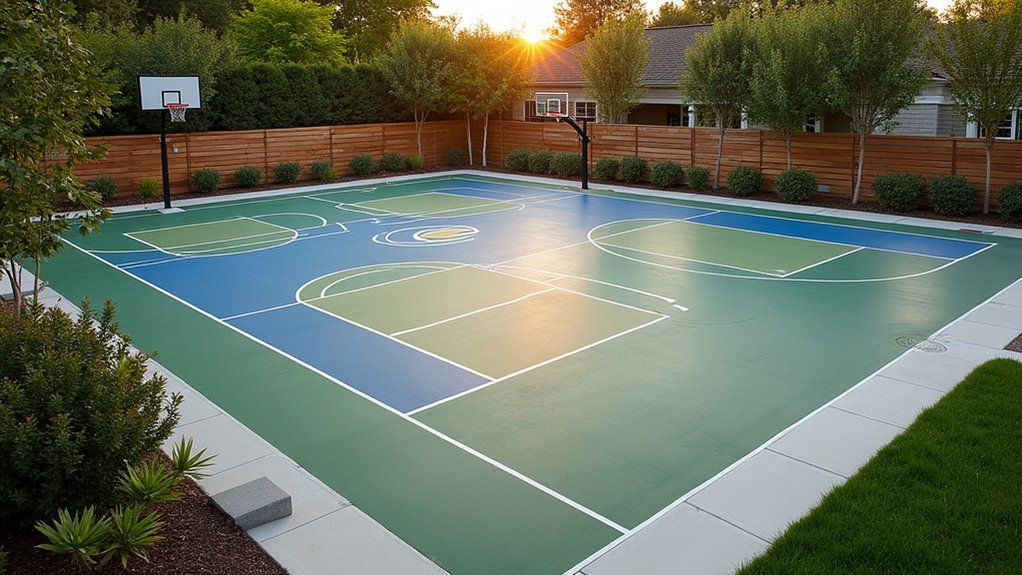
Creating a versatile backyard court starts with overlapping sport lines in contrasting colors, allowing you to play basketball and pickleball on the same compact footprint.
You’ll maximize limited space by selecting convertible equipment like adjustable nets and portable goals that transition between sports without permanent installations.
Strategic court configuration using cushioned modular tiles provides the flexibility to host multiple activities while maintaining safe play zones around the perimeter.
Overlapping Sport Lines
How can you fit multiple sports into one compact backyard court? The key is strategic line placement that prevents confusion while maximizing playability. When designing your multi-sport surface, consider these proven approaches:
- Use layered lines with distinct colors—typically white for basketball, blue for pickleball, and green for tennis—to create clear visual separation
- Position regulation pickleball boundaries (20 x 44 feet) within your primary court footprint, using bold edge markings to maintain clear sightlines
- Prioritize a half-court basketball design (approximately 30 x 50 feet) as your foundation when space is limited
- Incorporate removable markers for occasional games like hopscotch or shuffleboard rather than permanent lines
With flexible zones and adjustable net systems, you’ll create a versatile court where transitioning between sports takes minutes rather than hours.
Space-Maximizing Equipment Selection
Why struggle with dedicated courts when multi-functional equipment can transform your compact backyard into a versatile sports hub? VersaCourt modular tiles offer the perfect foundation—a single cushioned surface that seamlessly accommodates basketball, pickleball, and volleyball without complicated transitions.
Start with a half-court basketball footprint (30′ x 50′) as your anchor, then layer in pickleball or mini-tennis overlays with sport-specific colored lines to maintain visual clarity. Instead of permanent installations, invest in adjustable nets and portable equipment that can be quickly repositioned or removed as needed.
Design your layout to preserve open areas for younger children while ensuring adequate circulation space around the court edges. This scalable approach maximizes your backyard’s potential, allowing multiple sports without sacrificing safety or playability.
Convertible Court Configurations
The secret to maximizing your limited backyard space lies in mastering convertible court configurations that let you play multiple sports without expanding your property line. By strategically planning overlapping court markings, you’ll create versatility without sacrificing playability.
- Implement half-court designs, fitting a 30×50 basketball area alongside another sport to double your recreational options
- Choose VersaCourt modular tiles that allow you to reconfigure lines and boundaries as needed for different games
- Install adjustable net systems that can be quickly raised, lowered, or removed when switching between pickleball, tennis, or volleyball
- Utilize space-efficient dimensions like the 20×44 pickleball footprint that can overlap with basketball zones for optimal use of every square foot
Surface Materials for Small Court Durability

When selecting surface materials for your compact backyard sports court, durability becomes the cornerstone of a successful installation. VersaCourt modular tiles offer an ideal solution, providing cushioned surfaces that absorb impact and reduce joint stress during play across multiple sports.
These tiles resist harsh weather, UV exposure, and heavy use—maintaining their appearance and performance long-term. You’ll appreciate the engineered balance between traction and ball bounce, perfectly supporting basketball, tennis, pickleball, and volleyball on a single court.
You won’t spend weekends on maintenance either. The weather-resistant finishes require minimal upkeep and simple cleaning. During installation, prioritize proper drainage, high-impact resistance, and safety-compliant edges to meet multi-sport standards. This attention to surface quality ensures your small court delivers maximum enjoyment with minimum hassle.
Space-Efficient Court Markings and Lines
When designing a small backyard court for multiple sports, you’ll need to implement a multi-color line system that clearly distinguishes between activities. Choose one or two primary sports as your priority, marking those lines in the most visible colors while using less prominent hues for secondary activities. This thoughtful color-coding prevents visual confusion and creates a space that’s both functional and organized without overwhelming your compact playing surface.
Multi-Color Line Systems
Maximizing play options in a limited backyard space requires smart line management for multi-sport courts. By implementing a multi-color line system, you’ll create clear visual distinctions between sports while preventing confusing overlap during gameplay.
VersaCourt technology supports your multi-sport vision with these key advantages:
- Color-layered lines help players quickly identify relevant boundaries for basketball, pickleball, tennis, and other activities
- Professional application ensures regulation sizing even when multiple sports share the same surface
- Weather-resistant, high-visibility paints maintain clear lines year-round despite sun exposure and abrasion
- Temporary options like removable markers or chalk provide flexibility for casual games without permanent clutter
With the right color-coding approach, you’ll transform your compact backyard into a versatile sports hub that’s ready for whatever game your family chooses.
Prioritizing Primary Sports
Building on multi-color line systems, your next step involves making strategic decisions about which sports deserve primary focus on your limited court space. Start with minimum viable dimensions—pickleball requires just 20 x 44 feet, while half-court basketball needs 30 x 50 feet. These sports provide excellent bang-for-buck in tight spaces.
Once you’ve established your primary sport, overlay additional markings in complementary colors. VersaCourt surfaces excel at accommodating regulation-sized markings for multiple sports while maintaining visual clarity. Consider how activities might overlap spatially—a basketball key can share space with a pickleball service area.
For maximum flexibility, incorporate removable markers or chalk lines for less frequent activities. This approach preserves your court’s clean appearance while allowing you to adapt quickly for impromptu games without permanent line clutter.
Compact Equipment Options and Storage Solutions
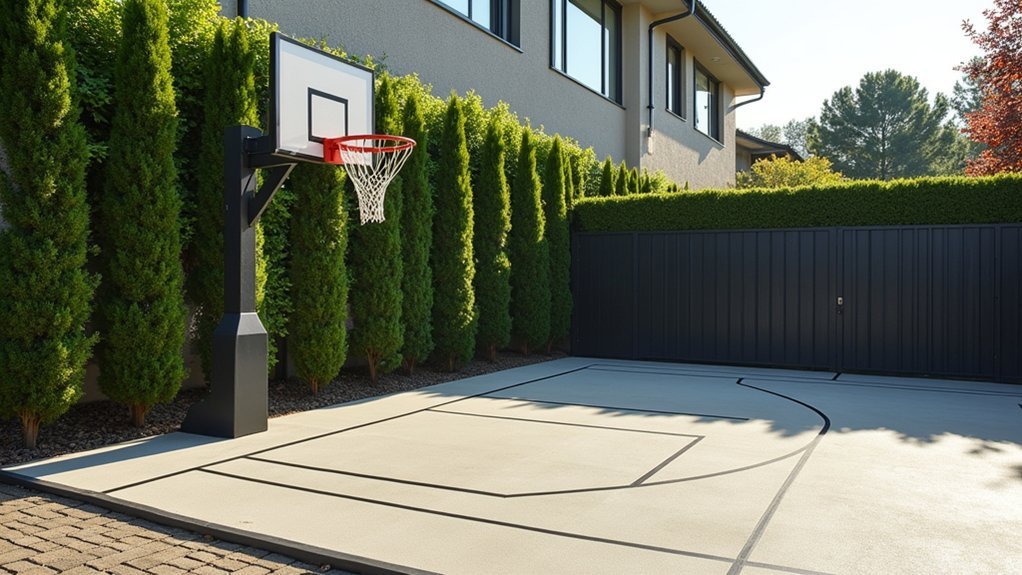
A clever sports court design isn’t complete without thoughtful equipment and storage solutions that maximize your limited space. Opt for multi-sport equipment that adapts to different games, such as adjustable-height hoops and portable nets that can be quickly reconfigured as needed.
- Wall-mounted or ceiling-mounted storage keeps balls, paddles, and nets organized without consuming valuable floor space
- Dual-purpose gear like hybrid basket/net systems reduces the number of separate items cluttering your court area
- Weather-resistant storage bins with clear labels streamline setup and cleanup between different activities
- Vertical shelving near the court edge creates a dedicated equipment zone that’s easily accessible when you’re ready to play
Lighting and Visibility for Small Courts
How well can you play when you can’t properly see the court? Proper visibility is essential for any sports court, especially in compact backyard spaces.
Install high-contrast court lines and boundary markings that remain visible under varied lighting conditions. For illumination, choose LED floodlights with 4000-5000K color temperature that provide bright, even light without excessive glare.
Visibility matters. High-contrast court markings and 4000-5000K LED lighting ensure clear play without blinding glare.
Position your fixtures at elevated angles around the court perimeter rather than from a single overhead point to minimize shadows. Add spill-light shields to reduce light pollution while maintaining consistent illumination across your playing area.
Select energy-efficient LED fixtures with dimming capabilities and smart controls. This allows you to adjust brightness for different sports and times of day, maximizing functionality while keeping energy costs down.
Creating Safe Buffer Zones in Tight Spaces

When designing a small backyard court, safety buffer zones become essential elements that prevent injuries and enhance the playing experience. Even in limited spaces, you’ll need at least 6 feet around the court for non-playing areas and 3 feet between court edges and fixed obstacles to prevent accidents.
- Choose compact court footprints like half-court basketball or 20×44 ft pickleball courts to maximize your buffer zones
- Install low-profile border padding and perimeter fencing to create visible, safe setbacks
- Use permeable, slip-resistant surfaces within buffer zones to reduce fall risks and water accumulation
- Position lighting to avoid glare while ensuring good visibility throughout the buffer areas
These thoughtful buffer zone design choices let you maximize safety without sacrificing the playability of your limited space.
Drainage Solutions for Limited Yard Areas
Effective water management in your small court requires thoughtful planning that directs flow away from play areas with a 1-2% slope.
Install compact drainage solutions like perimeter trenches or French drains that capture water before it reaches your playing surface.
Consider permeable VersaCourt tiles with built-in channels that maintain playability after rain while minimizing space requirements.
Strategic Water Flow Planning
Water management can make or break your small backyard court’s functionality and lifespan. For optimal drainage, design your court with a 1-2% positive slope away from buildings to prevent water accumulation after rainfall.
When planning water flow on limited space:
- Install catch basins at natural low points, connecting them to existing storm drainage systems
- Incorporate perimeter solutions using graded gravel base and permeable sub-base materials for better water infiltration
- Position low-profile trench drains along court edges to quickly channel water to designated areas
- Design integrated drainage with edge curbs and slope continuity across transitions
Remember to include maintenance access points to prevent clogging from debris. Proper water flow planning ensures quick drying time, minimizing downtime between games while protecting your investment from water damage.
Compact Drainage Systems
Compact drainage solutions demand creative engineering when space is at a premium in small backyard courts. Install a shallow grade of 1-2% sloping away from your court surface to direct water flow without wasting valuable space.
VersaCourt modular tiles with built-in gaps offer excellent permeability while the proper underlayment ensures quick water infiltration beneath the playing surface. Position a perimeter trench drain along court edges to capture rainfall and connect it to your existing stormwater system.
For subsurface moisture management, install a compact French drain beneath and around your court to prevent soft spots and structural heaving. Choose UV-resistant and frost-proof drainage components suited to your climate. Always position drainage outflows to avoid directing water onto neighboring properties or structures—maintaining good relations with neighbors is just as important as maintaining your court.
Permeable Surface Options
When designing small backyard courts, permeable surfaces offer the ideal solution for managing water runoff without sacrificing precious space. VersaCourt modular tiles allow water to drain quickly through the voids between tiles, reducing puddling and freeze-thaw damage in your compact yard.
For effective drainage, you’ll need:
- Integrated underlayment with proper 1-2% slope away from play areas
- Permeable paving combined with curbside or trench drainage systems
- Multi-sport compatible surfaces that maintain ball bounce and traction
- Strategic drainage outlets that direct water away from the court
These permeable options deliver long-term maintenance benefits, including easier sediment filtration and fewer surface cracks. You’ll need to periodically clean the joints to prevent clogging, but you’ll enjoy a court that performs well in various weather conditions.
Maximizing Play Value With Versatile Features
Since space comes at a premium in small backyards, strategic planning for versatility becomes essential when designing your sports court. Use overlapping court markings in different colors to designate basketball, pickleball, and tennis areas without creating visual clutter or confusion.
VersaCourt’s modular cushioned tiles provide an ideal single-surface solution that supports proper bounce, traction, and joint protection across multiple sports. Plan for a minimum footprint of 30 by 50 feet to accommodate half-court basketball and pickleball effectively in the same space.
Incorporate adjustable nets and posts for quick transitions between tennis and pickleball, reducing setup time for spontaneous family play. Add optional zone markings and removable markers to create dedicated areas for casual games like HORSE, shuffleboard, or mini-soccer within your court’s boundaries.
Budget-Friendly Design Options for Small Courts
You’ll find significant cost savings by exploring alternatives to premium court surfaces, such as concrete with specialized paint or interlocking plastic tiles instead of premium acrylic coatings.
Taking on parts of the installation yourself, particularly site preparation and basic concrete work, can reduce labor costs by up to 40%.
Consider a phased construction approach that starts with essential elements while preparing for future additions as your budget allows.
Affordable Surface Alternatives
Many homeowners assume that creating a backyard sports court requires premium materials and significant investment, but budget-friendly options abound for small spaces. VersaCourt modular tiles offer an excellent balance of quality and affordability with joint-friendly cushioning that supports multiple sports on one surface.
For cost-effective solutions that don’t sacrifice functionality:
- Choose multi-sport half-court layouts (30 x 50 feet) to maximize versatility while minimizing material costs
- Invest in weather-resistant surfaces with proper drainage to reduce long-term maintenance expenses
- Opt for color-coded line markings that distinguish between sports without requiring separate courts
- Consider scalable designs that allow for future expansion as your budget permits, starting with basic elements and adding portable equipment
DIY Installation Savings
Why spend thousands on professional installation when you can transform your backyard into a multi-sport court yourself? VersaCourt modular tiles offer a perfect DIY solution with their cushioned, slip-resistant surfaces that absorb impact while supporting multiple sports in your compact 30×50-foot space.
You’ll markedly cut labor costs by handling the installation yourself. Start with a basic half-court basketball setup, then expand your options by adding pickleball or shuffleboard lines later. Choose removable court markings or ones that can be easily re-colored to switch between activities without the hassle of repainting.
The smartest approach is scaling gradually—install your primary sport zone first, then add adjustable nets and portable goals as your budget allows. This strategy maximizes versatility while minimizing upfront costs and maintenance.
Phased Construction Approach
Smart planning transforms budget constraints into strategic advantages when building a backyard sports court. Instead of tackling a full-size court all at once, consider implementing a phased construction approach that matches your family’s needs and financial timeline.
- Start with a compact 30’×50′ multi-sport surface using versatile materials like VersaCourt tiles
- Install essential safety features first (proper drainage, lighting, and padding) before adding specialty lines
- Choose overlapping court markings and removable nets to support multiple sports without additional investment
- Begin with core elements and add accessories seasonally as budget allows, with a clear expansion plan
This strategic approach ensures you’ll enjoy your court immediately while building toward your ultimate vision over time.
Weather Considerations for Year-Round Use
When designing a backyard sports court, you’ll need to account for seasonal weather challenges that can affect playability throughout the year.
Start by insulating and creating a 1-2% slope with permeable underlayment to prevent water pooling and ice formation.
Select materials like VersaCourt tiles that offer UV resistance and low water absorption for durability in all seasons.
Don’t overlook lighting and heating options to extend court use during shorter winter days.
Install windbreaks or temporary shelters to shield players from snow, rain, and strong gusts—particularly important for pickleball and basketball.
Finally, implement a proactive maintenance schedule to check joints, fasteners, and edge padding regularly, as freeze-thaw cycles can create unexpected hazards.
With proper planning, you’ll enjoy your court regardless of weather conditions.
Integrating Courts With Existing Landscape Features
How effectively you harmonize your sports court with existing landscape elements can make the difference between an awkward addition and a seamless extension of your outdoor living space. Begin by thoroughly assessing your yard’s existing trees, slopes, and hardscape features to determine optimal court placement and drainage needs.
A thoughtfully integrated sports court transforms your backyard from disjointed to cohesive, becoming part of your outdoor living experience rather than disrupting it.
- Choose modular tiles like VersaCourt that can be cut to accommodate irregular shapes and preserve existing garden beds or pathways
- Align your court with natural sun and wind patterns to minimize glare and enhance year-round playability
- Create smooth transitions using low retaining walls or planters that maintain visual flow while ensuring proper water runoff
- Install strategic fencing or netting that follows natural property lines, adding protective padding near trees or hard edges
Maintenance Tips for Small Backyard Courts
While designing your court to blend with existing landscape features creates an appealing backyard oasis, preserving that investment requires regular attention.
Keep your modular VersaCourt tiles performing well by sweeping and washing regularly to prevent slips and maintain traction. If you’ve installed an asphalt or concrete base, seal it every 2-3 years to minimize cracking and ensure consistent ball bounce.
Conduct quarterly inspections of joints and edges, looking for weed intrusion, UV damage, or loose tiles that need reseating.
Opt for removable, weather-resistant court markings instead of permanent ones to maintain flexibility.
Don’t skip the annual professional maintenance check—it’s essential for addressing drainage issues, padding condition, and net systems that might compromise your court’s durability in a compact space.
Frequently Asked Questions
How Loud Will Court Activities Be for My Neighbors?
Noise varies by sport, but expect moderate sound levels. You’ll hear bouncing balls, player calls, and equipment contact. Consider rubber surfacing and acoustic fencing to minimize disruption for neighbors.
Can I Install Courts on Septic Drain Fields?
You shouldn’t install courts on septic drain fields. They can damage your septic system, cause soil compaction, and create drainage issues. Check local regulations, as many prohibit such construction entirely.
Will a Sports Court Affect My Home’s Resale Value?
A sports court can boost your home’s resale value if it’s well-designed and maintained. You’ll attract athletic buyers, but won’t appeal to everyone who might prefer other yard uses.
Do I Need Permits to Build a Backyard Court?
Yes, you’ll likely need permits to build a backyard court. Requirements vary by location, so check with your local building department about zoning laws, setbacks, and surface regulations.
How Do I Prevent Balls From Hitting Windows?
You’ll need to install protective netting or screens around your court. Position them strategically between play areas and windows. Consider shatterproof window films as an additional safeguard against stray balls.