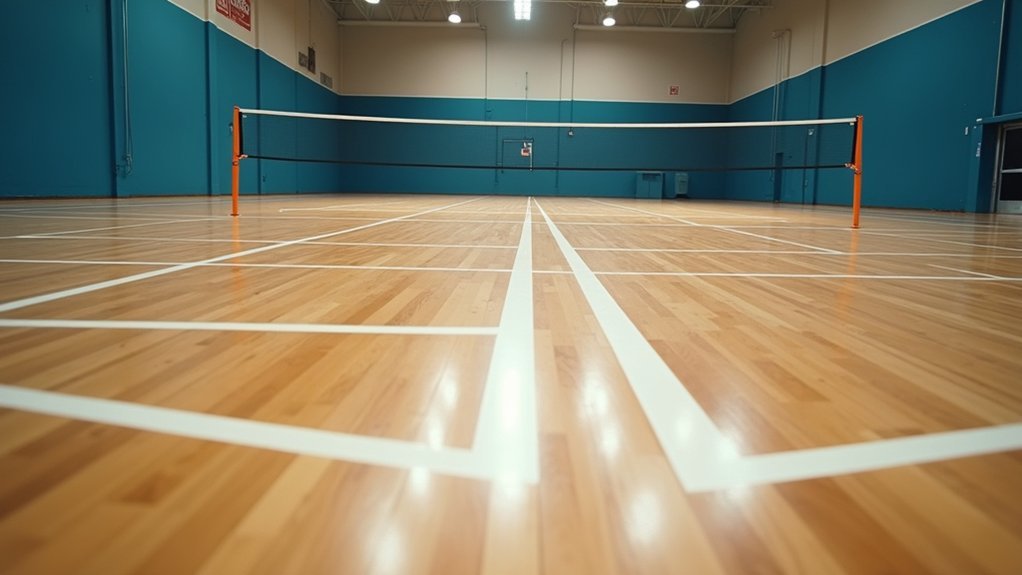
A standard badminton court measures 13.4 meters long by 6.1 meters wide for doubles, while singles uses a narrower 5.18-meter width. The net stands 1.55 meters high at posts and 1.52 meters at center. You’ll need service courts marked by the short service line (1.98 meters from net) and a center line dividing the court. For proper setup, allow at least 1-1.5 meters of clearance around all boundaries for safe play.
Standard Badminton Court Measurements and Boundaries

Ever wondered about the exact specifications of a badminton court? A regulation court measures 13.4 meters long by 6.1 meters wide for doubles play, creating a total playing area of 880 square feet. For singles matches, the width narrows to 5.18 meters (17 feet).
The court is divided equally by a net standing 1.55 meters tall at the posts and slightly lower (1.52 meters) at the center. Key boundary markings include the short service line positioned 1.98 meters from the net and the doubles long service line located 0.76 meters from the back boundary. When you’re setting up a court, don’t forget to allow for safety clearance—at least 1 meter on the sides and 1.5 meters at the back.
Singles vs. Doubles Court Markings Explained
While the game of badminton remains the same, the court markings differ considerably between singles and doubles play. The length stays consistent at 13.4 meters for both formats, but the width changes significantly.
In singles, you’ll use the narrower inner sidelines for a width of 5.18 meters (17 feet). For doubles, the court expands to 6.1 meters (20 feet) wide using the outer sidelines. This extra space accommodates two players per side.
The service areas also differ. Both formats use the short service line positioned 1.98 meters from the net, but doubles play includes a long service line placed 0.76 meters from the back boundary. Remember that each side has two service courts (left and right), separated by the center line.
Net Height Requirements and Positioning Guidelines
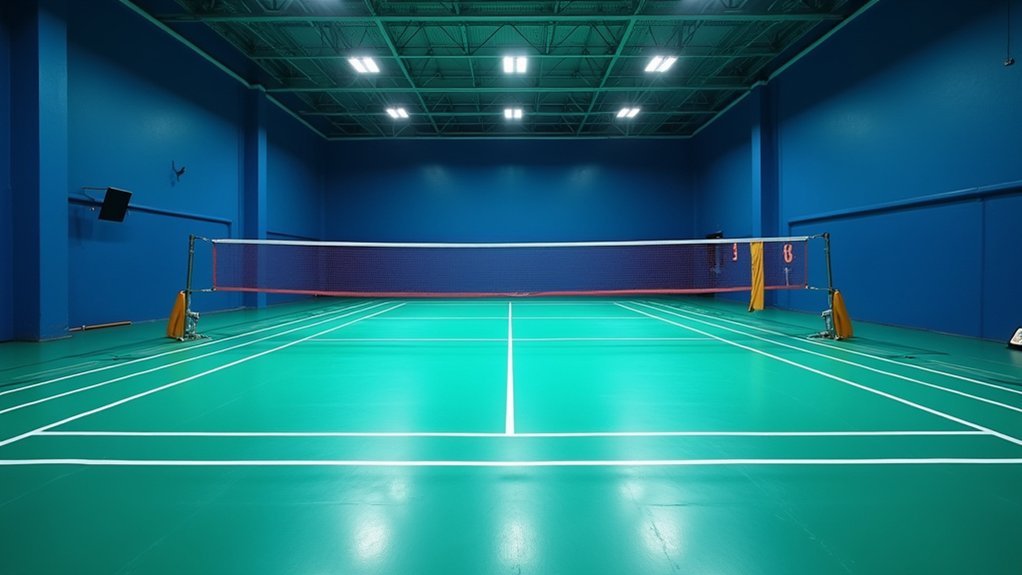
With court dimensions established, let’s examine the net that divides the playing area. The badminton net must maintain a height of 1.55 meters (5 feet 1 inch) at the posts while slightly dipping to 1.52 meters (5 feet) at the center. This precise measurement ensures consistent play across all competitive levels.
The net should be positioned centrally, running from sideline to sideline and creating two identical halves of the court. It’s placed directly above the center line, which divides the service courts on each side.
For proper gameplay, you’ll need to ensure adequate clearance around your court—at least 0.61 meters (2 feet) on the sides and sufficient overhead space for high shots. The net serves as the reference point from which the short service line is measured at 1.98 meters away.
Service Court Areas and Line Specifications
Service courts in badminton provide the foundation for properly executing and receiving serves, which makes understanding their dimensions critical for players.
The court features four distinct service boxes, created by a center line that splits the court width. Each service box begins at the net and extends to the short service line, positioned 1.98 meters from the net.
Singles play utilizes a narrower court width of 5.18 meters, while doubles expands to 6.1 meters. For doubles, the long service line marks the back boundary for serves, located 0.76 meters from the back boundary line. Singles play doesn’t use this long service line for service rules.
Remember that when serving, the shuttle must land in the diagonally opposite service court, and any shuttle landing on a line is considered in.
Clearance Requirements for Safe Backyard Installation

Creating a safe badminton court in your backyard requires more space than just the official court dimensions. You’ll need to maintain at least 1 meter (3.3 feet) of clearance on both sides and 1.5 meters (4.9 feet) behind each back boundary line for safe play.
When planning your installation, consider that a doubles court measures 6.1 meters (20 feet) wide by 13.4 meters (44 feet) long, while a singles court is narrower at 5.18 meters (17 feet) wide. With the required safety clearances added, you’ll need a minimum area of about 8.1 meters by 16.4 meters for a doubles court.
Ensure there are no obstacles within these clearance zones that could pose safety hazards during enthusiastic play.
Frequently Asked Questions
How Does Court Temperature Affect Shuttle Speed and Performance?
You’ll notice shuttles fly faster in warmer courts as air resistance decreases. In cooler temperatures, they’ll travel slower, requiring more power in your shots for equivalent performance.
Can Players Step on Boundary Lines During Rallies?
No, you can’t step on boundary lines during play. If your foot touches a line, it’s considered out of bounds and you’ll lose the point.
Are Temporary Court Markings Allowed in Official Tournaments?
Yes, you can use temporary court markings in official tournaments, provided they’re clearly visible, meet regulation dimensions, and are approved by tournament officials before play begins.
How Often Should Court Surfaces Be Replaced or Maintained?
You should replace wooden courts every 5-8 years and maintain them annually. Synthetic surfaces last 7-10 years but need quarterly inspection. Regular cleaning should happen daily during tournaments.
Do Paralympic Badminton Courts Have Different Dimensional Requirements?
No, Paralympic badminton courts don’t have different dimensions. You’ll find they use the standard court size and markings as regular badminton, accommodating athletes with various disabilities without dimensional changes.