For outdoor wine storage, maintain temperatures between 45°F-65°F, with 55°F being ideal. Limit daily fluctuations to ±5-10°F to prevent damage. Shield bottles from direct sunlight and UV exposure using shade structures. Keep humidity between 60-80% to preserve corks. Use multiple sensors to monitor temperature in different areas. Create insulated storage with proper drainage. Consider regional climate adaptations for your area. During extreme weather, have emergency cooling plans ready. These guidelines will help protect your valuable collection from the elements.
Optimal Temperature Range for Outdoor Wine Storage
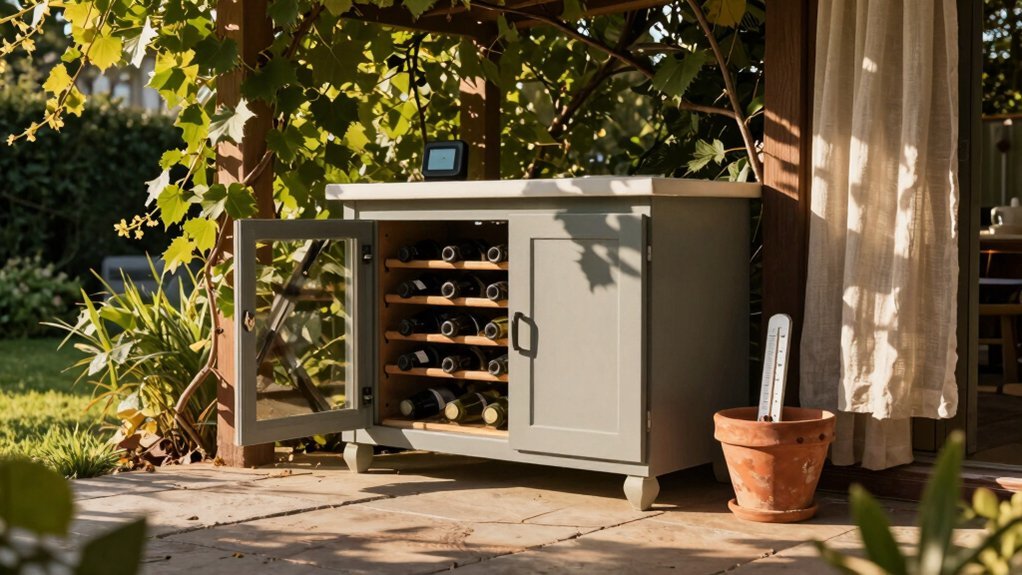
Why does temperature matter so much when storing wine outdoors? Temperature directly affects wine’s aging process and chemical stability. When temperatures climb too high, above 70°F (21°C), your wine essentially “cooks,” accelerating oxidation and degrading flavor compounds. Conversely, extreme cold can damage wine structure.
For outdoor storage, aim for the sweet spot between 45°F and 65°F (7°C-18°C), with 55°F (13°C) being ideal for long-term aging. This range maintains your wine’s intended development pace while preserving its character.
The most damaging factor isn’t necessarily the absolute temperature but rapid fluctuations. Your outdoor storage solution should buffer against daily temperature swings through insulation, shade, or partially underground placement. Consistent conditions will protect your investment and ensure your wines mature gracefully.
Protecting Wine From Seasonal Temperature Extremes
Seasonal weather presents significant challenges for outdoor wine storage beyond daily temperature fluctuations. You’ll need strategic solutions to shield your collection from extreme conditions that can ruin your wines.
- Create a temperature buffer – Use insulated cabinets or storage boxes that maintain internal temperatures between 45–65°F (7–18°C), even when outdoor temperatures fluctuate.
- Establish elevation – Keep wine storage off the ground to prevent moisture damage and improve ventilation, reducing mold risk.
- Manage humidity – Deploy silica desiccants or small dehumidifiers when moisture levels spike to protect labels and corks.
- Choose location carefully – Position your storage in consistently shaded areas away from direct sunlight, which accelerates aging and damages both wine and labels.
Managing Day-to-Night Temperature Fluctuations
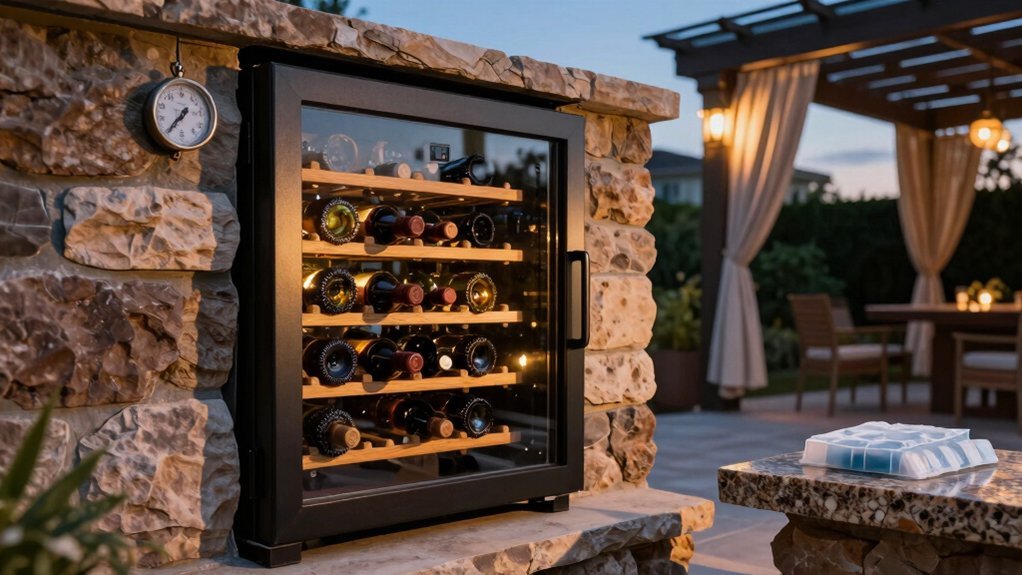
You’ll need to buffer your outdoor wine collection against the dramatic temperature swings that occur from day to night.
During daylight hours, use shade structures or reflective materials to prevent direct sun exposure that can quickly overheat bottles, while nighttime requires insulation to prevent rapid cooling.
Installing a temperature monitor near your storage area will help you track these diurnal fluctuations and make timely adjustments to maintain the stable environment your wine requires.
Daily Temperature Cycles
Throughout the course of each day, your outdoor wine storage will face natural temperature swings that can impact wine quality if not properly managed. Aim to maintain temperatures around 55°F (13°C) with fluctuations limited to ±5-10°F to preserve consistency. Monitor your storage environment closely and implement these strategies:
- Install insulation in your outdoor cabinet or cellar walls to dampen the amplitude of temperature variations
- Utilize shade or natural cooling to prevent heat buildup during peak daylight hours
- Implement passive or active cooling systems to keep temperatures below the critical 70°F (21°C) threshold
- Track temperature patterns with a data logger to identify problematic swings that could accelerate aging or stress corks
Buffering Outdoor Extremes
While daily temperature variations are inevitable in outdoor settings, properly buffering these extremes is essential for preserving wine quality. Your goal should be to limit temperature swings to just a few degrees, protecting cork integrity and slowing the aging process.
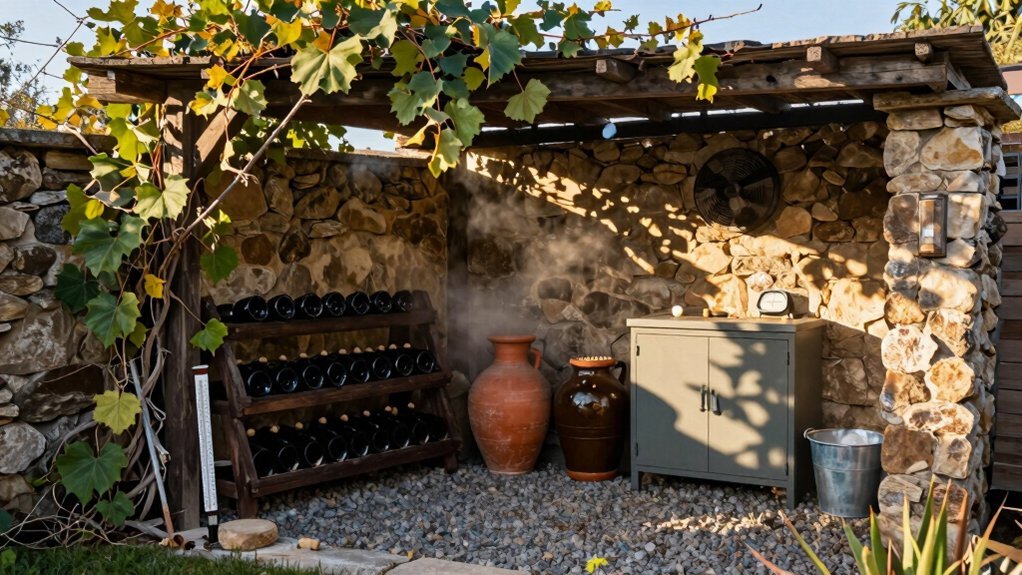
Implement strategic buffers like shade structures, windbreaks, and insulating sleeves for your bottles. For maximum stability, consider burying an insulated container or placing a dedicated wine cabinet in a shaded, ground-level location.
Track conditions using a thermometer and hygrometer to identify patterns and adjust your buffering techniques accordingly. During extreme weather—temperatures above 85–90°F or below 32°F—move your collection indoors temporarily. These precautions create a stabilized microclimate that shields your wine from damaging temperature fluctuations, preserving its intended flavor profile.
Shielding Wine From Direct Sunlight and Heat Sources
When storing wine outdoors, you’ll need to block harmful UV rays with colored bottles or specialized coverings to prevent flavor deterioration.
Set up reflective barriers around your storage area to redirect heat away from wine containers, keeping temperatures within ideal ranges.
Create dedicated cooling zones by utilizing shaded microclimates and avoiding heat-conducting surfaces like metal or rooftops that can dramatically raise wine temperatures.
UV Protection Strategies
Sunlight poses perhaps the greatest threat to outdoor wine storage, with UV rays silently degrading your precious bottles while you’re unaware. Even colored glass offers limited protection against harmful radiation that accelerates aging and diminishes quality.
Implement these proven UV defense strategies:
- Install retractable shade covers or pergolas with UV-resistant fabric above your storage area
- Use opaque, insulated wine cases that block 100% of sunlight when transporting or storing bottles outdoors
- Position storage behind decorative lattice screens that provide both aesthetics and functional UV blocking
- Set up UV-filtering plexiglass barriers if your collection faces unavoidable sun exposure during certain hours
Regularly check for faded labels or unusual bottle shimmer—telltale signs you need to enhance your UV protection immediately.
Reflecting Heat Away
Beyond blocking UV rays, mastering heat management represents the next frontier in outdoor wine protection. Position your collection away from direct sunlight by using reflective shields or creating dedicated shaded areas.
Don’t place bottles near heat-generating sources like grills, outdoor lighting, or sun-warmed pavement. Instead, opt for ambient shading and elevated storage that prevents ground heat transfer. Air circulation is critical—incorporate space for ventilation around your storage area.
Apply heat-reflective coatings in lighter colors to surrounding surfaces to minimize heat absorption. If possible, install a protective canopy that shields bottles from overhead sun while allowing airflow. Remember, even brief exposure to direct sunlight can dramatically increase wine temperatures. By thoughtfully redirecting heat away from your collection, you’ll maintain proper serving temperatures and preserve wine quality.
Creating Cooling Zones
Creating dedicated cooling zones forms the cornerstone of effective outdoor wine storage. You’ll need strategic placement to shield bottles from both direct sunlight and indirect heat sources that can elevate temperatures several degrees—even on cloudy days. Position your storage at least several feet away from grills, pavement, and poorly insulated exterior walls to prevent localized hotspots.
Target a stable environment around 55°F (13°C) to align with classic cellar conditions
Install windbreaks to minimize ambient warming and maintain temperature stability
Use reflective or heat-diffusing materials to counteract surrounding heat sources
Position zones away from concrete and metal surfaces that reflect and intensify radiant heat
These cooling zones provide crucial temperature regulation, protecting your wine from the harmful effects of heat fluctuations during outdoor storage.
Humidity Considerations in Outdoor Wine Environments
Just as temperature fluctuations can damage your wine collection, humidity levels play an equally essential role when storing wine outdoors. Aim for 60%-80% relative humidity to keep corks properly hydrated and minimize evaporation.
When humidity drops below 60%, corks can dry out and shrink, allowing oxygen to seep in and oxidize your wine. Conversely, levels above 80% encourage mold growth on labels and surfaces. This risk is particularly acute in hot, arid climates where high temperatures accelerate aging and cork degradation.
Manage moisture effectively by creating shaded areas with proper ventilation. Consider adding humidifiers or water features in dry environments. Choose materials for your outdoor racks that resist warping and mold growth while enabling easy cleaning to prevent odor transfer to your corks.
Insulation Strategies for Outdoor Wine Storage Solutions
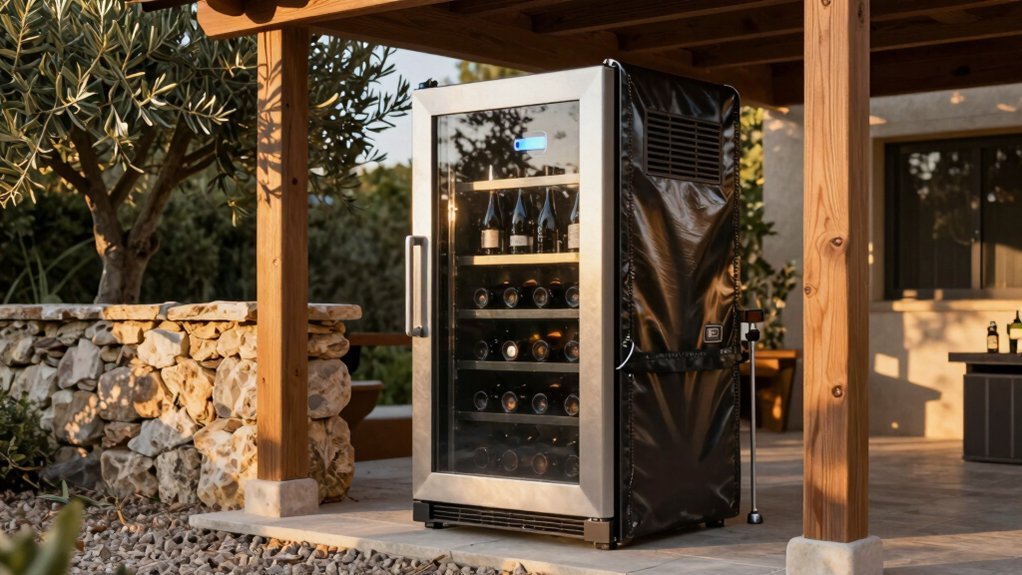
How well you insulate your outdoor wine storage directly determines whether your collection ages gracefully or deteriorates prematurely. Effective insulation creates a barrier between your wines and the temperature fluctuations that can ruin them. You’ll need to focus on creating a stable environment that mimics traditional cellars despite outdoor conditions.
For optimal insulation performance:
- Select double-wall panels with climate-appropriate R-values to minimize heat transfer
- Install complete moisture sealing to prevent humidity swings and condensation issues
- Incorporate shade elements or partial burial to reduce direct sun exposure
- Pair passive insulation with active cooling systems for consistent temperature control
Remember that proper insulation works in tandem with your cooling solution to maintain the ideal environment below 70°F, protecting your investment from seasonal extremes.
Temperature Monitoring Systems for Outdoor Wine Storage
While insulation creates the foundation for temperature stability, an effective monitoring system serves as your vigilant guardian against invisible threats to your wine collection. Choose an outdoor-rated system with remote sensors that track multiple temperature points in real-time.
| Sensor Type | Placement Location | Purpose |
|---|---|---|
| Ambient | Near storage area perimeter | Detect approaching temperature shifts |
| Bottle-level | Direct contact with storage racks | Monitor actual wine temperature |
| Surface | On exterior walls/surfaces | Identify heat transfer issues |
| Headspace | Upper area of storage | Track rising warm air patterns |
| Sun-exposed | Strategic problem areas | Alert to direct heat exposure |
Position sensors in both shaded and potentially sun-exposed areas to capture microclimate variations. Ensure your system logs historical data and sends alerts when temperatures drift beyond ±5-10°F of your target range (ideally 55°F).
Weather-Resistant Wine Storage Design Principles
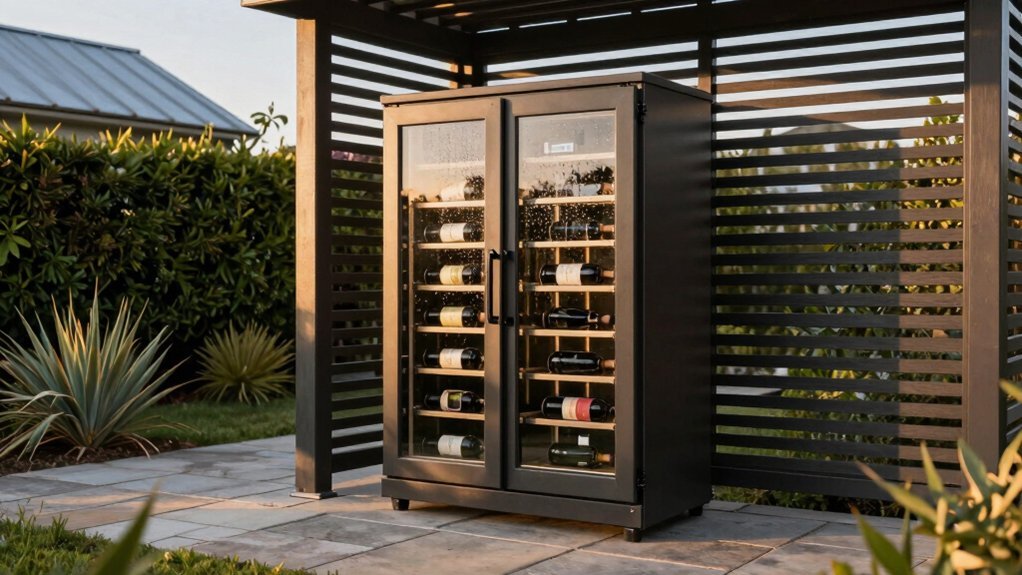
Beyond monitoring systems, the structural design of your outdoor wine storage determines its resilience against nature’s challenges. When building or selecting outdoor wine storage, prioritize materials and construction that shield your collection from temperature extremes, moisture, and UV exposure.
- Insulate thoroughly – Use double-walled construction with high R-value materials to maintain your 45-65°F temperature range and minimize thermal fluctuations during seasonal changes
- Install proper drainage – Ensure water flows away from your storage area while maintaining 60-80% humidity levels
- Incorporate UV protection – Choose opaque materials or UV-filtering glass for viewing areas to prevent light damage
- Design for passive cooling – Position storage in naturally shaded areas and use thermal mass elements to absorb daytime heat and release it slowly
Regional Climate Adaptations for Outdoor Wine Preservation
Where you live fundamentally shapes your approach to outdoor wine storage, as each climate zone presents unique challenges to maintaining ideal preservation conditions. You’ll need to adapt your strategy based on regional factors like seasonal temperature swings, humidity levels, and natural elements.
| Climate Zone | Primary Challenge | Key Adaptation Strategy |
|---|---|---|
| Hot/Desert | Excessive heat | Double-wall insulation with reflective barriers |
| Coastal | High humidity | Ventilation systems with moisture-absorbing materials |
| Continental | Freeze/thaw cycles | Underground or partially-buried designs |
| Tropical | Humidity + heat | Sealed systems with dedicated cooling units |
| Mountain | UV intensity | Opaque materials with northern orientation |
In humid regions, prioritize airflow while maintaining 60-80% humidity. For hot areas, incorporate shade structures and thermal mass to moderate temperature fluctuations rather than fighting for precise temperatures.
Emergency Temperature Control During Weather Events
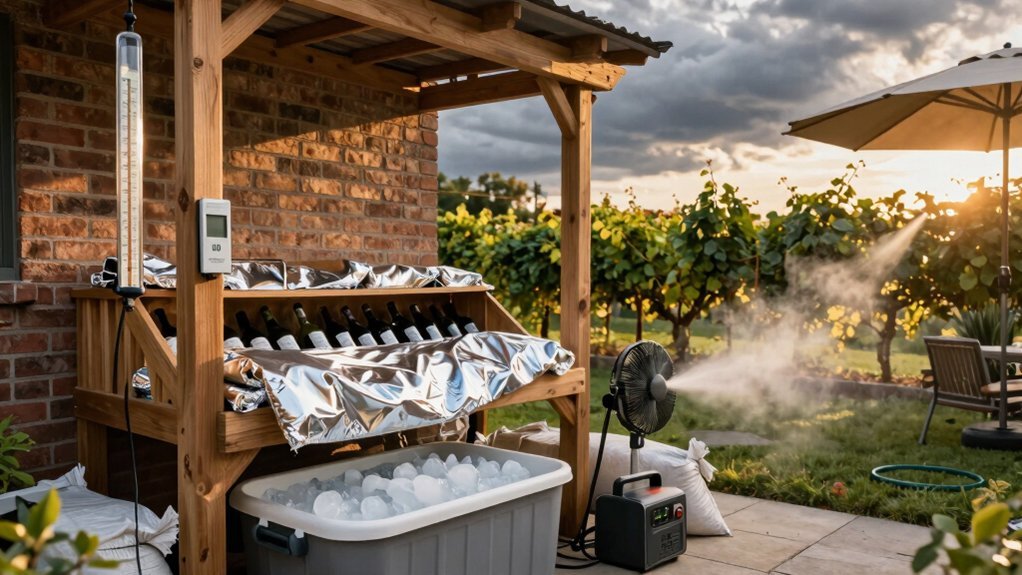
Extreme weather events can quickly destabilize your outdoor wine storage conditions, requiring immediate action to protect your collection. You’ll need a well-rehearsed emergency plan to prevent temperature fluctuations beyond the critical 45-65°F range.
When storms threaten, your wine collection hangs in the balance—act swiftly with a solid emergency plan.
When severe weather threatens, implement these protective measures:
- Deploy insulated shelters or cooling wraps that maintain temperatures as close to the ideal 55°F as possible
- Transfer bottles to portable coolers with dry ice packs for immediate temperature stabilization during heatwaves or cold snaps
- Create windbreaks and shade structures to minimize heat gain and protect bottles from direct sunlight and UV exposure
- Monitor humidity levels (aim for 60-80%) using dampening methods like humidity packs or mats to prevent cork desiccation
Always be prepared to relocate your collection indoors if extreme conditions persist.
Frequently Asked Questions
What Temperature Is Too Cold for Wine Storage?
You shouldn’t store wine below 45°F (7°C) outdoors. Temperatures under 40°F risk cork damage, while freezing (32°F/0°C) can crack bottles and push corks out.
What Is the 30 30 Rule for Wine?
The 30-30 rule means you shouldn’t store wine below 30°F (-1°C) or above 30°C (86°F). You’ll avoid freezing damage and premature aging that ruins flavor and quality.
Will Wine Spoil at 70 Degrees?
Wine won’t spoil immediately at 70°F, but you’ll notice quality decline if stored there long-term. It’s not ideal—your wine will age faster and develop flat, cooked flavors.
Is It Okay to Store Wine at 65 Degrees?
Yes, 65°F is fine for wine storage, especially for reds. It’s within the recommended range, and you’ll get better results if you maintain this temperature consistently over time.