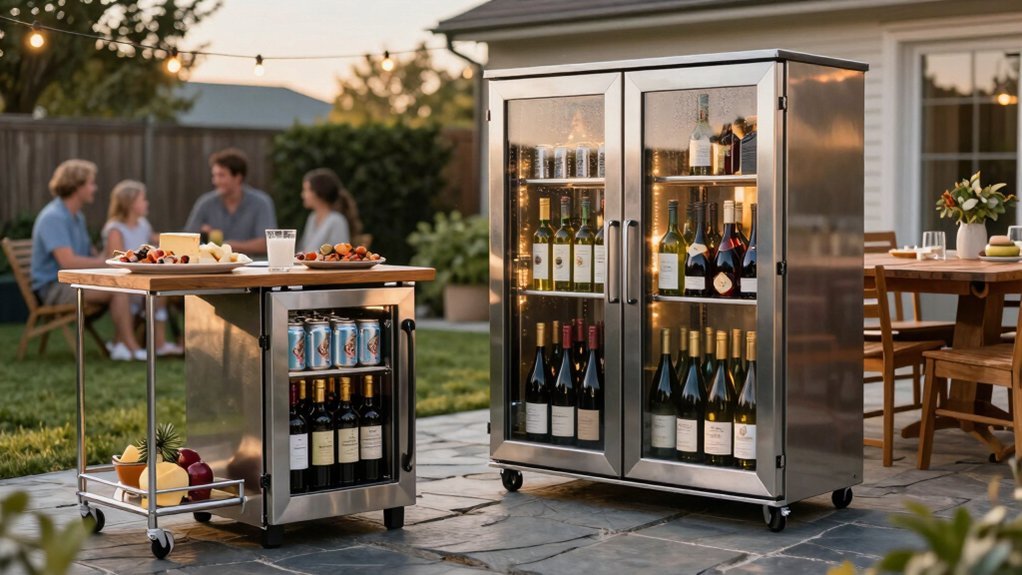
When choosing an outdoor wine cooler, size directly impacts your entertainment capacity and cooling performance. Smaller 40-bottle units work for intimate gatherings, while 100+ bottle models minimize refills for frequent hosts. Proper dimensions ensure adequate ventilation clearance—freestanding units need 10-12 inches on sides, while built-in models require minimal space. Size also affects temperature stability, with larger units maintaining more consistent cooling in variable outdoor conditions. The right dimensions will transform your outdoor entertaining experience.
Determining the Perfect Capacity for Your Outdoor Entertainment Needs
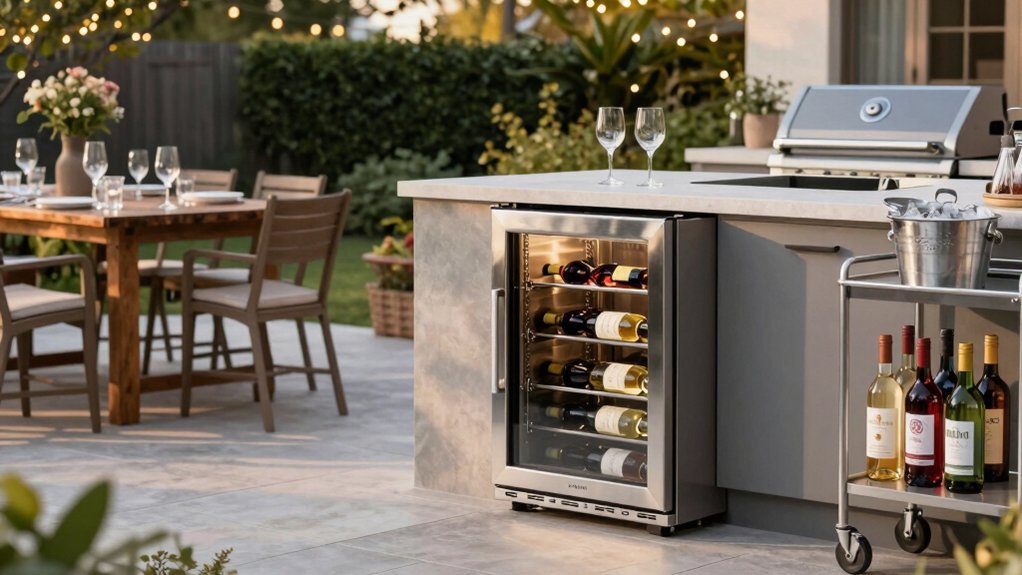
When selecting an outdoor wine cooler, capacity isn’t just about how many bottles you can store—it’s about matching your entertainment style and frequency. Consider how often you’ll host gatherings and how many wine-drinking guests typically attend your events.
For intimate patio dinners, a compact 40-bottle unit might suffice, while frequent entertainers should look toward models storing 100+ bottles to minimize refilling interruptions. Remember that larger capacities require more substantial floor space and proper ventilation clearance.
Your cooler should accommodate your collection’s diversity—look for adjustable racks that can handle various bottle shapes while maximizing space efficiency. Finally, balance your outdoor space constraints with your storage needs; a too-large unit can overwhelm a small deck, while an undersized cooler will frustrate during busy gatherings.
Space Requirements for Different Sized Outdoor Wine Coolers
When installing your outdoor wine cooler, you’ll need to account for specific clearance requirements that vary between front-venting built-in units and rear-venting freestanding models. Width considerations range from compact 15-inch models ideal for tight spaces to expansive 30+ inch units that demand significant real estate in your outdoor kitchen or bar area. Proper ventilation space is non-negotiable—inadequate airflow will compromise temperature regulation and potentially damage your investment while shortening its lifespan.
Clearance Requirements
How much space do you actually need around your outdoor wine cooler? It depends on your model type. Freestanding units require significant breathing room—10-12 inches on the sides, 6 inches at the back, and adequate top clearance to prevent heat buildup and ensure proper ventilation.
If you’re opting for a built-in or under-counter model, you’ll need much less space. These front-venting designs require only ¼ inch clearance on all sides. Before installation, verify your wine cooler’s ventilation design matches your intended placement.
Remember to position your unit away from direct sunlight and heat sources, regardless of type. For outdoor settings, elevating the cooler helps maintain consistent temperature and optimal airflow—critical factors for preserving your wine collection’s quality.
Width and Height Considerations
Selecting the appropriate dimensions for your outdoor wine cooler substantially influences both functionality and aesthetics in your outdoor entertaining area. Small coolers (15-18 inches wide) store about 40 bottles, perfect for compact spaces, while medium units fit between cabinetry like dishwashers, holding 40-100 bottles. Large models exceed 30 inches wide with capacities up to 300 bottles for serious collectors.
- For built-in models, ensure you’ve measured recessed space with proper clearance for front-exhaust ventilation
- Freestanding units require 10-12 inches of side clearance, plus adequate back and top space to prevent overheating
- Consider your typical entertaining needs and collection size when choosing between small (40 bottles), medium (40-100) or large (300) capacities
Ventilation Space Needs
Why do outdoor wine coolers need proper ventilation? Your cooler’s compressor generates heat while maintaining ideal wine temperature, and without proper airflow, this heat can damage the unit and affect cooling performance.
For freestanding outdoor models, you’ll need 10-12 inches of clearance on sides and back, plus top clearance for heat dissipation. Built-in or under-counter units with front-exhaust systems require at least ¼ inch clearance on all sides.
Never place rear-exhaust freestanding units flush against walls or cabinetry—they’ll overheat quickly. For recessed installations, choose front-exhaust models that can be installed flush while maintaining proper ventilation.
Remember to position your cooler away from direct sunlight and heat sources, and elevate it slightly to reduce dust accumulation. Don’t let objects obstruct ventilation spaces around your unit.
Single Zone vs. Dual Zone Options Based on Collection Size
When choosing an outdoor wine cooler, understanding the relationship between your collection size and temperature zone configuration can dramatically impact your storage success. Small to medium collections with primarily one wine type benefit from single-zone coolers, which maintain consistent temperature and offer greater energy efficiency. For diverse collections featuring both reds and whites, dual-zone models provide the flexibility to store different varieties at their ideal temperatures simultaneously.
- Consider a single-zone cooler if you collect predominantly one wine style or if long-term aging at a consistent temperature is your priority
- Opt for dual-zone when balancing serving readiness with proper storage conditions across varied wine types
- Match your zone configuration to your drinking habits—single zone for focused collectors, dual zone for versatile enthusiasts who serve different wines regularly
Compact Solutions for Small Patios and Decks
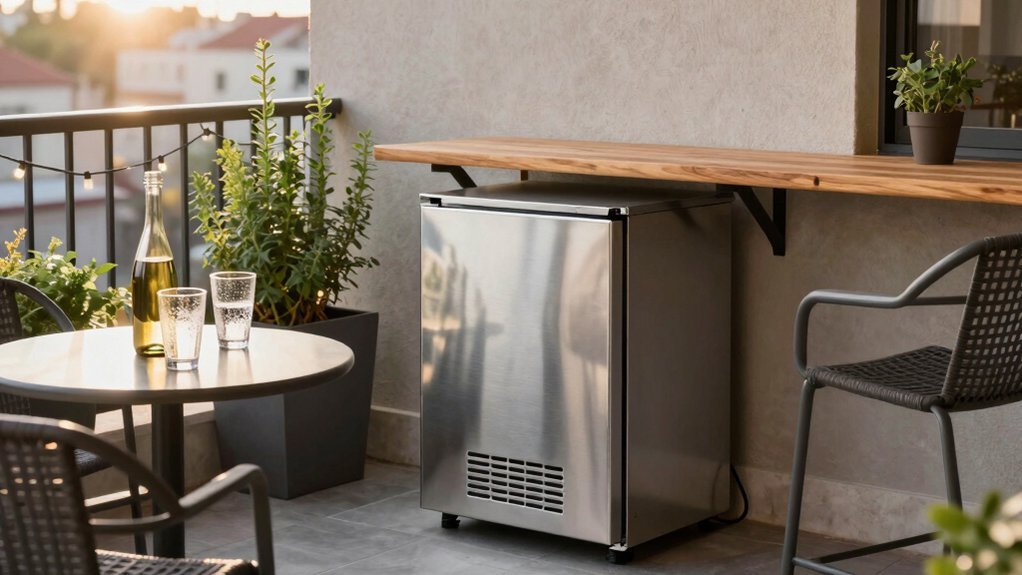
You’ll maximize your small outdoor living area with compact wine coolers that fit neatly into tight corners or under counters while still storing up to 40 bottles. Front-venting models offer the most flexibility since they don’t require clearance behind the unit, allowing flush installation against walls or within cabinetry. Elevating these space-saving coolers protects them from the elements while ensuring proper airflow, giving you both functionality and protection in your limited outdoor space.
Space-Saving Design Benefits
How often have limited outdoor dimensions prevented you from enjoying luxuries like wine storage? Thankfully, small outdoor wine coolers at just 15-18 inches wide deliver full functionality while fitting seamlessly into compact spaces. These versatile units can be integrated between existing cabinetry or tucked into spaces the size of a dishwasher, making them perfect for intimate patios and bar areas.
- Front-vented built-in models slide effortlessly under counters in tight outdoor kitchens
- Elevated placement with proper side clearances ensures optimal airflow in restricted spaces
- Flexible capacity options still accommodate both long-term storage and daily drinking needs
Placement Flexibility Options
Limited outdoor space shouldn’t mean sacrificing your wine collection. For compact patios, built-in units offer the most versatile installation options with their front-venting design and minimal ¼-inch clearance requirements, allowing seamless integration into outdoor cabinetry.
If you’re working with a deck that has accessible walls, consider freestanding models, but remember they need 10-12 inches of side clearance and 6 inches at the rear for proper ventilation. For truly tight spaces, compact 15-18 inch models that store around 40 bottles provide maximum capacity without overwhelming your area.
Regardless of your choice, proper placement is crucial—avoid direct sunlight by positioning your cooler in shaded areas, and elevate it to minimize dust and water exposure. Don’t forget security features like door locks for outdoor installations, especially in weather-exposed locations.
Large-Capacity Models for Serious Entertainers and Collectors
When entertaining guests on a grand scale or curating an extensive wine collection, large-capacity outdoor coolers become essential investments. These impressive units can store up to 300 bottles, making them ideal for commercial venues or serious collectors who need high-volume storage with weatherproof protection.
Starting at 30 inches wide, these models accommodate more racks and wider bottle formats while offering outdoor-rated certification for durability in the elements. You’ll find them perfectly suited for garages, patios, or entertainment spaces where frequent, large-scale serving is the norm.
- Consider your layout and ventilation requirements before installation
- Look for front-venting models if placement options are limited
- Choose units with flexible storage configurations to accommodate your specific collection
Before purchasing, ensure your space can properly support these substantial coolers for optimal performance.
Matching Wine Cooler Size to Your Outdoor Kitchen Dimensions
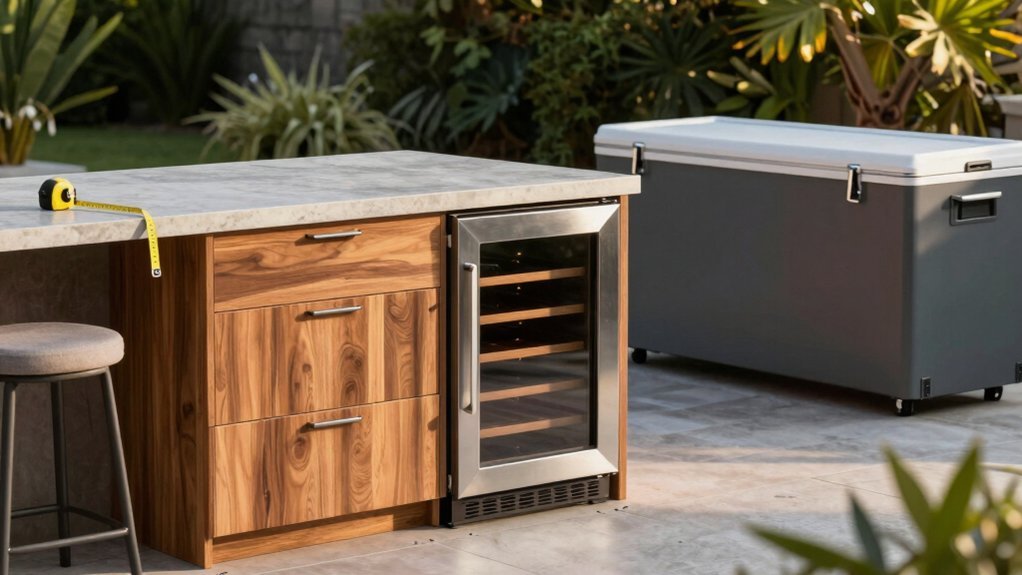
Selecting the right wine cooler dimensions for your outdoor kitchen involves balancing your storage needs with available space constraints. For compact kitchens, small 15-18 inch models holding 40 bottles offer functionality without dominating limited space.
Medium units (40-100 bottles) work well between existing cabinetry, similar to standard dishwasher dimensions. If you’re designing from scratch, consider whether you need a front-venting built-in model, which requires minimal ¼-inch clearance but demands dedicated cabinet space.
For spacious outdoor kitchens, large 30-inch units storing up to 300 bottles provide ample capacity for entertainers. Remember that installation type affects required clearance—freestanding units need 10-12 inches on sides and top for proper ventilation in outdoor settings, while built-ins can be recessed with minimal clearance, maximizing your layout efficiency.
Bottle Configuration and Shelving Considerations by Size
Your outdoor wine cooler’s shelf spacing directly impacts how many bottles you’ll actually fit, regardless of the advertised capacity.
Adjustable racks offer crucial versatility when your collection includes both standard Bordeaux and wider Burgundy bottles.
You’ll maximize your cooler’s potential by selecting a unit with shelving configurations that accommodate the specific bottle shapes in your collection.
Shelf Spacing Affects Capacity
How effectively you maximize your outdoor wine cooler’s capacity depends considerably on shelf spacing and configuration options. When selecting your unit, remember that larger models with adjustable racks accommodate more bottle rows and provide wider gaps for varied shapes. Mid-size coolers need slide-out shelves and configurable rack widths to properly store Burgundy and odd-shaped bottles without wasting space.
- Small units (≈40 bottles) require strategic shelving to maximize limited space, while large units can store up to 300 bottles with properly spaced racks
- Under-counter and built-in designs demand front-venting systems and specific cabinet clearances, directly affecting how shelves can be arranged
- Dual-zone coolers need reconfigurable racking to accommodate different bottle heights while maintaining temperature separation between zones
Adjustable Rack Versatility
When designing an outdoor wine cooler setup, adjustable rack versatility becomes a critical factor that directly impacts your collection’s accessibility and organization. You’ll need shelving that accommodates various bottle shapes, from standard horizontals to wider Burgundies, ensuring stable storage as your collection evolves.
As you transition between different unit sizes, the ability to reconfigure your layout becomes essential. Smaller 15-18 inch units with 40-bottle capacity offer fewer adjustable positions, while larger 30-inch models supporting up to 300 bottles provide significantly more configuration options with slide-out shelving.
For built-in or under-counter installations, proper rack adjustability helps maximize space efficiency, particularly when switching between single and dual-zone configurations. You’ll appreciate the flexibility to reallocate shelves when adding odd-shaped bottles or varied vintages to your collection.
Bottle Shape Compatibility
Why do standard wine racks often fail to accommodate diverse bottle collections? Most generic racks are designed for Bordeaux bottles only, leaving your prized Burgundies, champagnes, and other specialty bottles without a proper home. In your outdoor wine cooler, size directly impacts how well different bottle shapes can coexist without sacrificing capacity or accessibility.
- Larger coolers (150+ bottles) offer more flexibility for mixed collections with dedicated zones for wider Burgundy bottles and taller champagnes
- Medium units (60-150 bottles) require strategic shelving—opt for models with at least 30% adjustable racks to accommodate varied shapes
- Smaller coolers (under 60 bottles) benefit from fully adjustable slide-out shelves to maximize limited space while still fitting different bottle diameters
Temperature Performance Variations Across Different Sized Units
Where you place your outdoor wine cooler considerably impacts its performance, but size might be the most critical factor determining temperature stability. Larger coolers (up to 300 bottles) distribute cooling load more evenly, maintaining consistent temperatures even during outdoor heat fluctuations.
| Size | Temperature Stability | Best For |
|---|---|---|
| Small (40 bottles) | Requires tighter controls | Limited spaces, patios |
| Medium (100-150 bottles) | Good balance of efficiency | Most outdoor kitchens |
| Large (200+ bottles) | Superior stability | Serious collectors |
| Dual-zone (any size) | Specialized temperature ranges | Mixed wine collections |
| Built-in units | Enhanced by front-exhaust design | Custom outdoor installations |
When selecting your outdoor unit, remember that garage-ready or outdoor-rated models provide essential protection against elements regardless of size, but larger units generally offer more consistent cooling performance during extreme weather conditions.
Energy Efficiency Based on Cooler Dimensions
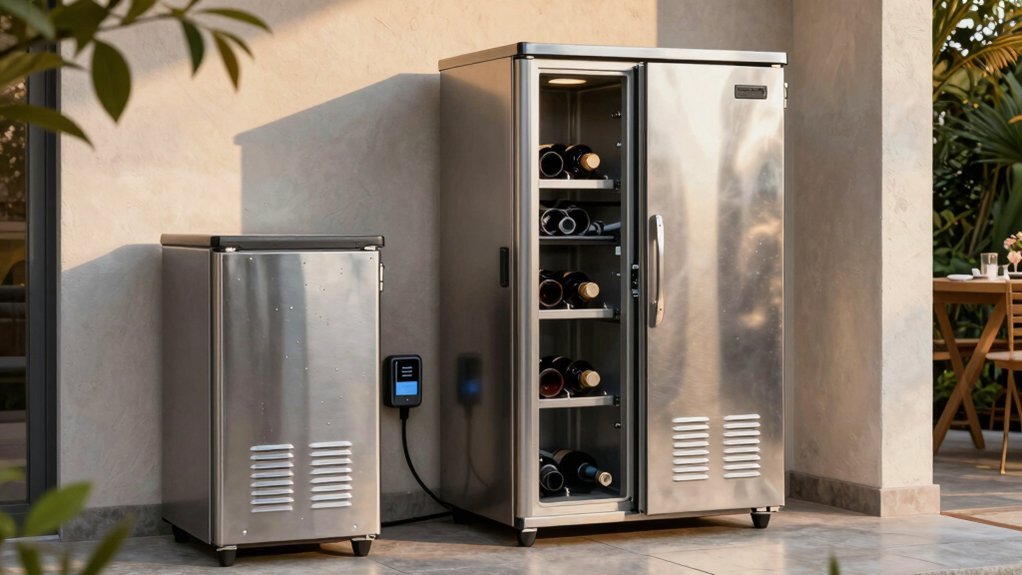
Energy efficiency represents a critical consideration when selecting an outdoor wine cooler, with dimensions playing a surprisingly significant role in overall power consumption. Larger units that store 200+ bottles may use more electricity overall, but they’re often more efficient per bottle when fully stocked. You’ll find that proper sizing matches your actual collection needs without wasting energy cooling empty space.
Size matters: larger wine coolers often deliver better bottle-for-bottle efficiency when properly filled.
- Insulation quality becomes more critical as unit size increases, with better-insulated models maintaining temperature with less compressor runtime
- Dual-zone configurations in larger coolers allow you to cool different wines at appropriate temperatures without energy waste
- Ventilation requirements differ between built-in and freestanding models, with proper clearance directly impacting energy usage
When calculating long-term costs, consider both upfront investment and ongoing energy consumption based on your collection size.
Future-Proofing Your Purchase: Choosing a Size That Grows With You
When selecting an outdoor wine cooler, choosing the right size isn’t just about your current collection—it’s about anticipating future growth. Rather than purchasing based solely on today’s needs, consider how your wine inventory might expand over time.
Large units (30+ inches wide) may seem excessive initially but provide room for your collection to flourish without requiring a future upgrade. Look for models with adjustable racks and flexible bottle supports that accommodate various bottle shapes as your preferences evolve.
If you’re starting with mainly reds but might add whites later, invest in a dual-zone cooler now instead of replacing your unit later. Don’t forget practical considerations like installation space, proper ventilation clearance, and how the cooler fits into your outdoor kitchen’s long-term layout plans.
Frequently Asked Questions
How Big of a Wine Cooler Do I Need?
You’ll need a small cooler (40 bottles) for casual enjoyment, medium (40-100) for growing collections, or large (300+) for serious collectors. Consider your space and drinking habits.
What Is the 20 20 Rule for Wine?
The 20/20 wine rule suggests you shouldn’t store wine above 20°C (68°F) or for longer than 20 years, as these conditions can substantially affect quality and flavor development.
What to Look for When Buying a Wine Cooler?
Look for appropriate capacity, freestanding or built-in design, single or dual temperature zones, proper dimensions for your space, and adequate ventilation requirements to ensure your wine cooler fits your needs perfectly.
Are Wine Fridges a Standard Size?
No, wine fridges aren’t a standard size. You’ll find them ranging from small 15-18 inch units to large 30+ inch models that can store anywhere from 40 to 300+ bottles.