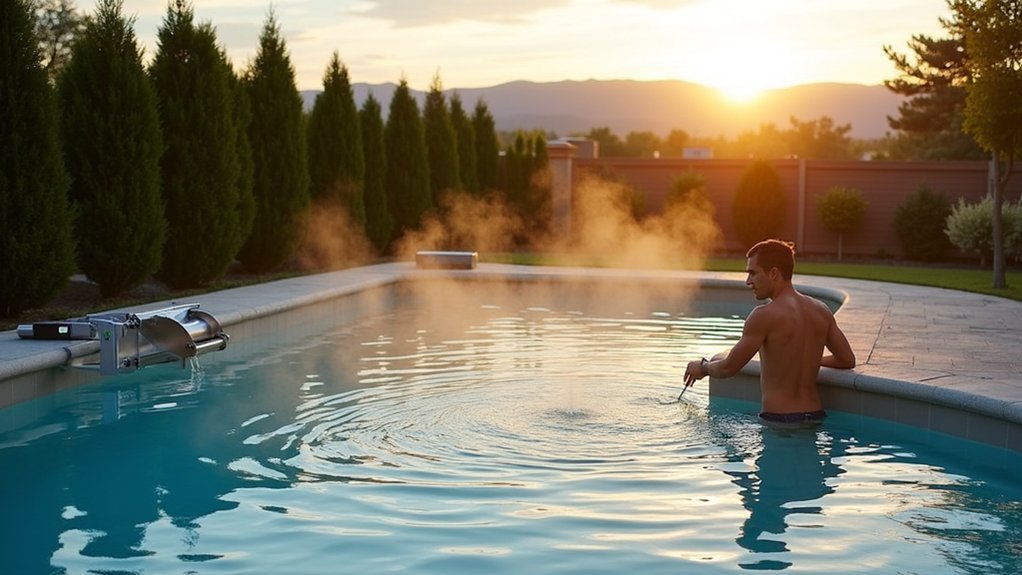
To heat your pool year-round, you’ll want to choose the right system for your climate and usage patterns. Heat pumps work best in moderate climates above 50°F and deliver three to seven times more energy than they consume. Gas heaters provide rapid heating for occasional use, while solar systems eliminate fuel costs entirely. Pairing any heater with a pool cover cuts heat loss by up to 70%. Below, you’ll discover which combination suits your needs best.
Understanding the Benefits of Year-Round Pool Heating
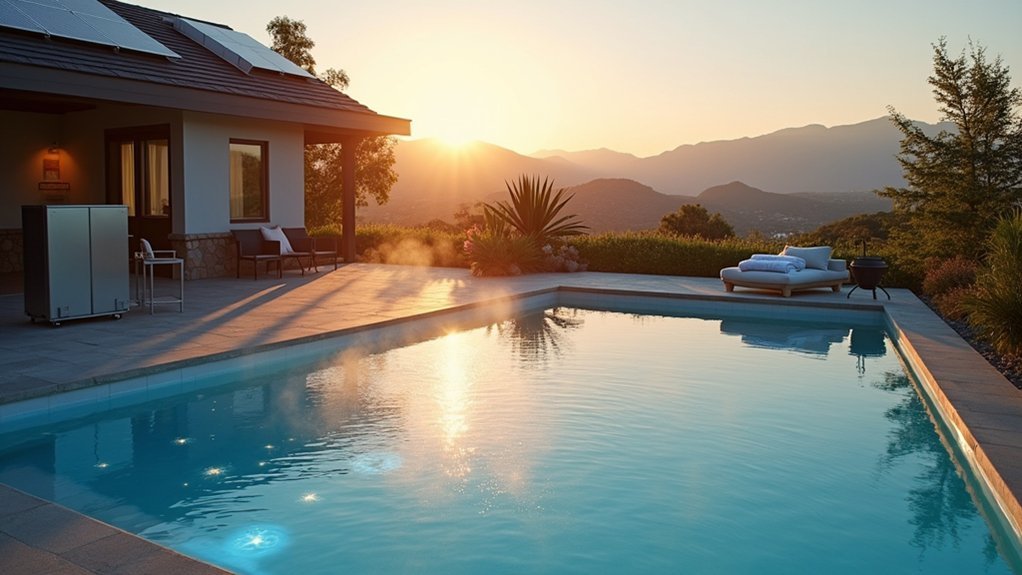
Year-round pool heating transforms your backyard investment from a seasonal luxury into a consistent source of enjoyment and wellness. You’ll maximize the return on your pool by extending swimming opportunities from a few summer months to all twelve.
Transform your pool from a summer splurge into a year-round wellness retreat that pays dividends every season.
Heated pools offer therapeutic benefits you can access anytime. Warm water soothes muscle tension, eases joint pain, and provides low-impact exercise conditions regardless of outdoor temperatures. You’ll maintain fitness routines without seasonal interruptions.
Your property value increases with a heated pool. Buyers recognize the appeal of year-round swimming capability, making your home more attractive in competitive markets.
You’ll also host gatherings and family activities whenever you choose. Evening swims in fall, holiday pool parties in winter, and early spring laps become possible when you control your water temperature.
Solar Pool Heaters: Harnessing Natural Energy
Among the most cost-effective ways to achieve consistent pool temperatures, solar pool heaters stand out for their ability to capture free energy from the sun. These systems pump your pool water through solar collectors, typically mounted on your roof, where it absorbs heat before returning to your pool.
You’ll find two main types of solar collectors: glazed and unglazed. Unglazed collectors work best in warm climates, while glazed versions perform better in cooler regions due to their insulated design.
Installation costs run higher than conventional heaters, but you’ll recover that investment through eliminated fuel expenses. With proper maintenance, your solar heating system can last 15 to 20 years.
For peak results, position your collectors facing south and guarantee they receive direct sunlight for maximum efficiency.
Gas Pool Heaters for Quick Temperature Control
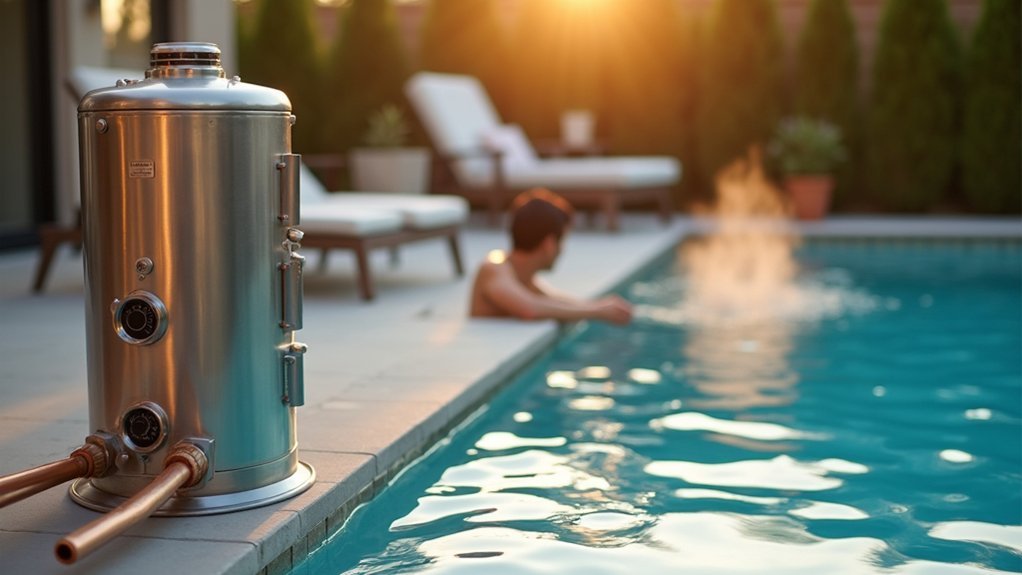
When you need your pool warm fast, gas heaters deliver unmatched speed by burning natural gas or propane to heat water as it passes through the unit. You’ll appreciate how quickly these systems raise water temperature regardless of weather conditions or time of year.
Before purchasing, you should understand the installation requirements and ongoing fuel costs that come with this rapid heating capability.
How Gas Heaters Work
Gas pool heaters ignite either natural gas or propane to generate heat rapidly, making them the fastest option for raising your pool’s temperature. When you turn on your heater, water flows from the pool through a filter and into the heater’s combustion chamber.
The burning gas heats copper coils, which transfer warmth directly to the passing water before it returns to your pool.
Here’s what happens during each heating cycle:
- Your pump draws water into the heater’s heat exchanger
- Sensors detect water temperature and activate the burner
- Hot gases pass through the exchanger, warming the water
- Heated water circulates back into your pool
You’ll notice temperature increases within hours rather than days, giving you complete control over when you swim.
Rapid Heating Benefits
Speed sets gas heaters apart from every other pool heating option on the market. While heat pumps need hours to warm your water, a gas heater can raise your pool’s temperature by 20°F or more in just one session. You’ll appreciate this capability when unexpected guests arrive or weather changes your plans.
| Scenario | Gas Heater Advantage |
|---|---|
| Weekend entertaining | Pool ready in 1-2 hours |
| Cool morning swims | Quick warmup before work |
| Seasonal shifts | Extend swimming into fall |
| Sporadic pool use | Heat only when needed |
Gas heaters work best for pools you don’t use daily. You won’t waste energy maintaining constant temperatures. Instead, you’ll fire up the heater precisely when you want to swim.
Installation and Costs
Understanding what you’ll spend upfront helps you decide if a gas heater fits your budget and pool setup.
Gas heaters typically cost between $1,500 and $4,000 for the unit alone, with installation adding $500 to $1,500 depending on your existing gas lines and local labor rates.
Consider these key cost factors before purchasing:
- Unit size: Larger BTU ratings handle bigger pools but increase purchase price
- Gas line installation: New lines add $200 to $800 if your current setup lacks capacity
- Permit fees: Many municipalities require permits ranging from $50 to $300
- Ongoing fuel costs: Natural gas runs cheaper than propane, affecting long-term expenses
You’ll recoup installation costs through reliable performance and the flexibility to swim whenever temperatures drop unexpectedly.
Electric Heat Pumps: Energy-Efficient Heating Solutions
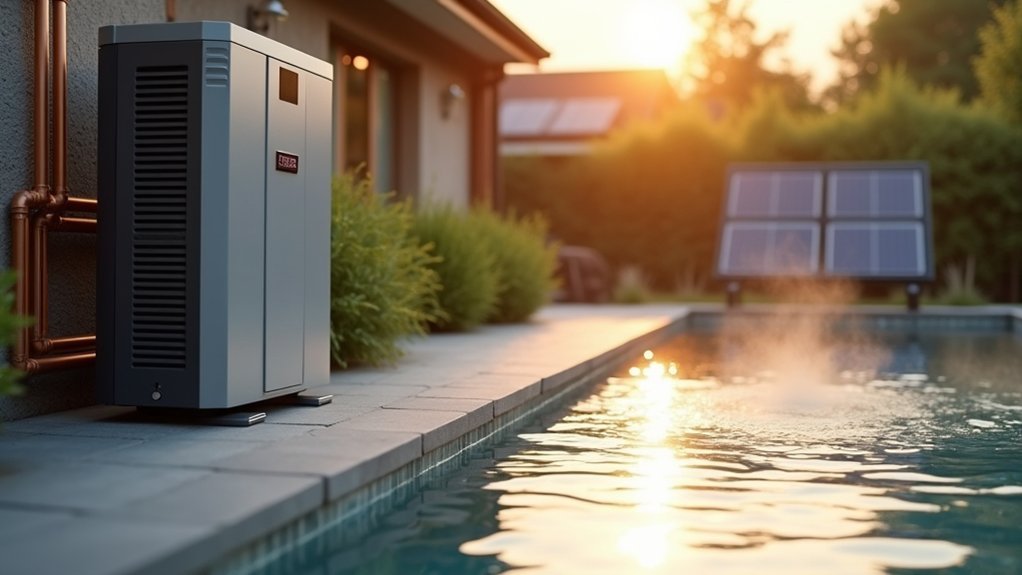
If you want to heat your pool without sky-high energy bills, electric heat pumps offer an excellent alternative to gas heaters. These systems extract heat from the surrounding air and transfer it to your pool water, using electricity only to run the compressor and fan rather than to generate heat directly.
You’ll see the greatest efficiency and cost savings when you live in a climate where temperatures regularly stay above 50°F, making heat pumps ideal for mild to warm regions.
How Heat Pumps Work
Electric heat pumps offer one of the most energy-efficient ways to warm your pool because they don’t generate heat directly—they transfer it. These systems extract warmth from the surrounding air and concentrate it to heat your pool water, using minimal electricity in the process.
Here’s how the cycle works:
- A fan pulls warm outdoor air across an evaporator coil containing refrigerant
- The refrigerant absorbs heat and transforms into a warm gas
- A compressor increases the gas temperature notably
- The hot gas passes through a condenser, transferring heat to your pool water
You’ll find heat pumps perform best when air temperatures stay above 50°F. They typically deliver three to seven times more energy than they consume, making them remarkably cost-effective for year-round heating.
Energy Cost Savings
That impressive efficiency translates directly into lower monthly bills.
When you compare electric heat pumps to gas heaters, you’ll typically see energy costs drop by 50-80%. A gas heater might cost you $300-500 monthly during peak swimming season, while a heat pump often runs just $50-150 for the same period.
Your actual savings depend on local electricity rates, pool size, and how often you swim.
In mild climates, heat pumps perform even better since they extract warmth from ambient air. The warmer your surroundings, the less energy required.
You’ll also benefit from minimal maintenance costs. Heat pumps have fewer mechanical components than gas systems, meaning fewer repairs over their 10-20 year lifespan.
This long-term reliability compounds your savings year after year.
Ideal Climate Conditions
Because heat pumps extract warmth from outdoor air, they work best in regions where temperatures stay above 50°F consistently. You’ll experience peak efficiency in moderate climates where winter temperatures remain mild.
When outdoor air drops below freezing, your heat pump must work harder, reducing its effectiveness and increasing energy consumption.
Consider these factors when evaluating your climate’s suitability:
- Average winter temperatures in your area should remain above 45-50°F for peak performance
- Humidity levels affect efficiency—higher humidity helps heat pumps extract warmth more effectively
- Coastal regions often provide ideal conditions due to moderate, stable temperatures
- Desert climates with cold nights may require a backup heating system
If you live in a temperate zone, you’ll maximize your heat pump’s potential and enjoy consistent pool temperatures throughout the year.
Pool Covers and Blankets to Retain Heat

While heating systems work hard to warm your pool, you’ll lose up to 70% of that heat through evaporation if you don’t cover the water’s surface. Pool covers and blankets act as barriers that trap warmth and dramatically reduce heat loss overnight.
Solar covers, also called bubble covers, float directly on the water and absorb sunlight during the day. They’re affordable and can raise water temperature by 10-15 degrees. Liquid solar covers offer a less visible alternative, creating a thin chemical layer that reduces evaporation.
For maximum insulation, thermal blankets provide the best heat retention. You’ll find automatic cover systems convenient for daily use, though they require a larger investment. Regardless of which option you choose, consistent cover use cuts heating costs notably and extends your swimming season.
Geothermal Heating Systems for Sustainable Warmth
If you’re looking for the most energy-efficient way to heat your pool, geothermal systems offer unmatched long-term savings. These systems tap into the earth’s constant underground temperature to transfer heat directly to your pool water.
While installation costs run higher than traditional heaters, you’ll recoup your investment through dramatically reduced energy bills.
Here’s what makes geothermal heating stand out:
- Operating costs drop by 50-80% compared to gas or electric heaters
- Systems last 20-25 years with minimal maintenance requirements
- They work efficiently in any climate, regardless of air temperature
- Zero on-site emissions make them environmentally responsible
You’ll need adequate yard space for the ground loop installation. Once operational, geothermal systems provide consistent, reliable warmth throughout every season.
Calculating the Right Heater Size for Your Pool
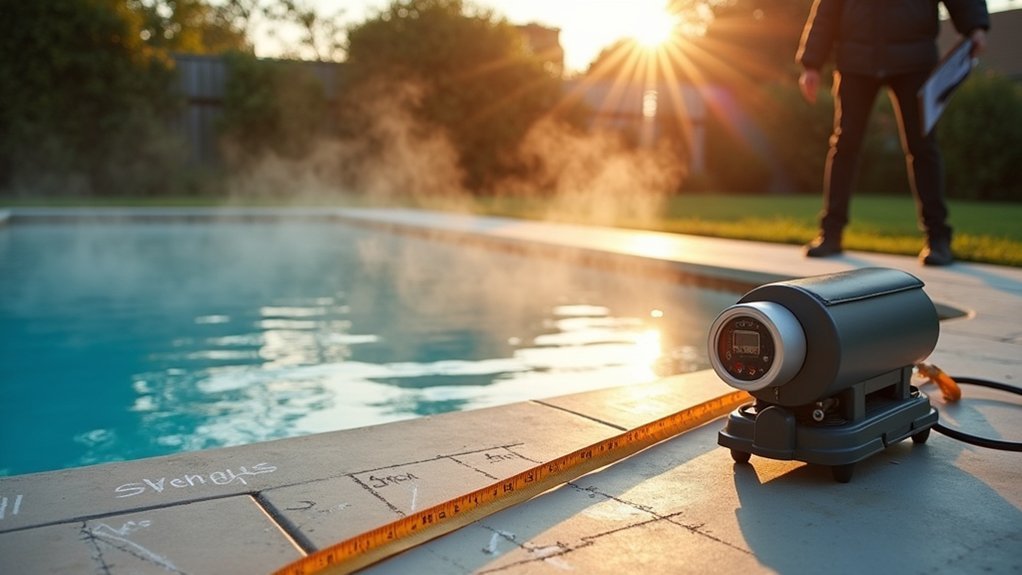
Sizing your pool heater correctly determines whether you’ll enjoy comfortable swims or waste money on inadequate equipment. Calculate your needs by measuring surface area, desired temperature rise, and local climate conditions.
Use this formula: Surface Area × Temperature Rise × 12 = Required BTUs per hour. For pools in windy areas or colder climates, add 25% capacity.
| Pool Size (Gallons) | Recommended BTU Range |
|---|---|
| 10,000 – 15,000 | 100,000 – 200,000 |
| 15,000 – 25,000 | 200,000 – 300,000 |
| 25,000 – 35,000 | 300,000 – 400,000 |
| 35,000 – 50,000 | 400,000 – 500,000 |
Don’t undersize your heater to save upfront costs. An undersized unit runs constantly, increasing energy bills and shortening equipment lifespan. Consult a professional to verify calculations before purchasing.
Installation Costs and Long-Term Operating Expenses
When you’re budgeting for a pool heater, you’ll need to account for several initial setup price factors, including the unit itself, labor, permits, and any necessary gas line or electrical upgrades.
Your monthly energy costs will vary markedly depending on whether you choose gas, electric heat pump, or solar heating options.
Understanding both upfront and ongoing expenses helps you calculate the true cost of ownership and select the most economical solution for your situation.
Initial Setup Price Factors
Setting up a pool heating system involves several upfront costs you’ll need to factor into your budget. The type of heater you choose materially impacts your initial investment, with heat pumps typically costing more than gas heaters but offering better long-term efficiency.
Consider these key price factors when planning your installation:
- Equipment cost – Heat pumps range from $2,000-$5,000, while gas heaters run $1,500-$3,500
- Professional installation labor – Expect $500-$2,000 depending on complexity
- Electrical or gas line modifications – Upgrading your infrastructure adds $300-$1,500
- Permits and inspections – Local requirements may cost $100-$500
Your pool’s size, location, and existing infrastructure directly affect these expenses. You’ll save money by getting multiple quotes from licensed contractors and comparing total installation packages rather than equipment costs alone.
Monthly Energy Cost Comparison
Although initial equipment costs influence your budget, monthly energy expenses ultimately determine the true cost of heating your pool over time. You’ll notice significant variations depending on which heating system you choose and your local utility rates.
| Heating Method | Average Monthly Cost |
|---|---|
| Electric Resistance | $500-$600 |
| Gas Heater | $300-$500 |
| Heat Pump | $100-$200 |
| Solar | $0-$20 |
Heat pumps deliver the best balance between performance and operating costs for most climates. They extract warmth from ambient air, making them roughly three times more efficient than gas heaters. Solar systems cost almost nothing to run but depend heavily on sunshine availability. Gas heaters heat quickly but consume the most fuel. Track your usage patterns to calculate your specific annual expenses accurately.
Combining Multiple Heating Methods for Optimal Results
While a single heating system can effectively warm your pool, combining multiple methods often delivers superior efficiency and cost savings. You’ll maximize performance by pairing complementary technologies that offset each other’s weaknesses.
Consider these effective combinations:
- Solar panels with a heat pump – Solar provides free daytime heating while the heat pump maintains temperature during cloudy periods and nighttime hours.
- Pool cover with any heating system – Reduces heat loss by up to 70%, dramatically cutting your energy costs.
- Gas heater with solar heating – Use solar as your primary source and gas for rapid heating when needed.
- Heat pump with thermal blanket – The blanket retains warmth overnight, reducing how hard your heat pump works each morning.
Maintenance Tips to Keep Your Pool Heater Running Efficiently
Regular maintenance keeps your pool heater operating at peak efficiency and extends its lifespan by years. You should schedule professional inspections annually before each swimming season to catch small problems early.
Clean your heater’s filter monthly during heavy use periods. A clogged filter forces your system to work harder, increasing energy costs and wear. Check the area around your heater for debris, leaves, and obstructions that block airflow.
Monitor your water chemistry weekly. Imbalanced pH levels corrode internal components and reduce heating efficiency. Keep calcium hardness and alkalinity within recommended ranges.
Inspect connections and fittings for leaks regularly. Even small drips waste energy and signal potential failures. Clear the condensate drain on gas heaters to prevent blockages. Replace worn gaskets and seals promptly to maintain peak performance throughout the year.
Smart Thermostats and Automation for Temperature Management
Because modern pool technology has advanced rapidly, you can now control your pool’s temperature from anywhere using a smartphone app. Smart thermostats connect to your home’s Wi-Fi network and let you monitor energy usage, adjust settings, and receive maintenance alerts in real time.
Automation takes convenience further by integrating your heater with other pool equipment. You’ll save money and reduce wear on your system when everything works together seamlessly.
Here’s what smart temperature management offers:
- Schedule heating cycles to match your swimming routine and off-peak energy rates
- Set temperature limits to prevent overheating and excessive energy consumption
- Receive instant notifications when your heater malfunctions or needs servicing
- Track monthly energy costs and optimize settings for maximum efficiency
You’ll enjoy consistent temperatures without constant manual adjustments.
Frequently Asked Questions
Can I Heat My Pool if I Live in a Climate With Freezing Winters?
Yes, you can heat your pool during freezing winters. You’ll need a quality heat pump or gas heater combined with a pool cover to retain warmth. You should also winterize your equipment properly.
How Long Does It Take to Heat a Cold Pool From Scratch?
You’ll typically need 24 to 72 hours to heat a cold pool from scratch. The exact time depends on your pool’s size, starting temperature, heater type, and BTU output. Larger pools require more patience.
Will Heating My Pool Void My Pool Liner Warranty?
Heating your pool typically won’t void your liner warranty, but you should check your specific warranty terms. Most manufacturers allow heating up to 82-86°F. Exceeding recommended temperatures or using incompatible heaters may affect coverage.
Is It Safe to Swim While the Pool Heater Is Running?
Yes, you can safely swim while your pool heater is running. Modern pool heaters are designed for continuous operation during use. However, you should avoid swimming near the water inlet where heated water enters the pool.
Do Heated Pools Require Different Chemical Balancing Than Unheated Pools?
Yes, heated pools do require different chemical balancing. You’ll need to check your water more frequently because warmer temperatures accelerate chlorine breakdown and promote algae growth. You should increase sanitizer levels and monitor pH closely.