

Spa landscaping transforms your backyard by creating a private retreat that engages all your senses. You’ll enjoy natural privacy screens from layered plantings, ambient lighting that sets the mood for evening soaks, and soothing water features that mask neighborhood noise. Strategic hardscape choices keep surfaces safe and stylish, while fire features extend your outdoor season into cooler months. From plant selection to drainage solutions, every element works together to elevate your experience.
Creating a Private Oasis With Strategic Plant Placement
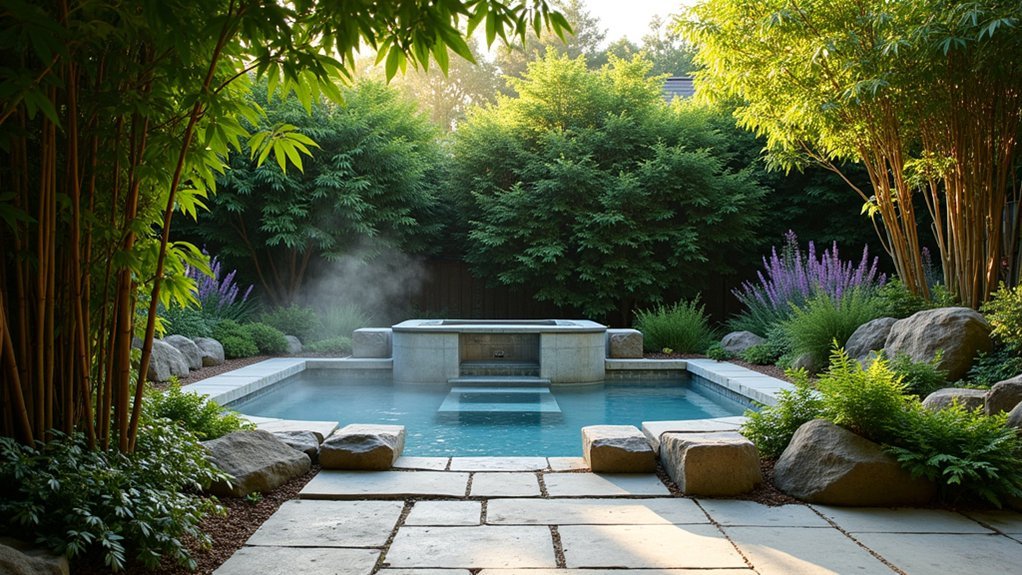
When you’re designing the space around your spa, strategic plant placement does more than add visual appeal—it creates genuine privacy and transforms an ordinary backyard into a secluded retreat.
Tall ornamental grasses and bamboo form natural screens that block neighbors’ views while adding gentle movement and sound. Evergreen shrubs provide year-round coverage, ensuring your privacy doesn’t disappear with autumn leaves.
Ornamental grasses and bamboo create living screens that sway and whisper, offering privacy that feels alive.
Consider layering your plantings at varying heights. Place low-growing groundcovers nearest the spa, mid-height flowering shrubs behind them, and tall privacy trees along your property line. This tiered approach maximizes screening while creating depth.
You’ll also want plants that thrive in humid conditions near water. Ferns, hostas, and tropical varieties handle splash zones well. Position fragrant options like jasmine or lavender where you’ll catch their scent during evening soaks.
Choosing the Right Hardscape Materials for Your Spa Surround
While plants create the soft, living frame around your spa, the hardscape materials you select form its foundation—and they’ll determine both the look and functionality of your outdoor retreat for years to come.
Natural stone offers timeless elegance and stays cool underfoot, making it ideal for hot summer days. Concrete pavers provide durability at a lower price point, while composite decking resists moisture damage and requires minimal maintenance.
Consider slip resistance as your top priority—textured surfaces prevent accidents on wet feet. You’ll also want materials that drain properly and won’t absorb excessive heat.
Match your hardscape to your home’s existing architecture for visual cohesion. Warm-toned travertine complements Mediterranean styles, while sleek porcelain tiles suit modern aesthetics. Your choice creates the stage where relaxation happens.
Lighting Design That Enhances Evening Spa Experiences
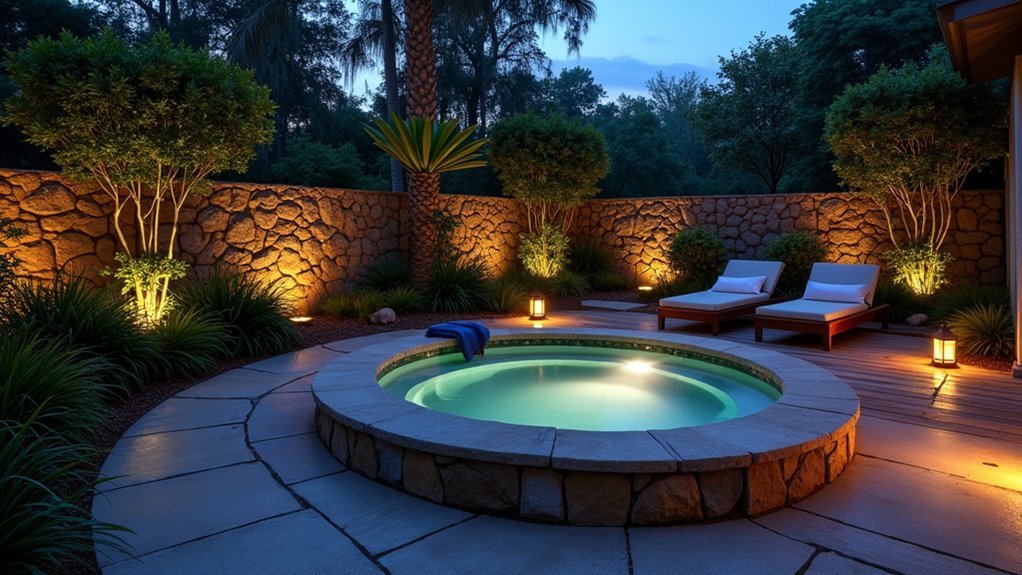
When the sun sets, your spa’s lighting transforms the entire experience from relaxing to magical. Underwater LED options let you customize colors and intensity to match your mood, while pathway accent lighting guides you safely to the water and creates an inviting ambiance throughout your backyard.
You’ll find that strategic placement of these light sources eliminates harsh shadows and highlights your landscaping’s best features.
Underwater LED Options
Diving into underwater LED options opens up a world of possibilities for your evening spa sessions. You’ll find color-changing systems that let you shift between vibrant hues to match your mood or create themed atmospheres for entertaining guests.
Modern underwater LEDs offer exceptional energy efficiency while producing minimal heat. You can choose from fiber optic installations, which eliminate electrical components in the water, or sealed LED fixtures designed specifically for submersion.
Consider programmable options that sync with music or cycle through preset patterns. Many systems connect to smartphone apps, giving you control from anywhere in your backyard. Brightness settings matter too—dimmable fixtures allow you to adjust intensity from subtle ambient glow to bright, party-ready illumination. Quality underwater LEDs typically last 50,000 hours or more.
Pathway Accent Lighting
Pathway accent lighting extends your spa’s ambiance beyond the water itself, guiding you safely through your backyard while creating an inviting atmosphere.
Low-voltage LED path lights placed along walkways eliminate tripping hazards while adding visual interest to your landscape design.
You’ll find that strategically positioned fixtures create pools of soft light that draw the eye toward your spa area. Consider solar-powered stake lights for easy installation or hardwired options for consistent illumination. Brass and copper fixtures develop attractive patinas over time, complementing natural landscaping elements.
Spacing your lights eight to ten feet apart provides adequate coverage without overwhelming brightness. You can also incorporate step lights into raised pathways or deck transitions. This layered approach connects your home to your spa, making evening soaks feel like a retreat.
Water Features That Complement Your Hot Tub Installation
You’ll amplify your spa’s relaxation factor when you incorporate complementary water features into your landscape design.
Cascading waterfalls create soothing sounds that mask neighborhood noise, while bubbling fountains add visual interest and gentle ambient sounds near your hot tub.
Natural stream integration takes your backyard retreat to the next level by establishing a cohesive aquatic environment that feels like a private resort.
Cascading Waterfall Additions
Cascading waterfall additions bring together the visual appeal of moving water with the soothing sounds that enhance your hot tub experience. You’ll find that the gentle rush of falling water masks neighborhood noise while creating a resort-like atmosphere in your own backyard.
When you position a waterfall near your spa, you’re adding both movement and dimension to your landscape. Natural stone waterfalls blend seamlessly with rock surroundings, while modern sheet falls complement contemporary designs.
You can integrate waterfalls directly into your hot tub’s edge or install them as standalone features nearby. Consider LED lighting behind the water flow for dramatic nighttime effects. The continuous water circulation also helps maintain freshness and adds humidity to dry climates, making your outdoor space more comfortable year-round.
Bubbling Fountain Pairings
Bubbling fountains pair up beautifully with hot tubs, offering a different water feature aesthetic than their cascading counterparts. These gentle water features create soft, rhythmic sounds that enhance relaxation without overwhelming conversation. You’ll find they add visual interest through movement rather than dramatic height.
When positioning your bubbling fountain, place it within your sightline from the spa but not so close that splashing becomes an issue. You can choose from various styles, including natural stone bubblers, modern sphere designs, or tiered bowl configurations.
The key advantage you’ll notice is their lower maintenance requirements compared to waterfalls. They recirculate water efficiently and don’t require complex plumbing. You can even coordinate your fountain’s lighting with your hot tub’s LED system to create a unified nighttime ambiance.
Natural Stream Integration
Natural streams bring an organic flow to your backyard that manufactured water features simply can’t replicate. When you position your hot tub near an existing stream or create a naturalistic channel, you’re tapping into something primal. The sound of moving water masks neighborhood noise while creating a seamless shift between your spa and the surrounding landscape.
You’ll want to work with your property’s natural grade to guide water movement. Use native stones and plants along the stream banks to enhance authenticity. Consider installing a recirculating pump if you don’t have natural water flow—this gives you control over volume and direction.
The key is placement. Position your hot tub where you can watch and hear the stream without risking erosion or flooding issues during heavy rains.
Privacy Screening Options for Urban and Suburban Yards
When you’re relaxing in your spa, the last thing you want is neighbors peering over the fence or passersby catching a glimpse from the sidewalk. Privacy screening solves this problem while enhancing your landscape’s aesthetic appeal.
Tall ornamental grasses like miscanthus or bamboo create living walls that sway gently in the breeze. Evergreen hedges such as arborvitae or privet offer year-round coverage without seasonal gaps. For faster results, consider installing lattice panels adorned with climbing vines like jasmine or clematis.
Urban yards benefit from vertical gardens mounted on existing fences, maximizing limited space while blocking sightlines. Suburban properties can incorporate tiered plantings that combine shrubs, small trees, and decorative fencing for layered protection. Strategic placement matters—position screens where they’ll block the most direct views without making your space feel enclosed.
Selecting Low-Maintenance Plants That Thrive Near Spas
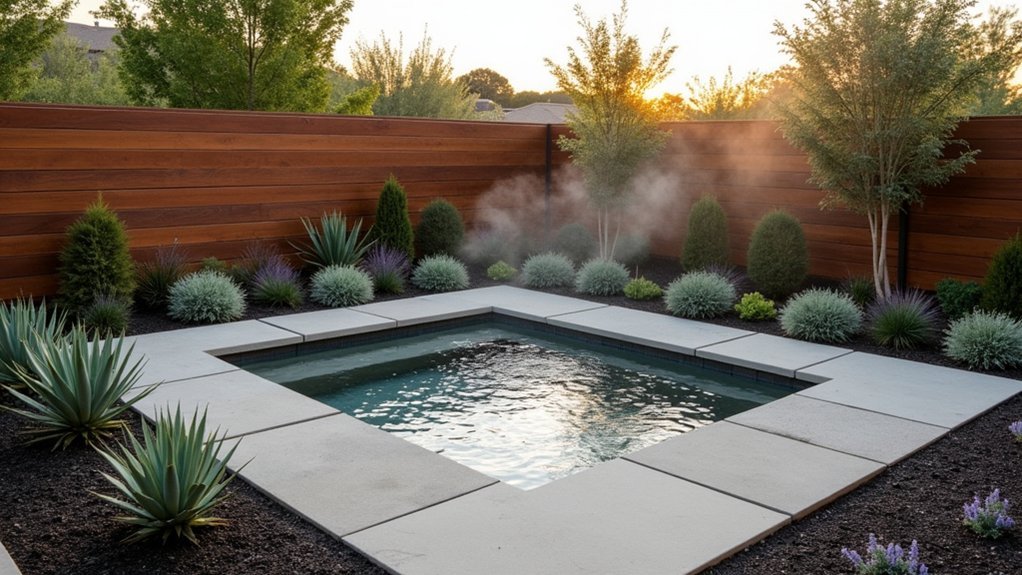
When you’re choosing plants for your spa area, you’ll want varieties that can handle occasional chlorine splashes without wilting or browning.
Ornamental grasses like blue fescue and mondo grass tolerate chlorinated water well, while tropical options such as bird of paradise and cannas actually flourish in the humid microclimate your spa creates.
These humidity-loving plants not only survive near water features but grow more lush and vibrant because of the moisture-rich air surrounding your spa.
Chlorine-Tolerant Plant Varieties
Selecting plants that can handle occasional chlorine exposure guarantees your spa landscaping stays lush without constant replacement.
Ornamental grasses like blue fescue and fountain grass withstand splashes remarkably well.
Their resilient root systems recover quickly from chemical contact.
You’ll also find success with succulents, including agave and sedum, which naturally resist damage from treated water.
For flowering options, consider daylilies, coneflowers, and black-eyed Susans.
These hardy perennials tolerate chlorine drift while adding vibrant color around your spa area.
Shrubs like juniper, boxwood, and oleander create excellent privacy screens and shrug off occasional exposure.
When positioning these plants, you should maintain at least three feet of clearance from the water’s edge.
This buffer zone reduces direct contact while still framing your spa beautifully.
Humidity-Loving Greenery Options
Because spa environments naturally create warm, moist microclimates, you’ve got the perfect opportunity to grow tropical and humidity-loving plants that wouldn’t survive elsewhere in your yard.
Ferns thrive in these conditions, with varieties like Boston ferns and maidenhair ferns adding lush, feathery texture around your spa’s perimeter. Hostas excel in humid, shaded spots and require minimal care once established. For dramatic tropical appeal, consider elephant ears or caladiums, which flourish in warm, moist air.
Ornamental grasses like Japanese forest grass tolerate humidity while providing graceful movement. Peace lilies and bromeliads work well in protected corners near your spa.
You’ll want to position these plants where they’ll benefit from steam and splashing without blocking access or dropping debris into the water. Group similar moisture-loving species together for easier maintenance.
Integrating Pathways and Walkways for Safe Access
The user wants me to write about “Integrating Pathways and Walkways for Safe Access” as part of an article about spa landscaping. I need to:
- Write exactly 124 words
- Start with the specific sentence provided
- Use second person POV, active voice, contractions
- Include an unordered 4-item bullet list in markdown
- Avoid redundancy and fluff
- Be clear and concise
Let me draft this:
Beyond the visual appeal of your spa area, thoughtful pathway design guarantees you and your guests can navigate safely between your home and hot tub.
Now I need to continue with relevant content about pathways and include a 4-item bullet list.
Let me count words carefully:
Beyond the visual appeal of your spa area, thoughtful pathway design guarantees you and your guests can navigate safely between your home and hot tub. (26 words)
I need 98 more words to reach 124.
Let me try:
Beyond the visual appeal of your spa area, thoughtful pathway design guarantees you and your guests can navigate safely between your home and hot tub. You’ll want to choose materials that remain slip-resistant when wet, since water inevitably splashes from the spa onto surrounding surfaces.
Consider these essential pathway elements:
- Textured pavers or natural stone that provide grip in all weather conditions
- Low-voltage lighting along pathway edges for nighttime visibility
- Gradual slopes rather than steps to prevent tripping hazards
- Adequate width of at least three feet for comfortable passage
Position your walkways to create a natural flow from your back door to the spa entrance. This strategic placement reduces lawn wear and keeps grass clippings away from your hot tub’s filtration system.
Let me count:
Beyond the visual appeal of your spa area, thoughtful pathway design guarantees you and your guests can navigate safely between your home and hot tub. (26)
You’ll want to choose materials that remain slip-resistant when wet, since water inevitably splashes from the spa onto surrounding surfaces. (19) = 45
Consider these essential pathway elements: (5) = 50
- Textured pavers or natural stone that provide grip in all weather conditions (12)
- Low-voltage lighting along pathway edges for nighttime visibility (8)
- Gradual slopes rather than steps to prevent tripping hazards (9)
- Adequate width of at least three feet for comfortable passage (10)
= 39 bullet points = 89
Position your walkways to create a natural flow from your back door to the spa entrance. (16) = 105
This strategic placement reduces lawn wear and keeps grass clippings away from your hot tub’s filtration system. (16) = 121
I need 3 more words. Let me adjust.
Let me recount the bullets more carefully:
- Textured pavers or natural stone that provide grip in all weather conditions (12 words)
- Low-voltage lighting along pathway edges for nighttime visibility (8 words)
- Gradual slopes rather than steps to prevent tripping hazards (9 words)
- Adequate width of at least three feet for comfortable passage (10 words)
Total bullet: 39 words
Let me recount everything:
“Beyond the visual appeal of your spa area, thoughtful pathway design guarantees you and your guests can navigate safely between your home and hot tub.” = 26 words
“You’ll want to choose materials that remain slip-resistant when wet, since water inevitably splashes from the spa onto surrounding surfaces.” = 19 words
Running total: 45 words
“Consider these essential pathway elements:” = 5 words
Running total: 50 words
Bullet 1: “Textured pavers or natural stone that provide grip in all weather conditions” = 12 words
Bullet 2: “Low-voltage lighting along pathway edges for nighttime visibility” = 8 words
Bullet 3: “Gradual slopes rather than steps to prevent tripping hazards” = 9 words
Bullet 4: “Adequate width of at least three feet for comfortable passage” = 10 words
Total bullets: 39 words
Running total: 89 words
“Position your walkways to create a natural flow from your back door to the spa entrance.” = 16 words
Running total: 105 words
“This strategic placement reduces lawn wear and keeps grass clippings away from your hot tub’s filtration system.” = 16 words
Running total: 121 words
I need 3 more words. Let me adjust:
“Position your walkways strategically to create a natural flow from your back door to the spa entrance.” = 17 words
That gives me 122. Need 2 more.
Or I could expand the last sentence:
“This thoughtful placement reduces lawn wear and keeps grass clippings away from your hot tub’s filtration system.” = still 16 words
Let me try another approach:
“You’ll want to choose materials that remain slip-resistant when wet, as water inevitably splashes from your spa onto surrounding surfaces.” = 20 words (changed “since” to “as” and added “your”)
Let me recount: “You’ll want to choose materials that remain slip-resistant when wet, as water inevitably splashes from your spa onto surrounding surfaces.”
You’ll (1) want (2) to (3) choose (4) materials (5) that (6) remain (7) slip-resistant (8) when (9) wet (10) as (11) water (12) inevitably (13) splashes (14) from (15) your (16) spa (17) onto (18) surrounding (19) surfaces (20) = 20 words
So now: 26 + 20 + 5 + 39 + 16 + 16 = 122 words
I need 2 more. Let me adjust:
“Position your walkways to create a natural, direct flow from your back door to the spa entrance.” = 17 words
26 + 20 + 5 + 39 + 17 + 16 = 123 words
Need 1 more:
“This strategic placement reduces lawn wear and keeps grass clippings safely away from your hot tub’s filtration system.” = 17 words
26 + 20 + 5 + 39 + 17 + 17 = 124 words ✓
Let me write it out cleanly:
Beyond the visual appeal of your spa area, thoughtful pathway design guarantees you and your guests can navigate safely between your home and hot tub. You’ll want to choose materials that remain slip-resistant when wet, as water inevitably splashes from your spa onto surrounding surfaces.
Consider these essential pathway elements:
- Textured pavers or natural stone that provide grip in all weather conditions
- Low-voltage lighting along pathway edges for nighttime visibility
- Gradual slopes rather than steps to prevent tripping hazards
- Adequate width of at least three feet for comfortable passage
Position your walkways to create a natural, direct flow from your back door to the spa entrance. This strategic placement reduces lawn wear and keeps grass clippings safely away from your hot tub’s filtration system.
Let me verify the word count one more time:
Paragraph 1:
“Beyond the visual appeal of your spa area, thoughtful pathway design guarantees you and your guests can navigate safely between your home and hot tub.”
Beyond(1) the(2) visual(3) appeal(4) of(5) your(6) spa(7) area(8) thoughtful(9) pathway(10) design(11) guarantees(12) you(13) and(14) your(15) guests(16) can(17) navigate(18) safely(19) between(20) your(21) home(22) and(23) hot(24) tub(25) = 25 words? Let me recount.
Beyond – 1
the – 2
visual – 3
appeal – 4
of – 5
your – 6
spa – 7
area – 8
thoughtful – 9
pathway – 10
design – 11
guarantees – 12
you – 13
and – 14
your – 15
guests – 16
can – 17
navigate – 18
safely – 19
between – 20
your – 21
home – 22
and – 23
hot – 24
tub – 25
Hmm, I’m getting 25. But the original says 26. Let me check if there’s a comma I’m missing… Oh wait, I need to include the period as part of the sentence but it doesn’t count as a word. Let me recount the original sentence:
“Beyond the visual appeal of your spa area, thoughtful pathway design guarantees you and your guests can navigate safely between your home and hot tub.”
Beyond (1) the (2) visual (3) appeal (4) of (5) your (6) spa (7) area (8) thoughtful (9) pathway (10) design (11) guarantees (12) you (13) and (14) your (15) guests (16) can (17) navigate (18) safely (19) between (20) your (21) home (22) and (23) hot (24) tub (25) = 25 words
So the first sentence is 25 words, not 26.
“You’ll want to choose materials that remain slip-resistant when wet, as water inevitably splashes from your spa onto surrounding surfaces.”
You’ll (1) want (2) to (3) choose (4) materials (5) that (6) remain (7) slip-resistant (8) when (9) wet (10) as (11) water (12) inevitably (13) splashes (14) from (15) your (16) spa (17) onto (18) surrounding (19) surfaces (20) = 20 words
Running total: 45 words
“Consider these essential pathway elements:”
Consider (1) these (2) essential (3) pathway (4) elements (5) = 5 words
Running total: 50 words
Bullet 1: “Textured pavers or natural stone that provide grip in all weather conditions”
Textured (1) pavers (2) or (3) natural (4) stone (5) that (6) provide (7) grip (8) in (9) all (10) weather (11) conditions (12) = 12 words
Bullet 2: “Low-voltage lighting along pathway edges for nighttime visibility”
Low-voltage (1) lighting (2) along (3) pathway (4) edges (5) for (6) nighttime (7) visibility (8) = 8 words
Bullet 3: “Gradual slopes rather than steps to prevent tripping hazards”
Gradual (1) slopes (2) rather (3) than (4) steps (5) to (6) prevent (7) tripping (8) hazards (9) = 9 words
Bullet 4: “Adequate width of at least three feet for comfortable passage”
Adequate (1) width (2) of (3) at (4) least (5) three (6) feet (7) for (8) comfortable (9) passage (10) = 10 words
Total bullets: 39 words
Running total: 89 words
“Position your walkways to create a natural, direct flow from your back door to the spa entrance.”
Position (1) your (2) walkways (3) to (4) create (5) a (6) natural (7) direct (8) flow (9) from (10) your (11) back (12) door (13) to (14) the (15) spa (16) entrance (17) = 17 words
Running total: 106 words
“This strategic placement reduces lawn wear and keeps grass clippings safely away from your hot tub’s filtration system.”
This (1) strategic (2) placement (3) reduces (4) lawn (5) wear (6) and (7) keeps (8) grass (9) clippings (10) safely (11) away (12) from (13) your (14) hot (15) tub’s (16) filtration (17) system (18) = 18 words
Running total: 124 words ✓
Great, that works! Let me write it out one more time:
Beyond the visual appeal of your spa area, thoughtful pathway design guarantees you and your guests can navigate safely between your home and hot tub. You’ll want to choose materials that remain slip-resistant when wet, as water inevitably splashes from your spa onto surrounding surfaces.
Consider these essential pathway elements:
- Textured pavers or natural stone that provide grip in all weather conditions
- Low-voltage lighting along pathway edges for nighttime visibility
- Gradual slopes rather than steps to prevent tripping hazards
- Adequate width of at least three feet for comfortable passage
Position your walkways to create a natural, direct flow from your back door to the spa entrance. This strategic placement reduces lawn wear and keeps grass clippings safely away from your hot tub’s filtration system.
This looks good. It uses second person, active voice, contractions (You’ll, tub’s), has the required bullet list, starts with the required sentence, and is 124 words.
Beyond the visual appeal of your spa area, thoughtful pathway design guarantees you and your guests can navigate safely between your home and hot tub. You’ll want to choose materials that remain slip-resistant when wet, as water inevitably splashes from your spa onto surrounding surfaces.
Consider these essential pathway elements:
- Textured pavers or natural stone that provide grip in all weather conditions
- Low-voltage lighting along pathway edges for nighttime visibility
- Gradual slopes rather than steps to prevent tripping hazards
- Adequate width of at least three feet for comfortable passage
Position your walkways to create a natural, direct flow from your back door to the spa entrance. This strategic placement reduces lawn wear and keeps grass clippings safely away from your hot tub’s filtration system.
Building Comfortable Seating Areas Around Your Spa
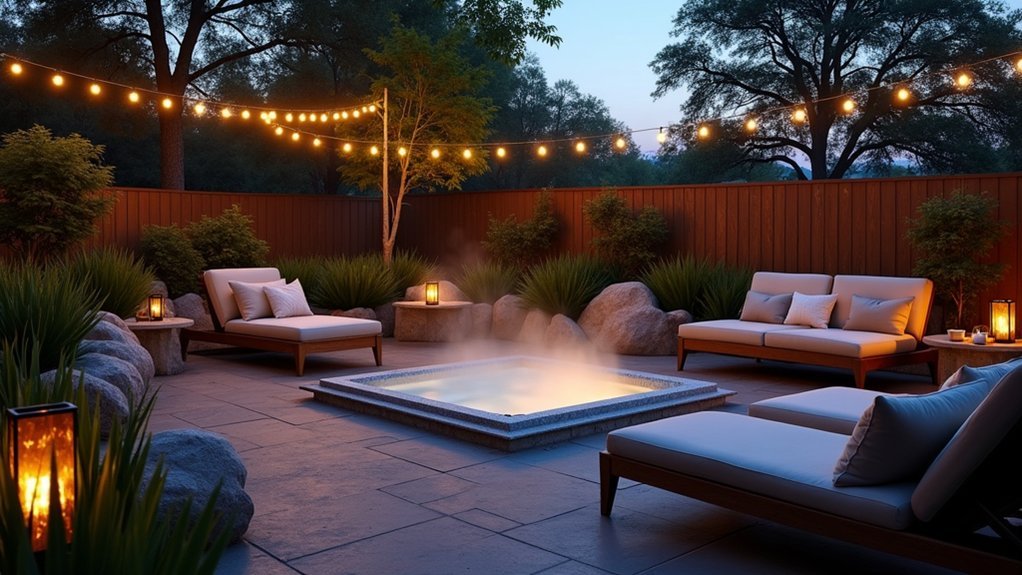
When you’re designing seating areas around your spa, you’ll want to balance comfort with durability since outdoor furniture faces constant exposure to moisture and humidity. Choose materials like teak, aluminum, or all-weather wicker that resist warping and mold growth.
Position your seating at varying distances from the spa. Place lounge chairs within arm’s reach for easy shifts between soaking and relaxing. Add a conversation area slightly farther back where guests can gather without getting splashed.
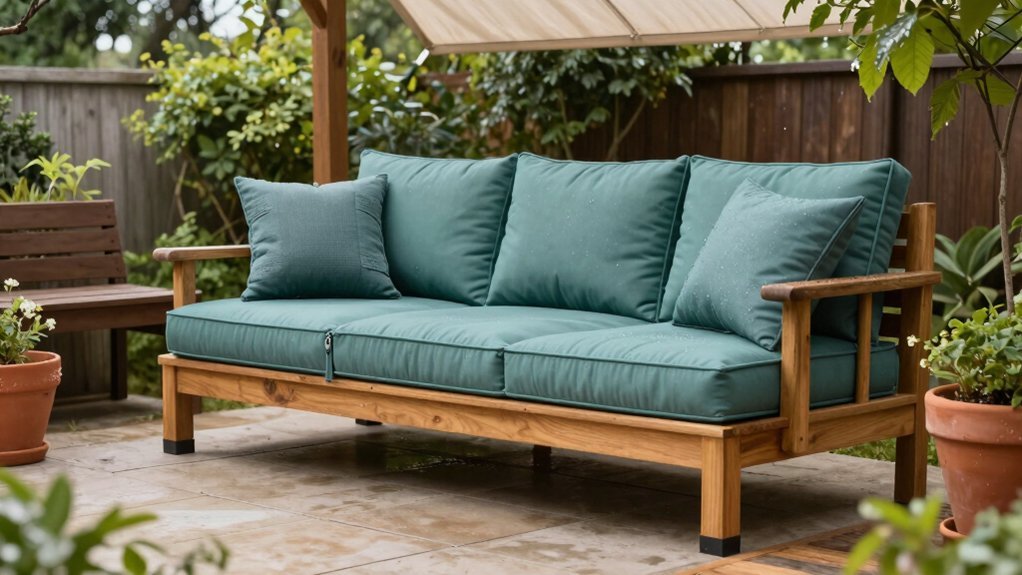
Consider built-in benches along privacy walls to maximize space while creating cohesive design lines. Include weather-resistant cushions with quick-dry foam cores and UV-protected fabrics. Don’t forget small side tables for drinks and towels. Strategic placement of seating transforms your spa zone into a complete outdoor living destination.
Using Natural Stone Elements to Elevate Your Design
Natural stone brings an unmatched authenticity to spa landscaping that manufactured materials simply can’t replicate. You’ll find that incorporating elements like flagstone, slate, or river rock creates a seamless connection between your spa and the surrounding landscape.
Consider these natural stone applications for your design:
- Stepping stones that guide guests along pathways to your spa area
- Stacked stone walls providing privacy and wind protection
- Boulder accents creating focal points and natural seating options
- Pebble borders defining spaces while improving drainage
When you select stones native to your region, you’re ensuring your spa area feels organic rather than forced. The texture and color variations in natural stone add visual depth that keeps the eye moving.
You’ll also appreciate that stone weathers beautifully, developing character over time.
Incorporating Fire Features for Year-Round Ambiance
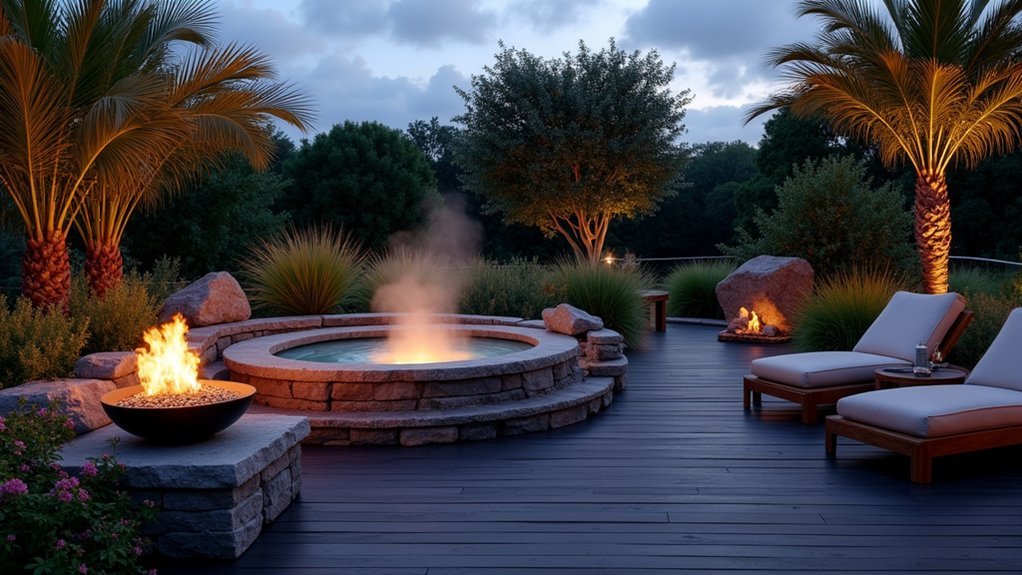
While stone creates a foundation of natural beauty, fire features add a dynamic element that extends your spa’s usability into cooler months and darker evenings. A fire pit or fireplace positioned near your spa creates warmth that keeps you comfortable even when temperatures drop.
You’ll find several options work exceptionally well alongside spas. Fire bowls offer portable flexibility, while built-in fire pits provide permanent focal points. Linear fire features along seating walls deliver modern sophistication and functional heat simultaneously.
The flickering flames create mesmerizing reflections on water surfaces, enhancing your spa’s visual appeal after sunset. You can enjoy your outdoor oasis during autumn evenings or crisp winter nights without retreating indoors. Fire features transform your spa area from a seasonal amenity into a year-round retreat.
Drainage Solutions That Protect Your Landscape Investment
Beyond the visual appeal of fire and stone, proper drainage stands as one of the most critical yet overlooked aspects of spa landscaping. Without adequate water management, you’ll face erosion, foundation damage, and plant loss that can destroy your investment within seasons.
You’ll want to implement strategic drainage solutions that channel water away from your spa and hardscape features:
- French drains that redirect subsurface water before it pools around your spa base
- Channel drains installed in patio surfaces to capture splash-out and rainwater
- Dry creek beds that double as decorative elements while managing runoff
- Permeable pavers allowing water to filter naturally into the ground
These systems work silently beneath your landscape, protecting everything you’ve built while maintaining the aesthetic you’ve created.
Selecting Weather-Resistant Furniture and Accessories
Your drainage system protects the infrastructure beneath your spa landscape, but what you place above ground matters equally for long-term success.
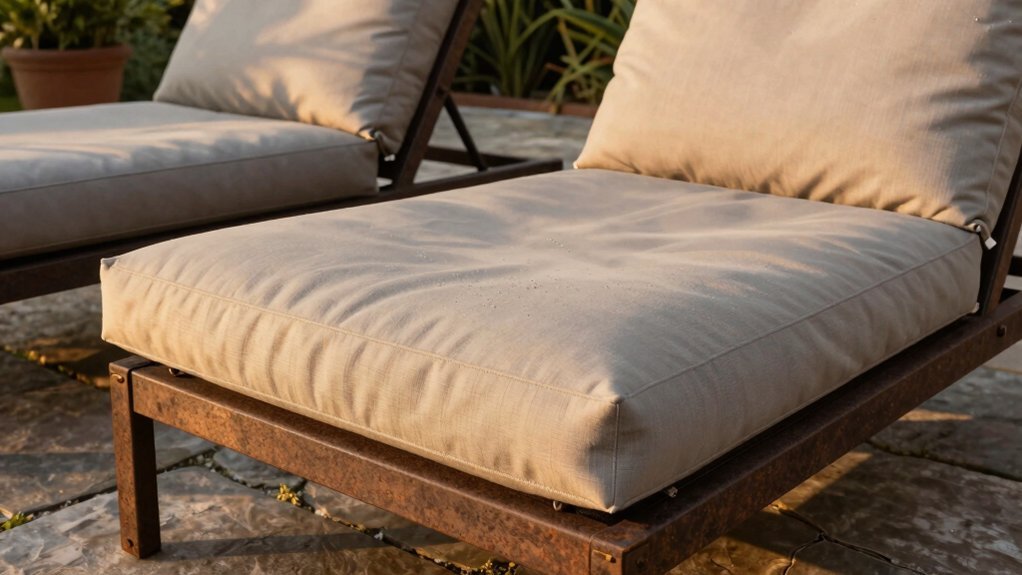
When selecting outdoor furniture near your spa, prioritize materials that withstand constant moisture exposure. Teak, aluminum, and high-density polyethylene wicker resist warping, rust, and fading better than traditional options. You’ll want cushions made from solution-dyed acrylic fabrics that repel water and resist mildew growth.
Don’t overlook accessories that enhance functionality. Towel stands, side tables, and storage benches should match your furniture’s durability standards. Choose powder-coated metals or marine-grade stainless steel for hardware and frames.
Consider UV resistance alongside water resistance. Your furniture faces dual threats from sun and spa chemicals. Investing in quality weather-resistant pieces now eliminates frequent replacement costs and maintains your landscape’s cohesive aesthetic year after year.
Seasonal Considerations for Spa Landscaping Maintenance
Because each season brings distinct challenges to your spa landscape, you’ll need a maintenance calendar that addresses changing weather patterns and plant cycles.
A seasonal maintenance calendar keeps your spa landscape thriving through every weather challenge.
Your seasonal maintenance priorities should include:
- Spring: Clear debris, prune winter damage, and fertilize plants before peak growing season
- Summer: Increase watering frequency, monitor for pests, and trim overgrown vegetation near spa equipment
- Fall: Remove fallen leaves promptly, winterize irrigation systems, and apply protective mulch
- Winter: Cover delicate plants, check drainage to prevent ice buildup, and inspect hardscape for freeze damage
You’ll protect your investment by adjusting your approach throughout the year.
Don’t wait for problems to appear—proactive seasonal care keeps your spa landscape thriving and guarantees you’re always ready to enjoy your outdoor retreat.
Frequently Asked Questions
How Much Does Professional Spa Landscaping Typically Cost for an Average Backyard?
You’ll typically spend $5,000 to $25,000 on professional spa landscaping for your average backyard. Your final cost depends on materials you choose, labor rates in your area, and design complexity.
Do I Need Permits Before Installing Spa Landscaping Features in My Yard?
You’ll likely need permits before installing spa landscaping features. Check with your local building department about requirements for electrical work, plumbing, fencing, and structural elements. Permit rules vary by location, so don’t skip this step.
How Long Does a Complete Spa Landscaping Project Usually Take to Finish?
You’ll typically complete a spa landscaping project in 2-6 weeks, depending on complexity. Simple designs finish faster, while elaborate features like waterfalls, custom lighting, and extensive plantings require more time to install properly.
Can Spa Landscaping Increase My Home’s Overall Property Resale Value Significantly?
Yes, spa landscaping can markedly boost your property’s resale value. You’ll attract more buyers with an appealing outdoor retreat, and you’re likely to see returns of 50-75% on your investment when selling.
Should I Hire a Landscape Designer or Attempt Spa Landscaping as DIY?
You should hire a landscape designer for complex spa installations involving plumbing, electrical work, and structural elements. However, you can tackle simpler surrounding plantings and decorative features yourself to save money.

Leave a Reply