
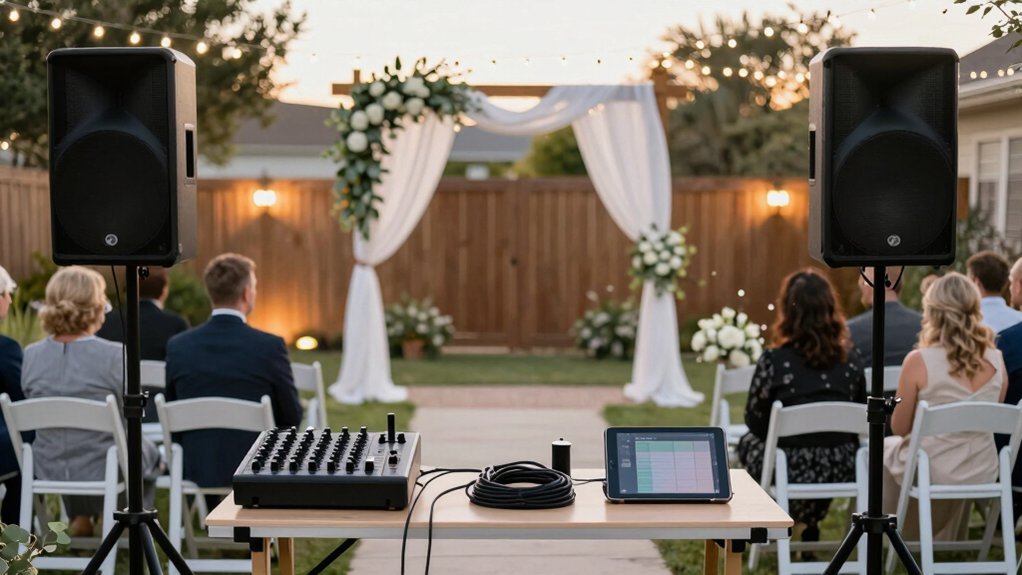
For a backyard wedding sound system rental, you’ll need weather-resistant speakers elevated on stands, wireless microphones for vows, and proper power planning. Choose multiple smaller speakers over one large unit for even coverage, and consider battery-powered options if outlets are limited. Test your setup during the same time of day as your event, and secure all cables with ramps to prevent tripping. The right audio equipment ensures every guest hears your special moments clearly.
Assessing Your Backyard’s Sound Requirements
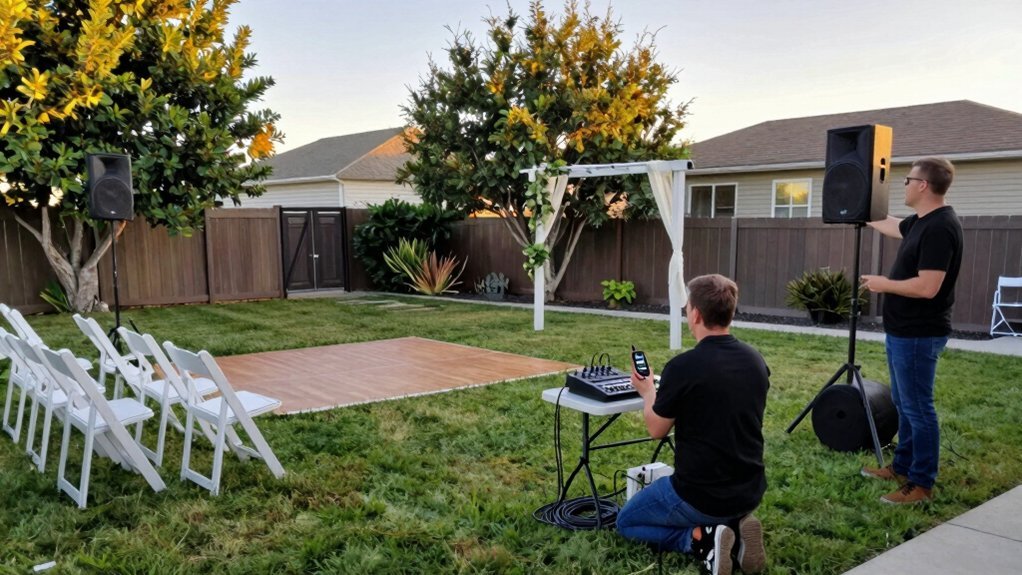
How well your backyard wedding sounds can make or break the experience for you and your guests.
Your backyard wedding soundtrack deserves the same attention as your floral arrangements and menu selection.
Start by evaluating your yard’s size and shape to determine how many speakers you’ll need for consistent coverage throughout your celebration space.
Check your power situation early—locate accessible outlets or plan for battery-powered alternatives. If using extension cords, secure them with cable ramps to prevent tripping hazards.
Don’t overlook environmental factors like wind, which can carry sound away, or open spaces that might require higher volume levels. Consider your neighbors when planning sound projection.
Treat ceremony and reception areas as separate zones, ensuring wireless microphones for your officiant and toasts operate on clear, non-interfering channels. Factor in weather protection and appropriate stands for your yard’s surface.
Key Equipment Components for Outdoor Ceremonies
You’ll need wireless microphones with a compact mixer to ensure vows are heard clearly while managing feedback in open spaces. Position your speakers at ear level, angling them toward guests and utilizing multiple smaller units for even sound distribution across your backyard venue. Battery-powered equipment like the GPSS-650 will eliminate unsightly extension cords and provide reliable performance throughout your ceremony.
Wireless Mic Essentials
When capturing every precious word of your backyard ceremony matters, wireless microphones become the unsung heroes of your wedding sound system. For outdoor settings, invest in wireless lavalier mics that keep your officiant’s hands free while minimizing movement noise.
- Never risk missing “I do” moments—secure a second lapel mic for your partner or co-officiant
- Create toast-ready celebrations with a wireless handheld that passes easily between speakers
- Ensure tear-jerking vows remain crystal clear by setting mics to non-overlapping frequencies
- Prevent anxiety-inducing dropouts with fresh batteries and on-site backups
- Plan for 6-8 hours of battery life with replacement batteries and a spare mic ready for unexpected failures
Speaker Placement Strategies
Where you position your speakers can make the difference between a ceremony where every guest hears your vows clearly and one where half your family strains to catch the important moments. Proper speaker setup ensures your heartfelt words reach everyone.
| Placement Tip | Why It Matters |
|---|---|
| Elevate speakers on stands | Prevents sound absorption by guests’ bodies |
| Use multiple smaller speakers | Creates even coverage throughout seating area |
| Position around obstacles | Avoids dead spots caused by trees or structures |
| Keep wires away from paths | Maintains safety and preserves ceremony aesthetics |
Always conduct a sound check from multiple locations before your ceremony. Stand where your officiant will be, then walk to the farthest guest seat to verify speech clarity. Adjust speaker angles and volume accordingly for optimal coverage that reaches every corner of your celebration.
Choosing the Right Speaker Size and Power
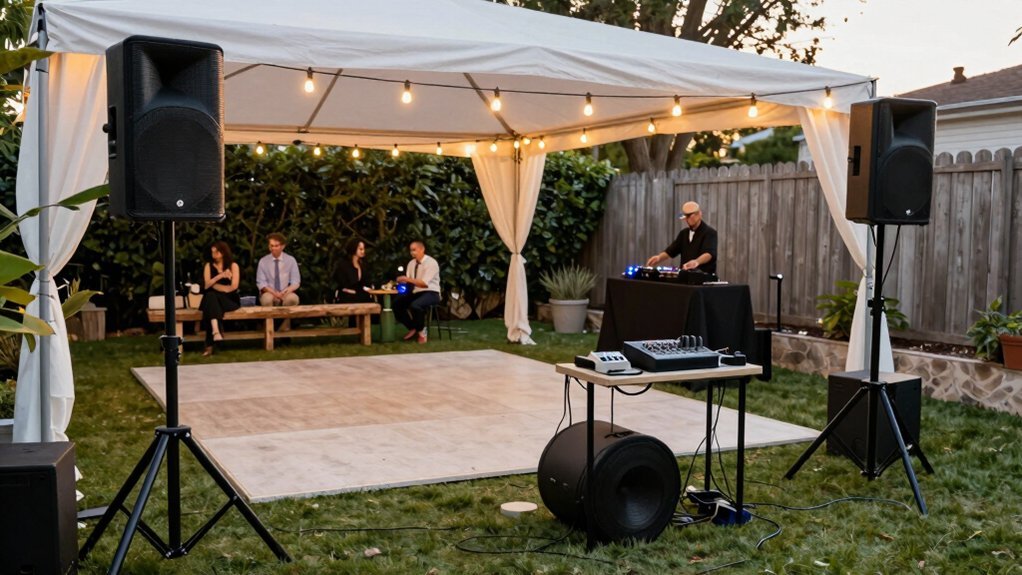
When selecting speakers for your backyard wedding, you’ll need to match speaker quantity to your guest count, with one portable unit often sufficient for under 100 guests and multiple speakers necessary for larger gatherings.
Consider your power source options carefully, as battery-powered models like the GPSS-650 offer flexibility when electrical outlets are limited or when sound needs to travel across different ceremony areas.
Your ideal system balances coverage and portability, typically prioritizing voice clarity with strategically placed speakers rather than raw wattage from a single overwhelming unit.
Speaker Size for Guests
How many speakers will you need for your backyard wedding? For most celebrations with 100-150 guests, two properly positioned 12-15 inch speakers on stands will provide excellent coverage. Position them at ear level for even sound distribution from front to back.
Consider these essential factors when selecting speakers:
- Choose portable powered speakers with 200-600W peak each for ideal coverage without overwhelming electrical requirements
- Position at least one speaker within clear line of sight of the officiant’s microphone
- Use multiple smaller speakers instead of one large unit to reduce muddiness across uneven terrain
- Select battery-powered options like GPSS-650 or AS-15TOGO for areas with limited outlets
- Place speakers on stands at audience ear height to ensure speeches reach everyone clearly
Power Source Considerations
Why do power requirements matter for your backyard wedding sound system? Limited electrical access in outdoor settings can complicate your audio setup, potentially disrupting key moments like vows or first dances.
Battery-powered speakers like the GPSS-650 offer up to 12 hours of operation, eliminating extension cord hazards in your backyard venue. For ceremonies away from outlets, portable 200W–650W units run on internal batteries, ensuring sound reaches every guest without unsightly cabling.
Active speakers with built-in amplifiers reduce your setup complexity by combining components into single units. For flexibility with changing guest counts, consider modular systems like the WPX-2000TOGO that provide scalable, battery-operated coverage.
Always test battery run-time before your event and check battery health to prevent unexpected silence during critical moments. Your peace of mind depends on reliable power planning.
Coverage vs. Portability
Beyond power considerations, the perfect balance between sound coverage and speaker portability can make or break your backyard celebration.
When selecting your system, choose multiple smaller speakers instead of one large unit for even sound distribution across rectangular yards. Aim for 1000–2000W peak modular systems, such as paired 200–500W units or a 1000W line array, which provide sufficient power without excessive bulk.
- Feel the freedom of battery-powered options like GPSS-650 or AS-15TOGO that eliminate anxiety over power failures
- Experience seamless transitions between ceremony and reception with lightweight, handle-equipped speakers you can easily relocate
- Enjoy your special day without unsightly cables snaking across your carefully decorated space
- Create intimate moments where every guest hears your vows clearly, regardless of seating location
- Celebrate confidently knowing your equipment won’t cause embarrassing trips or interruptions
Wireless Microphone Options for Vows and Speeches
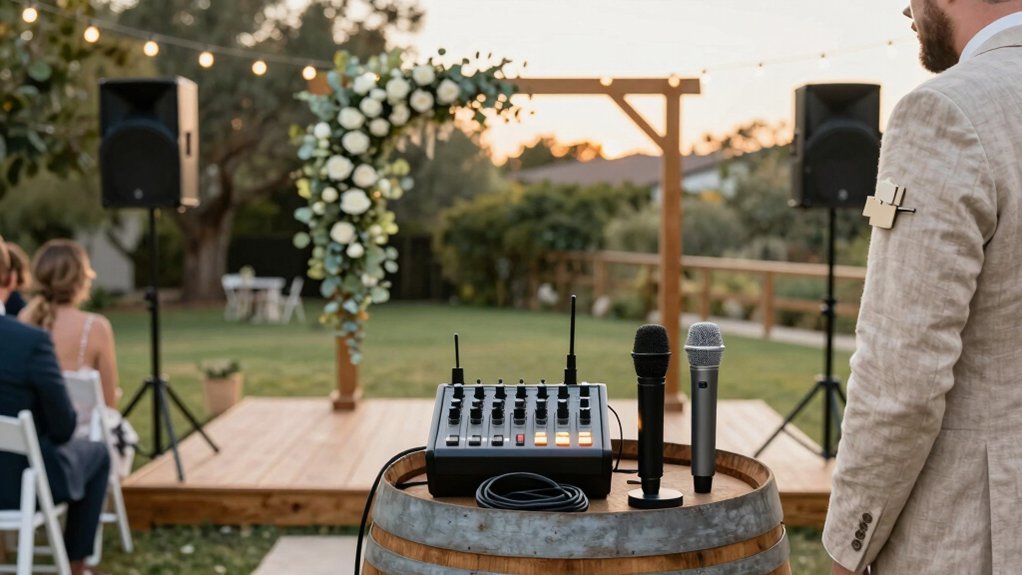
When planning your backyard wedding sound setup, choosing the right microphones for vows and speeches can make the difference between guests straining to hear or fully experiencing your special moments.
For the ceremony, equip your officiant with a wireless lavalier mic clipped discreetly to their clothing. Add a second lapel mic on a different frequency for your partner to ensure clear audio throughout your vows.
For reception toasts, you’ll want a wireless handheld microphone that can be easily passed among speakers. This prevents awkward crowding around a stationary mic and maintains consistent volume as guests share their congratulations.
Ensure all wireless equipment operates on separate RF bands to prevent interference that could interrupt these precious moments you’re working so hard to capture.
Weather Considerations for Outdoor Audio Equipment
Weather can quickly transform your perfect backyard wedding into an audio nightmare if you haven’t properly prepared your sound equipment. Protect your investment and ensure crystal-clear sound by choosing weather-resistant speakers elevated off the ground to prevent moisture damage during sudden rain showers.
- Nothing ruins vows like crackling speakers shorting out from unexpected drizzle
- Feel the confidence of uninterrupted music when positioned away from sprinklers and dew
- Imagine guests’ relief hearing every word despite gusting winds
- Experience the peace of mind knowing your equipment won’t fail when emotions are highest
- Enjoy the freedom of celebrating without constantly checking weather forecasts
Remember to consider wind direction when placing speakers, as it significantly impacts sound travel and clarity for your guests.
Power Sources and Cable Management Solutions
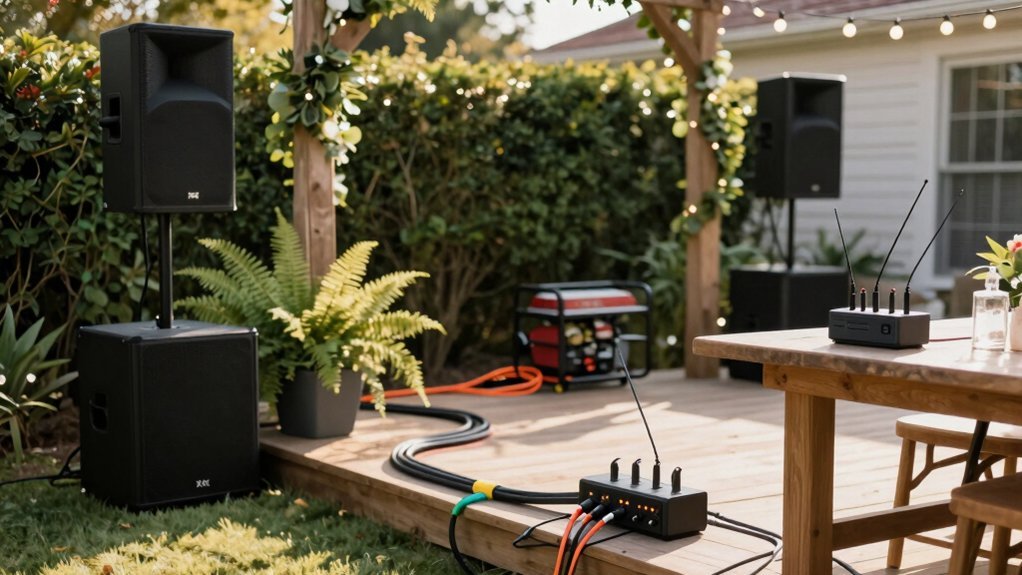
You’ll need to calculate your power requirements by adding up the wattage for all audio equipment and ensuring your outdoor circuits can handle the load.
Managing cables at your backyard wedding requires strategic planning with cable ramps, weatherproof extensions, and proper labeling to prevent tripping hazards while maintaining aesthetics.
Consider battery-powered options or a small generator as backup to avoid the disappointment of unexpected power limitations during your special day.
Outdoor Power Calculations
Planning the electrical needs for your backyard wedding sound system requires careful calculation to avoid mid-ceremony power failures. Start by assessing your total wattage requirements for all audio equipment, lighting, and other powered devices you’ll use throughout the event.
- Create a detailed power map showing every available outlet and its circuit capacity to prevent overloading
- Calculate each device’s wattage draw and add 20% buffer for safety margin
- Test your setup during the same time of day as your wedding to identify potential power fluctuations
- Position generators at least 50 feet from ceremony spaces to minimize noise disruption
- Prepare a backup power solution that can be deployed within 5 minutes if primary sources fail
Battery-powered speakers offer excellent flexibility when outlets are limited, particularly in garden settings far from your home’s electrical system.
Taming Wedding Cabling Chaos
Why do so many picture-perfect wedding ceremonies devolve into tangles of unsightly cords and sudden power outages? The culprit is often poor planning of power sources and cable management.
Start by mapping your venue’s available outlets and creating a dedicated circuit plan. Assign separate outlets for your PA system, DJ equipment, and lighting to prevent overloads. For remote ceremony locations, consider battery-powered speakers like the GPSS-650 or AS-15TOGO to eliminate extension cord hazards.
Implement proper cable management using ramps and gaffer tape to create safe walkways. Hide cables under scrims or stage skirts to maintain aesthetics. Create a color-coded cable layout and detailed floor plan showing exact equipment placement.
Finally, schedule a pre-event power rehearsal to test your setup and identify potential issues before your big day arrives.
Professional vs. DIY Sound System Setup
When deciding between professional and DIY audio for your backyard wedding, the differences extend far beyond simply plugging in a portable speaker. Professional systems deliver even coverage through modular line arrays and battery-powered options like Gemini Sound’s WPX-2000TOGO, ensuring your vows reach every guest clearly.
- You’ll avoid that sinking feeling when guests strain to hear your heartfelt vows
- You won’t face the panic of unexpected feedback just as you say “I do”
- You’ll experience the confidence of knowing every word will carry to the back row
- You’ll eliminate the stress of recruiting friends to manage complex audio setups
- You’ll treasure professional-quality recordings of your most meaningful moments
Professional setups include pre-event testing, trained technicians, and optimized equipment specifically designed for outdoor acoustics and wind challenges.
Music Playback Options and Connectivity
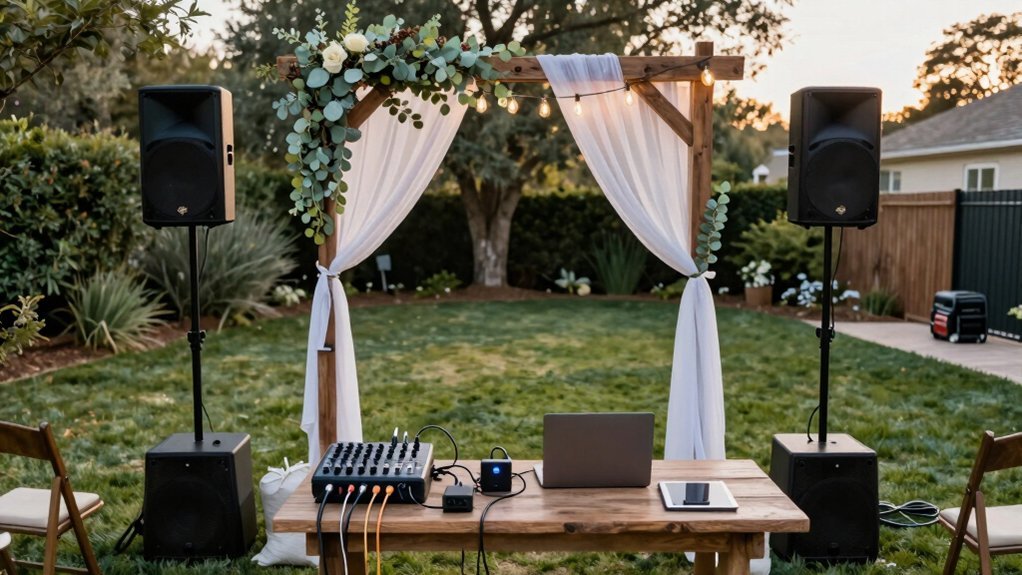
Your sound system’s connectivity options directly impact your celebration’s flow and mood. Consider how you’ll play music throughout your event and what devices you’ll use.
| Playback Option | Benefits | Best For |
|---|---|---|
| Bluetooth | Wireless convenience, familiar | Small venues, simple setups |
| UHF Wireless | Longer range, less interference | Larger yards, professional needs |
| USB MP3 | No external device needed | Pre-planned playlists |
| Battery-powered | No outlets required | Remote locations |
| Mixer setup | Multiple sources, smooth transitions | DJ + announcements |
For optimal results, position speakers strategically to prevent feedback, and always conduct a sound check from the furthest guest seating location. If using wireless options, verify non-overlapping channels to avoid signal conflicts. Battery-powered speakers like GPSS-650 work perfectly for locations without convenient power access.
Cost Comparison: Rental Packages vs. À La Carte
How much should you budget for your backyard wedding sound system? While costs vary by location and needs, rental packages typically offer better value than piecing together equipment individually.
Save hundreds with all-inclusive packages that eliminate unexpected add-on charges
Reduce stress knowing compatible equipment arrives together with proper cables and connections
Gain peace of mind from professional setup and technical support included in most packages
Avoid equipment transport headaches with delivery and pickup services
Preserve your energy for celebrating instead of troubleshooting sound issues
Package deals generally include everything needed for ceremony, cocktail hour, and reception sound—often with a technician who ensures everything runs smoothly. For backyard weddings, these turnkey solutions provide reliable coverage without the hassle of sourcing separate components.
Day-of Setup Timeline and Testing Protocols
While great packages offer value, they won’t deliver results without proper implementation on your wedding day. Plan for a 2-3 hour setup window before guests arrive to install and thoroughly test all equipment.
Begin with a comprehensive soundcheck at both ceremony and reception locations, ensuring even coverage throughout.
Next, conduct a live walk-through with your officiant and speakers to confirm mic placement, adjust headset visibility, and secure cables for both aesthetics and safety.
Follow a structured testing sequence: power up systems, verify wireless frequencies, check battery life, and confirm backup mics are ready.
Finally, create a written protocol with contact information, setup steps, and contingency plans for weather changes or equipment issues.
These protocols ensure your sound system performs flawlessly when it matters most.
Troubleshooting Common Backyard Audio Challenges
When planning your backyard wedding, audio challenges can threaten even the most beautiful ceremony. Outdoor environments introduce variables that indoor venues don’t face, requiring strategic solutions to ensure every word is heard.
- Wind noise can drown out vows – position directional speakers closer to guests rather than trying to overpower nature
- Battery-powered speakers like the GPSS-650 eliminate trip hazards from extension cords while providing mobility
- Wireless microphone interference occurs frequently outdoors – assign non-overlapping frequency bands after conducting an RF scan
- Dead spots develop in unexpected places – perform a clap test across the entire seating area to identify sound clarity issues
- Technology fails at the worst times – prepare a backup plan with spare batteries, an extra wireless receiver, and a wired microphone option
Frequently Asked Questions
How Much Does It Cost to Rent a Sound System for a Wedding?
You’ll typically pay $200-600 for wedding sound system rentals, depending on your venue size, equipment quality, if you’re adding a technician, and whether it’s peak season.
Is It Cheaper to Rent or Buy a Sound System?
Renting’s typically cheaper for your one-time wedding. You’ll avoid the upfront investment, maintenance costs, and storage hassles while getting professional-grade equipment that you won’t need to upgrade later.
How Much Does It Cost to Hire a Sound System?
You’ll typically pay $250-$600 for a basic wedding sound system rental. Costs increase with added speakers, microphones, on-site technicians, or peak-season Saturday bookings.
What Sound System Do You Need for a Wedding?
You’ll need a powered speaker system with built-in mixer, wireless lapel mic for the officiant, handheld mic for toasts, and speaker stands. Battery-powered options work best for outdoor settings.



Leave a Reply