
The best BBQ brush depends on your priorities. Traditional wire bristle brushes offer superior cleaning power but pose safety risks from shed bristles. For safer alternatives, consider bristle-free designs with scrapers, nylon brushes for cool grates, or steam-cleaning options. Match your brush to your grate material—use non-metallic tools on porcelain coatings to prevent damage. A good brush combines an 11-12 inch handle for leverage with a design that suits your specific grill type.
Why Grill Brush Quality Matters for BBQ Results
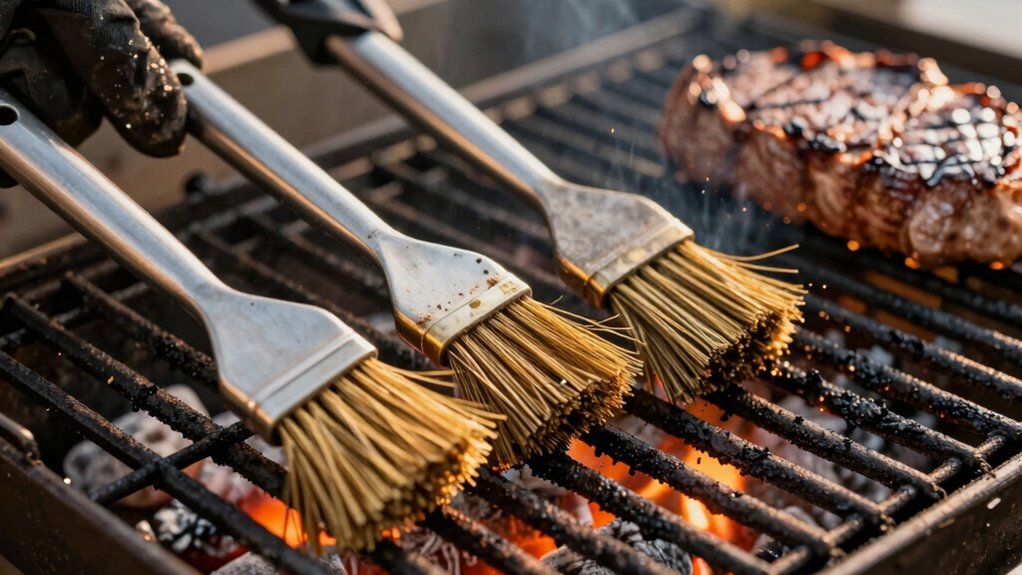
Why do so many BBQ enthusiasts overlook their grill brush? You’ll invest in premium meats and high-end grills but might grab the cheapest brush available—a decision that affects both safety and cooking results.
Quality matters significantly when choosing a grill brush. Safer, bristle-free designs dramatically reduce the risk of metal fragments ending up in your food while still effectively cleaning between grates. While bristle-free or nylon options trade some cleaning power for safety, they’re worth considering alongside traditional stainless steel coiled brushes.
The best brushes feature ergonomic handles (11–12 inches) that keep your hands away from heat and provide better leverage for removing stubborn residue. Investing in durable brushes with replaceable heads delivers long-term value by extending lifespan and reducing frequent replacements.
Types of BBQ Grill Brushes: Safety and Performance Compared
The selection of BBQ grill brushes goes well beyond simple cleaning tools—it’s a choice that affects both your safety and grilling performance. When evaluating your options, safety concerns should take priority, particularly regarding bristle shedding.
Bristle-free designs like pad-type brushes offer the safest overall experience, while traditional wire bristle brushes provide stronger cleaning power but come with risks. For those who prefer a middle ground, the Traeger nylon brush combines safety with effectiveness through its long handle and integrated scraper.
Safety first: bristle-free brushes eliminate risks, while wire models offer deeper cleaning. Traeger’s nylon design balances both considerations effectively.
- Bristle-free triple-helix designs prevent dangerous fallout into food
- Steam cleaners work well on cooled surfaces for residue removal
- Stainless steel bristles clean hot surfaces best but may shed
- Short scraper blades with side grooves improve efficiency without compromising safety
Your ideal brush depends on your grill type and personal safety priorities.
Wire Bristle Brushes: Benefits and Risks for Grate Cleaning
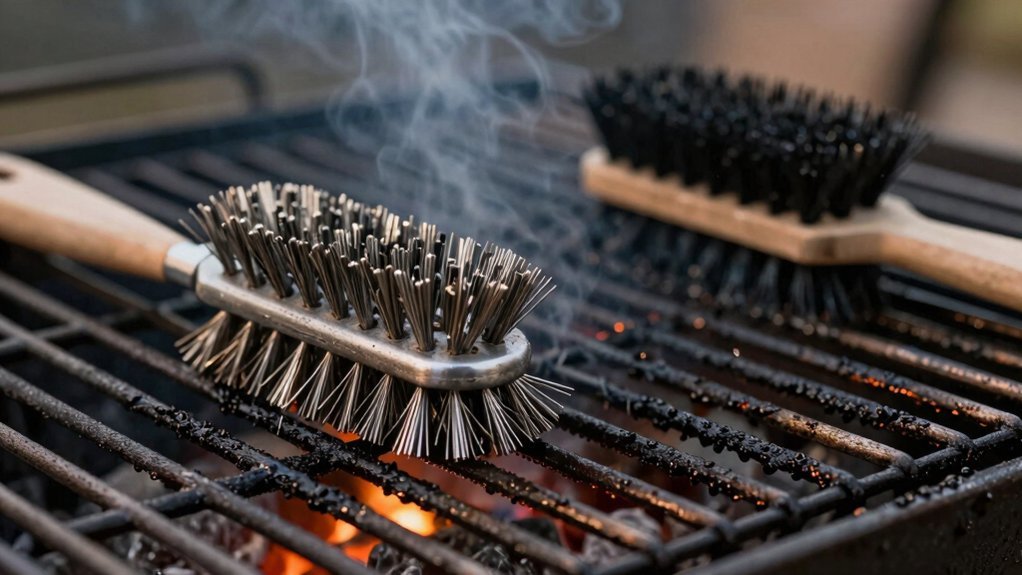
Wire bristle brushes offer unmatched cleaning power on hot grates, removing even the most stubborn residue where bristle-free options often struggle. Despite their effectiveness, these brushes come with significant risks, as bristles can break off and potentially end up in your food, leading to serious health hazards if ingested. You’ll find safer alternatives like nylon-bristled brushes or scraper tools that, while sometimes less powerful on tough grime, eliminate the dangerous possibility of wire contamination.
Effective Cleaning Power
When it comes to raw cleaning power, traditional wire bristle brushes remain hard to beat for tackling stubborn grill residue. Their coiled or woven stainless-steel bristles effectively scrub away burnt-on food, especially when used on hot grates. Testing confirms they often outperform bristle-free alternatives when dealing with tough, baked-on gunk.
The superior cleaning efficiency comes from several design advantages:
- Robust steel bristles provide necessary abrasion without damaging grate surfaces
- Long handles and angled heads offer leverage to apply more pressure
- Durable construction allows sustained scrubbing of problem areas
- Effective performance on high-heat surfaces where other materials might melt
You’ll need to inspect your brush regularly for signs of wear, as effectiveness diminishes when bristles become bent or worn down, requiring more frequent replacement.
Bristle Shedding Dangers
Despite their effective cleaning power, wire bristle brushes carry a well-documented safety risk that can’t be ignored. Loose metal bristles can shed from the brush and adhere to grill grates, potentially ending up in your food. While longtime grillers report few actual ingestion incidents, the risk exists nonetheless.
The severity of this danger depends on the brush type. Traditional coiled or woven stainless steel bristles clean effectively but pose the highest shedding risk. Nylon bristles offer a safer alternative but may melt or deform when used on hot grates.
For complete peace of mind, consider bristle-free alternatives like cleaning pads, steam cloths, or chainmail scrapers. Though they might require more effort for stubborn residue, they eliminate any chance of bristle contamination—a worthwhile trade-off for safety-conscious grillers.
Safer Alternative Options
For grillers seeking peace of mind, several bristle-free alternatives have emerged that eliminate the risk of metal contamination entirely. These options provide effective cleaning without the safety concerns that plague traditional wire brushes.
Pad-type cleaners and bristle-free designs offer safer approaches to tackle baked-on grime, though they may require different techniques than you’re accustomed to. For stubborn residue, you can still use the preheat-and-dunk method with these alternatives – heating your grill to around 400°F before cleaning.
- Coiled stainless steel cleaners provide excellent scrubbing power without loose bristles
- Nylon non-metallic options work well on cooled grates without melting risks
- Pad-type cleaners offer bristle-free safety with moderate cleaning effectiveness
- Bristle-free wooden scrapers conform to your grate pattern over time
You’ll typically spend $15-20 for quality replacement heads that last 4-12 months with regular use.
Nylon and Coiled Brushes: The Safer Alternatives
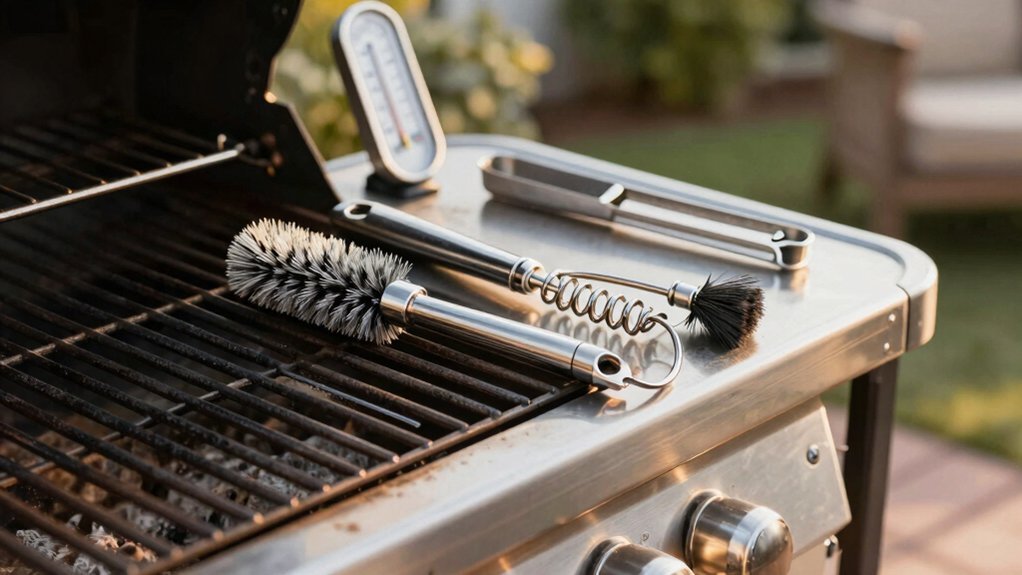
Two growing concerns have pushed many grillers toward safer brush alternatives: the risk of metal bristles breaking off and the damage traditional wire brushes can cause to grate surfaces. Nylon brushes address these worries by eliminating metal bristles entirely.
Traeger’s Nylon Grill Brush, with its built-in metal scraper, offers a good option for coated or nonstick surfaces.
However, this safety comes with tradeoffs. You’ll need to let your grates cool first, as nylon bristles can melt on hot surfaces. Models like the OXO Good Grips struggle with design issues affecting cleaning effectiveness.
While nylon excels with soft food residue, it’s less effective on stubborn, burnt-on grime than coiled stainless steel options.
Choose nylon for safety or coiled brushes for a compromise between safety and cleaning power.
Steam-Cleaning Brushes: The Science Behind the Clean
Steam-cleaning brushes harness the powerful combination of heat and moisture to penetrate stuck-on grill residue without harsh chemicals. When you press the cloth head against hot grates, the water transforms into steam that lifts and loosens food particles while simultaneously sanitizing the surface. You’ll find this method particularly effective for regular maintenance cleaning, as the steam works its way into crevices where traditional brushes might struggle to reach.
How Steam Penetrates Residue
How exactly does a stream of heated water vapor transform stubborn BBQ residue into easily removable gunk? Steam’s effectiveness lies in its temperature and moisture combination. When you press a steam-cleaning brush against your grill surface, the hot vapor (212°F or higher) immediately begins penetrating the crusty residue layer. This thermal shock causes rapid expansion of hardened grease and food particles.
- Steam molecules are smaller than liquid water, allowing them to infiltrate microscopic cracks in residue
- The moisture softens carbonized materials while heat breaks down fat molecules
- Surface tension of debris weakens as steam condenses between grill and residue
- Pressure from steam helps lift particles away from the metal surface
Remember that steam works best on fresh or moderate buildup rather than deeply carbonized layers, which still require mechanical scrubbing for complete removal.
Heat Plus Moisture Efficiency
Why do steam-cleaning brushes work so effectively? It’s the powerful combination of heat and moisture that creates the cleaning magic. When you dunk the heat-safe cloth head in water and press it against hot grates, you’re generating steam that lifts surface residue without needing metal bristles.
This thermal-moisture duo excels at loosening light to moderate buildup, though you’ll find it less effective on stubborn, burnt-on gunk. Tools like the Cuisinart Grill Renew Steam Cleaner offer convenient surface-level cleanup, but don’t expect deep cleaning from steam alone.
For best results, you’ll want to combine steam cleaning with traditional brushing techniques for thoroughly clean grates. The removable, dishwasher-safe steam heads give you a maintenance advantage over standard brushes, keeping your cleaning tools sanitary between uses.
Sanitizing Without Chemicals
The natural sanitizing power of steam offers a chemical-free alternative for health-conscious grillers. Tools like the Cuisinart Grill Renew Steam Cleaner harness water’s transformative properties when it meets heat, creating steam that effectively loosens surface residue without chemical cleaners.
You’ll appreciate how steam cleaning works:
- Water-dampened heads generate steam when pressed against hot grill surfaces
- Dishwasher-safe, removable heads make maintenance simple
- No bristles means zero risk of bristle shedding into your food
- Perfect for quick surface-level cleaning between grilling sessions
While steam cleaners excel at sanitizing and removing surface debris, they’re less effective with stubborn, baked-on gunk or reaching between grates. For best results, you’ll want to rest the tool directly on hot grates, allowing the steam to do its work.
Wooden Scrapers vs. Metal Brushes for Different Grill Types
When choosing between wooden scrapers and metal brushes, your grill type considerably impacts which tool will clean most effectively.
For gas grills, metal brushes excel when used on hot grates, providing superior scrubbing power to remove stubborn residue. However, if you have porcelain-coated grates, opt for non-metallic brushes to prevent damage to the coating.
Wooden scrapers work best on cooled grates and are excellent for removing large burnt pieces, though they’ll struggle with drippings under the grates. They’re ideal for preserving delicate surfaces but lack versatility across all cleaning tasks.
Chainmail or rail-cleaner tools offer a middle ground, providing deep cleaning without bristle shedding risks, but they require more effort to clean grate sides completely compared to traditional metal brushes.
Testing Methodology: How We Evaluated Cleaning Power
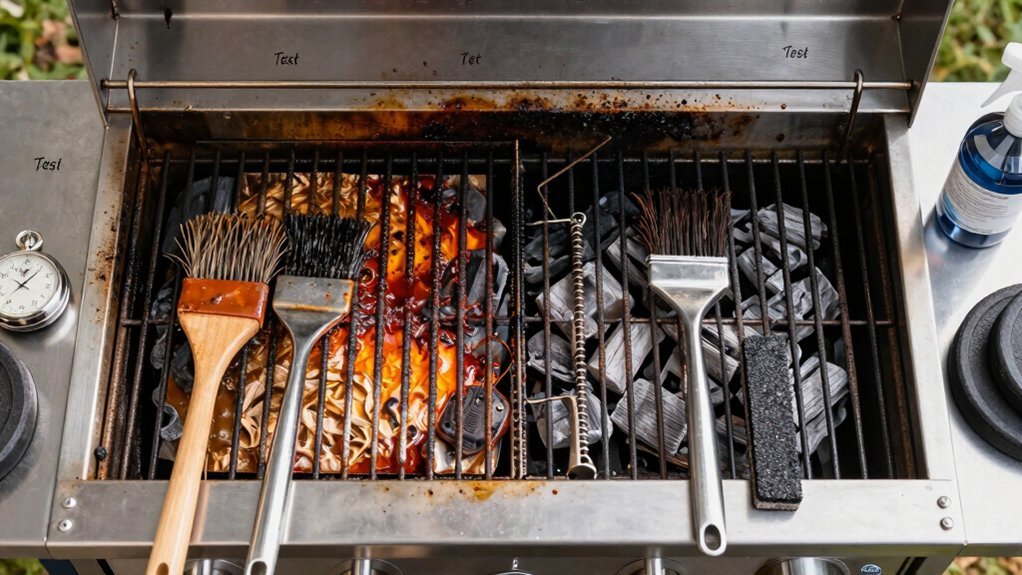
To determine which BBQ brushes genuinely outperform others, we created a rigorous testing environment that mirrors real-world grilling challenges. We simulated typical messes using vegetables, burgers, and sticky barbecue sauce on both hot and cooled grill surfaces to evaluate real cleaning power.
Our comprehensive assessment focused on:
- Cleaning efficiency on burnt-on residue and between grates
- Safety considerations, particularly with wire bristle designs
- Performance differences between stainless steel, nylon, and bristle-free options
- Long-term durability under outdoor conditions
We tested across different grill types, noting that some tools perform better on specific grate designs. The evaluation accounted for practical factors like leverage, head design, and replacement options, recognizing that while bristle-free designs may prioritize safety, traditional bristle brushes often deliver faster cleaning results.
Best Brushes for Specific Grate Materials: Cast Iron, Stainless Steel, Porcelain
Different grill materials demand specialized cleaning approaches if you want optimal results without damaging your cooking surface.
For cast iron grates, choose coiled stainless steel brushes with strong leverage to remove stubborn residue while preserving the essential seasoning. Stainless steel grates work best with bristle-type brushes featuring woven or twisted stainless wires that won’t shed on hot surfaces.
If you’re cleaning porcelain-coated grates, opt for bristle-free or nylon-bristle brushes to prevent scratching. These gentler tools protect the coating while still tackling grime effectively. Non-metallic nylon brushes provide extra safety for porcelain surfaces but may require cooler grates and additional passes.
For an alternative approach with coated grates, try steam-cleaning cloths or pad-style tools that clean without abrasion, extending the life of your delicate cooking surfaces.
Handle Design and Ergonomics: The Overlooked Cleaning Factor
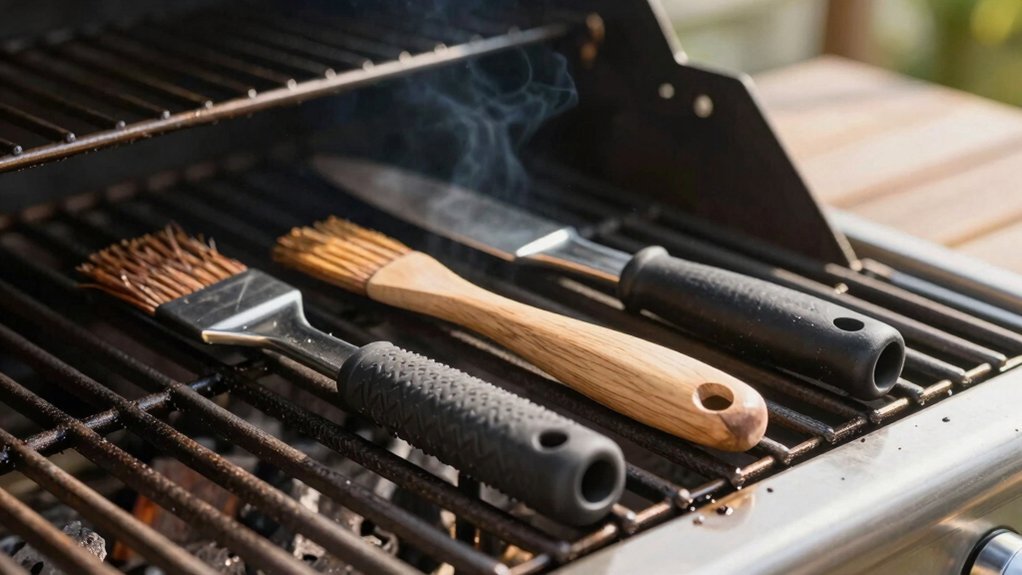
Many grill enthusiasts focus solely on bristle material while overlooking one of the most critical factors in effective grill cleaning: handle design and ergonomics.
The right handle transforms your cleaning experience. Look for brushes with angled heads that improve pressure application and reach between grates. Longer 11-12 inch handles keep your hands safely away from heat while providing better leverage for stubborn residue. You’ll notice a significant difference when using brushes with thoughtfully designed grips.
- Slip-resistant molded grips reduce hand fatigue during longer cleaning sessions
- Secondary knobs near the brush head offer additional leverage for tough spots
- Angled designs allow better pressure application and grate access
- Proper handle length (11-12″) provides safety and mechanical advantage
Your comfort while cleaning directly impacts how thoroughly you’ll maintain your grill.
Heat Resistance: Which Brushes Can Clean Hot Grates Safely
When should you clean your grill grates? Many experts recommend cleaning while the grates are still hot, but not all brushes are designed for this task.
Stainless steel wire brushes effectively clean hot grates but pose the risk of bristles breaking off and ending up in your food. Safer alternatives include pad-type and bristle-free designs, though they may require additional passes for thorough cleaning. For surface-level residue, steam-cleaning cloths or specialized tools like the Cuisinart/Grill Renew work well on hot surfaces without bristle concerns.
Remember that nylon bristle brushes are never suitable for hot grates—they’re designed exclusively for cooled surfaces. Whatever tool you choose, select one with a 10-13 inch heat-resistant handle to keep your hands safely away from the heat.
Maintenance Tips to Extend Your Grill Brush Lifespan
Store your grill brush in a dry, covered location to prevent moisture damage and extend its usable life. Clean your brush after each use by tapping it against a hard surface to remove debris and rinsing it thoroughly under hot water. Before each grilling session, inspect the brush head for loose bristles, wear patterns, or damage that might indicate it’s time for replacement.
Proper Storage Methods
How you store your BBQ brush can dramatically affect its lifespan and performance. After each use, clean your brush thoroughly with soapy water or run it through the dishwasher if it’s dishwasher-safe. Allow it to dry completely before storing to prevent rust and bacteria growth.
Choose a dry, well-ventilated storage location away from moisture and direct sunlight. Hanging your brush is ideal, as it keeps bristles from contacting surfaces and maintains their shape.
- Hang brushes using a hook or nail to prevent ground contact
- Store in a dry area to prevent handle warping and bristle degradation
- Keep away from extreme temperatures to protect plastic components
- Regularly inspect for loose bristles or cracks and replace when necessary
Proper storage not only extends your brush’s life but ensures safer grilling experiences.
Regular Cleaning Routine
Maintaining your BBQ brush properly can triple its useful lifespan while ensuring ideal grill cleaning performance. After each grilling session, pre-heat your grill to about 400°F, then dunk your brush in water before cleaning to create steam that loosens debris.
Use broad, full-stroke passes across the entire grate surface rather than focusing solely on visible buildup. This prevents residue accumulation and extends time between deep cleanings.
Regularly inspect your brush for signs of wear. If you’ve chosen a bristle-free or nylon option, you’ll enjoy better longevity and eliminate metal shedding risks. For maximum efficiency, opt for a long-handled design (11-18 inches) with a sloped head and built-in scrapers or a three-sided configuration that cleans more area per stroke than flat-head models.
Inspect Before Use
Why risk damaging your grill or contaminating food when a quick inspection before use can prevent problems? Before you start scrubbing those grates, take a moment to check your brush for signs of wear that could compromise its performance or safety.
- Examine bristles for bending or looseness, and ensure scraper blades are securely attached
- Check metal parts for rust or corrosion, especially on stainless steel components
- Verify the handle attachment is structurally sound for proper leverage
- Confirm bristle-free designs have intact, securely connected heads
After each cleaning session, dry your brush thoroughly before storing it. This simple step prevents rust formation and maintains the integrity of all components. With these quick inspection habits, you’ll extend your brush’s lifespan and ensure safer, more effective grill cleaning.
Top Recommended Grill Brushes by Cleaning Challenge
When tackling different grilling messes, you’ll need specific tools for optimal results. For everyday cleaning, Weber’s 12-inch 3-sided brush offers exceptional value with its triangle head for detail work, though its shorter handle may expose your hands to heat.
For stubborn, caked-on residue, GRILLART’s 18-inch brush with three rows of stainless steel bristles provides strong leverage, despite its occasionally loose grip. When safety’s your priority, choose Traeger’s nylon brush with its 10.5-inch handle and built-in metal scraper—just don’t use it on hot grates.
For surface-level messes, BBQ Daddy Steam option gives you a safe, steam-clean approach with its 13-inch handle. If you’re willing to invest for long-term safety, the Grill Rescue Brush offers a bristle-free stainless steel design and lifetime guarantee.
Frequently Asked Questions
What Is the Best Thing to Clean Grill Grates With?
For your grill grates, you’ll get the best cleaning with a nylon bristle brush like Traeger’s, which safely scrubs coated surfaces, or a stainless steel coiled brush for hot grates.
Why Do Mexicans Use Onions to Clean Grills?
Many Mexicans use onions because they’re affordable, accessible, and effective. You’ll find their natural acids help break down grease while the moisture loosens stubborn residue without harsh chemicals.
What Is the Best Brush for a Barbecue?
The Traeger BBQ Cleaning Nylon Brush is your best overall choice, offering safety and effectiveness on cool grates with its long handle and metal scraper. You’ll appreciate its thoughtful design.
What’s the Safest Grill Brush to Use?
Bristle-free brushes are your safest option. Choose a triple-helix stainless steel coil brush that won’t shed dangerous wires into food. Nylon-bristle brushes work well too when you’re cleaning cooled grates.