
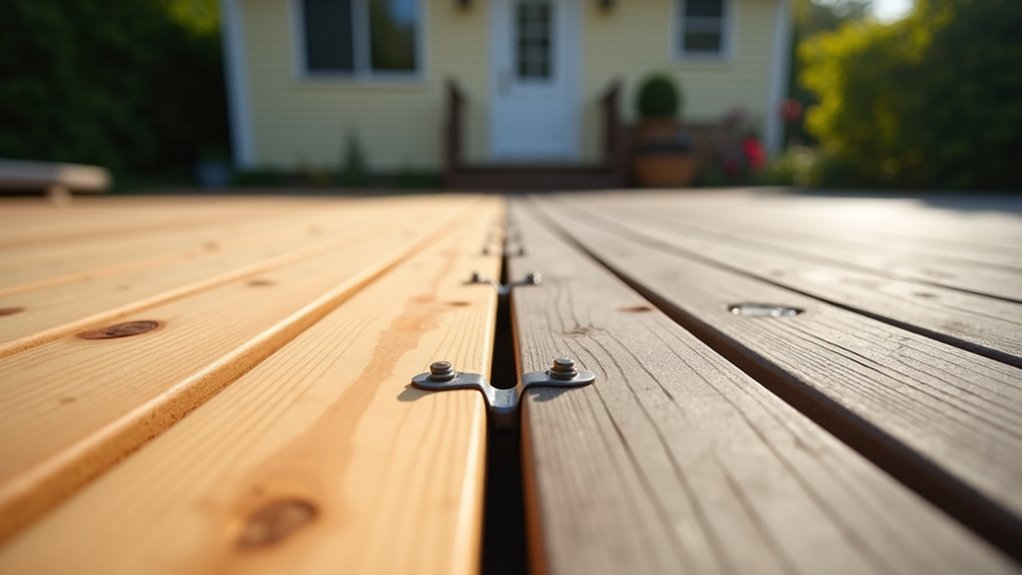
You’ll pay $20–$60 per square foot for composite materials compared to $2–$25 for wood, depending on the grade you choose. However, wood’s lower upfront cost comes with a catch—you’ll spend $200–$500 annually on staining and sealing, while composite maintenance rarely exceeds $100. Over 25 years, a 400-square-foot wood deck typically costs $25,000–$35,000, while composite runs $18,000–$28,000. The breakdown below reveals exactly where your money goes with each option.
Initial Material Costs for Composite Decking

When you’re planning a composite deck project, material costs typically range from $15 to $45 per square foot for the decking boards alone. Entry-level brands like Trex Enhance or Fiberon Good Life fall on the lower end, while premium options like TimberTech Azek or Trex Transcend command higher prices.
Composite decking boards alone cost $15 to $45 per square foot, with premium brands like TimberTech Azek commanding top prices.
You’ll need to factor in hidden fasteners, which add $1 to $3 per square foot. Joist tape, end caps, and fascia boards increase your budget by another $2 to $5 per square foot.
Don’t forget the structural components. Pressure-treated lumber for your frame and joists runs $3 to $8 per square foot.
When you combine all materials, expect to spend $20 to $60 per square foot before installation labor enters the equation.
Initial Material Costs for Wood Decking
Natural wood decking offers a broader price spectrum than composite, ranging from budget-friendly to luxury-tier options. Pressure-treated pine sits at the economical end, costing $2 to $5 per square foot for materials.
Cedar and redwood occupy the mid-range at $6 to $12 per square foot, offering natural rot resistance and attractive grain patterns.
If you’re seeking premium options, tropical hardwoods like ipe, tigerwood, and cumaru run $15 to $25 per square foot. These exotic species deliver exceptional durability and striking aesthetics but require a significant upfront investment.
You’ll also need to budget for additional materials: screws, joist hangers, concrete footings, and sealant or stain. These extras typically add $1 to $3 per square foot to your total material costs, regardless of which wood species you select.
Labor and Installation Expenses Compared

Beyond material costs, labor expenses substantially impact your total deck investment—and this is where composite and wood diverge in unexpected ways.
Labor costs tell a different story than material prices—and the gap between composite and wood might surprise you.
You’ll typically pay $15-$25 per square foot for wood deck installation, while composite runs $20-$35 per square foot. The price difference stems from composite’s hidden fastener systems and specialized cutting requirements.
Key factors affecting your labor costs include:
- Deck complexity: Multi-level designs, curves, and intricate railings increase installation time for both materials
- Fastener systems: Composite’s concealed clips take longer to install than traditional wood screws
- Material weight: Composite boards weigh more, requiring additional handling time
However, composite’s uniformity means fewer boards get rejected on-site. Wood’s natural variations often require sorting and culling, adding unexpected labor hours to your project.
Long-Term Maintenance Cost Analysis
When you’re comparing deck materials, you’ll want to look beyond the initial price tag to understand what you’ll spend on annual upkeep expenses over time.
Wood decks require regular staining, sealing, and potential board replacements, while composite decking needs minimal attention beyond occasional cleaning.
Understanding these refinishing and repair costs alongside replacement timeline differences will reveal the true lifetime investment for each material.
Annual Upkeep Expenses
Although the initial price tag often drives purchasing decisions, annual maintenance costs can dramatically shift the financial equation between composite and wood decking over time. You’ll find that wood decks demand consistent yearly attention, while composite options require minimal intervention.
Annual maintenance expenses typically include:
- Wood decks: $200-$500 yearly for staining, sealing, and repairs
- Composite decks: $50-$100 yearly for basic cleaning supplies
- Power washing: $100-$300 if you hire professionals for either material
When you factor these recurring costs, your wood deck maintenance over 20 years can exceed $4,000-$10,000.
Meanwhile, composite decking keeps you under $2,000 for the same period. You’ll spend more time maintaining wood too—approximately 8-12 hours annually versus 2-4 hours for composite surfaces.
Replacement Timeline Differences
Replacement timelines represent another major factor that separates the true costs of these two decking materials. You’ll typically need to replace a wood deck every 10 to 15 years, depending on your climate and maintenance habits. Composite decking lasts 25 to 30 years before you’ll face replacement costs.
This difference means you could go through two or three wood decks in the same period a single composite deck serves you. When you factor in demolition, disposal, and installation costs for each replacement cycle, wood’s lower initial price becomes less attractive.
You’re effectively paying for multiple projects over your homeownership timeline with wood. Composite’s upfront premium buys you decades without worrying about structural deterioration, rot, or the hassle of coordinating major construction projects around your home.
Refinishing and Repair Costs
Beyond replacement cycles, you’ll encounter ongoing refinishing and repair expenses that differ dramatically between these materials.
Wood decks demand consistent attention to maintain their appearance and structural integrity. You’ll spend $500-$1,500 every 2-3 years on staining, sealing, and minor repairs. Individual board replacement runs $15-$50 per board, plus labor.
Composite decks require minimal refinishing but aren’t maintenance-free. Here’s what you’ll typically spend:
- Cleaning supplies and equipment: $50-$150 annually for specialized composite cleaners
- Board replacement: $75-$200 per board when damage occurs, though it’s less frequent
- Fade touch-ups: Some manufacturers offer color-matching kits for $30-$60
Over a 25-year period, wood refinishing costs total $4,000-$12,500, while composite maintenance stays under $2,000. This difference often offsets composite’s higher upfront investment.
Lifespan and Replacement Frequency
When you’re comparing composite and wood decking, understanding how long each material lasts directly affects your total investment.
Composite decking typically endures 25 to 30 years with minimal upkeep, while pressure-treated wood averages 15 to 20 years and requires consistent maintenance to reach that lifespan.
Your replacement timeline depends heavily on how well you protect and care for your deck throughout its life.
Expected Material Durability
Although initial material costs often dominate homeowner decision-making, a deck’s lifespan dramatically affects your true long-term investment. Composite decking typically lasts 25-30 years with minimal maintenance, while pressure-treated wood averages 15-20 years before requiring replacement.
Your material choice impacts durability in several key ways:
- Composite resists rot, insects, and moisture damage that commonly plague wood decks in humid climates
- Wood requires annual sealing and staining to maintain structural integrity and prevent warping
- Premium hardwoods like ipe can match composite longevity but demand considerably higher upfront costs
When you calculate cost-per-year of ownership, composite often proves more economical despite higher initial pricing. You’ll spend less on repairs, treatments, and eventual replacement. Factor these durability differences into your budget before making your final decision.
Maintenance Impact Costs
Regularly maintaining your deck creates ongoing expenses that markedly shift the cost comparison between composite and wood materials.
Wood decks demand annual staining or sealing, costing $200 to $500 per treatment. You’ll also face periodic board replacements as sections warp, crack, or rot. Over 25 years, these costs typically add $3,000 to $8,000 to your initial investment.
Composite decks require minimal upkeep. You’ll spend money on occasional cleaning supplies and perhaps a pressure washer rental. Annual maintenance costs rarely exceed $50.
When you factor in replacement frequency, the gap widens further. Wood decks last 10 to 15 years before requiring major rebuilds, while composite materials maintain structural integrity for 25 to 30 years. This extended lifespan means you’ll potentially replace a wood deck twice before your composite version needs attention.
Typical Replacement Timelines
Because deck materials deteriorate at vastly different rates, understanding replacement timelines helps you calculate true long-term costs.
Expected Lifespan by Material
- Pressure-treated wood: 10-15 years before structural replacement becomes necessary
- Cedar or redwood: 15-20 years with consistent maintenance
- Composite decking: 25-30 years with minimal upkeep required
You’ll likely replace a wood deck twice before a composite deck needs its first replacement. This frequency dramatically shifts the cost equation over a 30-year period.
Planning for Replacement
When you factor in demolition, disposal fees, and new installation labor, each wood deck replacement costs nearly as much as the original build. Composite’s longer lifespan eliminates these recurring expenses, making the higher upfront investment more financially sound for homeowners planning to stay long-term.
Hidden Costs Most Homeowners Overlook
When you’re budgeting for a new deck, it’s easy to get caught up in the per-square-foot material costs while overlooking expenses that can add hundreds or thousands to your final bill.
Permit fees vary markedly by municipality, ranging from $100 to $500 or more. You’ll also need to factor in site preparation costs if your yard requires grading, tree removal, or old deck demolition. These services alone can add $500 to $2,000.
Before breaking ground, check your local permit fees and assess site prep needs—these costs catch most homeowners off guard.
Don’t forget about hidden fasteners, post caps, and trim pieces—composite decks especially require specialized hardware that adds up quickly. Delivery fees for heavy materials often surprise homeowners, particularly for remote locations.
Finally, consider the cost of stairs, railings, and any electrical work for lighting. These additions can increase your total investment by 20-30%.
Regional Price Variations Across the Country
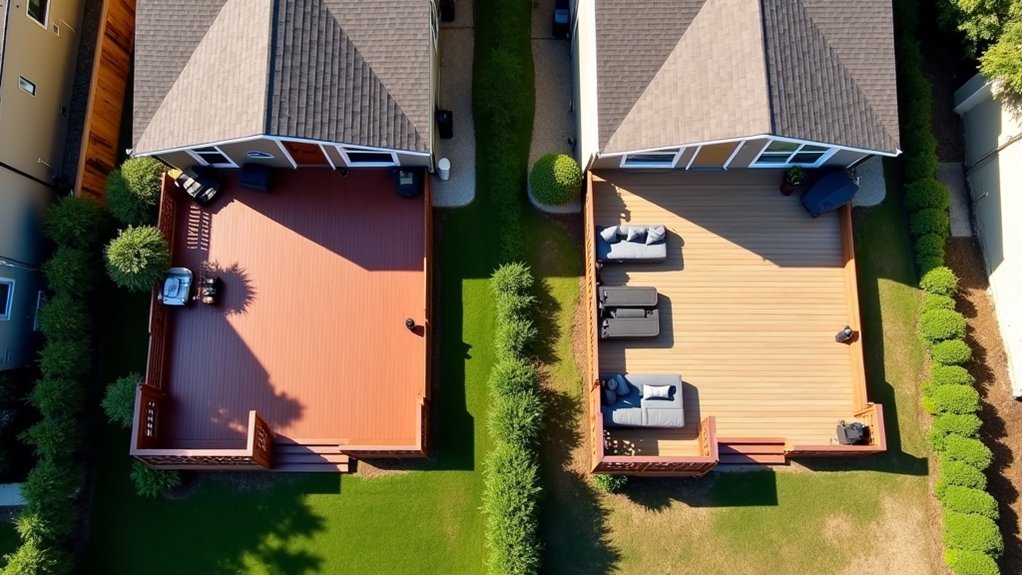
Where you live markedly impacts what you’ll pay for both composite and wood decking materials. You’ll find notable differences when comparing Northeast pricing trends, Southern market costs, and West Coast variations.
Understanding these regional factors helps you budget accurately for your specific location.
Northeast Pricing Trends
Given the Northeast’s harsh winters and shorter building seasons, you’ll typically pay 15-25% more for deck installation compared to national averages.
Labor costs run higher in metropolitan areas like Boston, New York, and Philadelphia, where skilled contractors charge premium rates.
Material costs also spike in this region due to transportation expenses and high demand during the compressed construction season from April through October.
Key Northeast pricing factors:
- Pressure-treated lumber costs $18-26 per square foot installed, while composite runs $35-55 per square foot
- Permit fees in major cities add $500-2,000 to your total project cost
- Winter-rated fasteners and freeze-resistant footings increase material expenses by 10-15%
You’ll save money by booking contractors during late fall or early spring when demand drops considerably.
Southern Market Costs
Southern deck markets offer a stark contrast to Northeast pricing, with homeowners typically saving 20-30% on both materials and labor. You’ll find pressure-treated pine running $2-4 per linear foot in states like Texas, Georgia, and Florida, compared to $4-6 in northern regions.
Labor costs drop markedly too. Southern contractors charge $15-25 per square foot for installation, while their Northeast counterparts command $25-40. This difference stems from lower operating costs, year-round building seasons, and increased contractor availability.
Composite materials show smaller regional gaps since manufacturers set more uniform pricing. However, you’ll still save on installation labor. A 300-square-foot composite deck that costs $12,000 in Boston might run just $8,500 in Atlanta.
Climate factors work in your favor here—milder winters mean faster project completion and fewer weather delays.
West Coast Differences
Although West Coast deck prices rival Northeast figures, the cost drivers differ considerably. You’ll face unique challenges that impact your bottom line when building in California, Oregon, or Washington.
Key West Coast Cost Factors:
- Stringent building codes require fire-resistant materials in wildfire zones, pushing you toward composite options that meet Class A fire ratings
- Higher labor rates in metropolitan areas like San Francisco, Seattle, and Los Angeles add 15-25% to installation costs
- Environmental regulations mandate specific lumber certifications, limiting cheaper wood options
You’ll find redwood and cedar more accessible here since they’re regionally sourced, potentially reducing wood deck material costs by 10-15%. However, composite materials often ship from Midwest manufacturers, adding freight expenses.
Your total project cost typically ranges $45-$85 per square foot installed.
Return on Investment for Resale Value

When you’re weighing deck materials, resale value deserves serious thought alongside upfront costs. According to Remodeling Magazine’s Cost vs. Value Report, wood decks typically recoup 65-75% of their cost at resale, while composite decks recover 60-70%.
However, these numbers don’t tell the whole story. Your composite deck’s condition at sale time will likely be pristine, requiring no last-minute repairs or staining. A neglected wood deck can actually decrease home value if buyers see it as an immediate expense.
Location matters greatly here. In upscale neighborhoods where buyers expect low-maintenance features, composite often commands premium returns. In rustic or historic areas, natural wood may appeal more to potential buyers. You’ll want to weigh your specific market and how long you plan to stay before selling.
Seasonal Pricing and Best Times to Buy
Beyond resale considerations, the timing of your deck purchase can materially impact your total project cost. Material prices and contractor availability fluctuate throughout the year, creating opportunities for significant savings.
Best times to buy deck materials:
- Late fall and winter (November-February): Lumber yards clear inventory, offering discounts of 10-25% on both composite and wood materials
- Early spring (March-April): You’ll beat the summer rush while still finding competitive pricing before demand peaks
- Holiday sales (Memorial Day, Labor Day): Home improvement stores often discount decking materials by 15-20%
Contractors typically offer lower labor rates during their slow season from November through February.
Budget-Friendly Alternatives Within Each Category
If premium decking materials stretch your budget too thin, you’ll find cost-effective options within both the composite and wood categories that don’t sacrifice durability or appearance.
For composite decking, consider capped polymer boards from budget-friendly brands like Trex Enhance or TimberTech Edge. These products cost 30-40% less than premium lines while still offering fade resistance and low maintenance requirements.
In the wood category, pressure-treated pine remains the most affordable choice at $2-5 per square foot. Cedar’s a mid-range option that naturally resists rot without chemical treatment. You can also save by selecting lower grades of premium woods—#2 grade cedar performs nearly identically to #1 grade at reduced cost.
Another strategy: mix materials by using premium boards for visible surfaces and budget options for hidden structural components.
Total Cost of Ownership Over 25 Years
Upfront material costs tell only part of the story—what you’ll actually spend over your deck’s lifespan determines the true value of your investment.
When you calculate 25-year ownership costs, composite decking typically wins despite higher initial prices. Here’s what drives the numbers:
- Wood decks require staining every 2-3 years ($500-$1,500 per application), board replacements, and potential structural repairs—adding $15,000-$25,000 over 25 years
- Composite decks need only occasional cleaning, with maintenance costs averaging $1,000-$3,000 total over the same period
- Replacement timing matters: pressure-treated wood may need full replacement at year 15-20, while quality composite maintains structural integrity throughout
Your 25-year total for a 400-square-foot wood deck often reaches $25,000-$35,000, while composite runs $18,000-$28,000—making composite the more economical long-term choice.
Frequently Asked Questions
Can I Install Composite Decking Directly Over My Existing Wood Deck?
You can install composite decking over your existing wood deck if the substructure is structurally sound. You’ll need to inspect joists for rot, guarantee proper spacing, and verify the frame can support the added weight.
Which Deck Material Is Safer for Homes in Wildfire-Prone Areas?
You’ll want composite decking for wildfire-prone areas. It’s more fire-resistant than wood, won’t ignite as easily from embers, and many composites carry Class A fire ratings for maximum protection.
Are Composite Decks More Slippery Than Wood When Wet?
Yes, composite decks can be more slippery than wood when wet. You’ll want to choose textured composite boards with slip-resistant surfaces, especially if you’re installing around pools or in rainy climates.
Do Composite Decks Get Hotter Than Wood in Direct Sunlight?
Yes, composite decks typically get hotter than wood in direct sunlight. You’ll notice darker composite colors absorb more heat, so you should consider lighter shades if you’re building in sunny, warm climates.
Can I Mix Composite and Wood Materials in the Same Deck Project?
Yes, you can mix composite and wood materials in your deck project. Many builders combine a wood frame with composite decking boards, giving you structural strength while reducing surface maintenance requirements.




Leave a Reply