
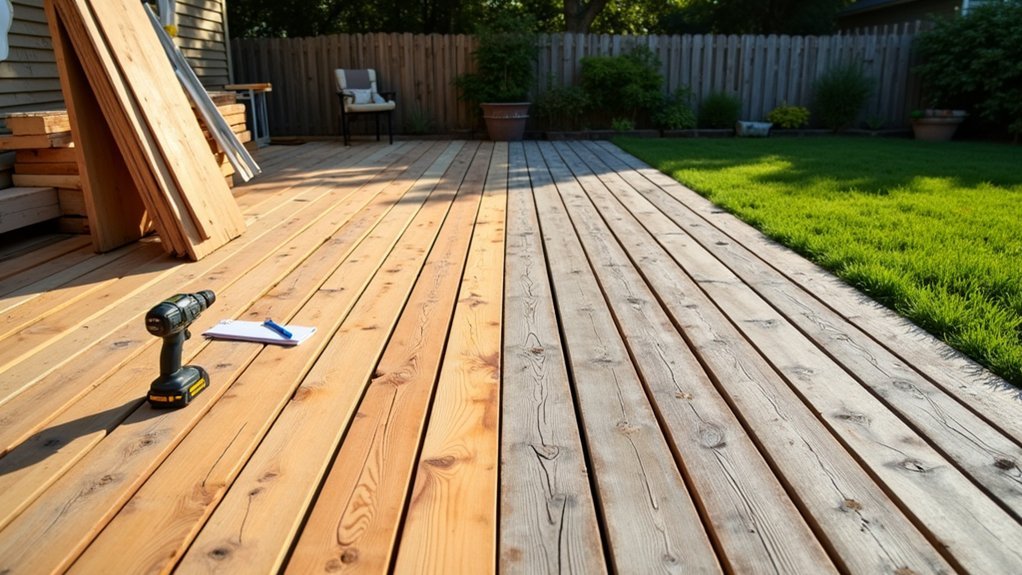
Your deck’s condition determines whether you’ll spend a few hundred dollars on targeted repairs or invest thousands in a complete replacement. Start by probing support posts and joists with a screwdriver—soft wood signals rot that may require extensive work. Compare material costs carefully: pressure-treated lumber runs $2 to $5 per linear foot, while composite decking costs $20 to $45 per square foot. Don’t forget that labor typically accounts for 50% to 60% of your total budget, and timing your project for fall or winter can save you 10% to 20%. Understanding these five key factors will help you make the smartest financial decision for your home.
Assess the Current Condition of Your Deck Structure
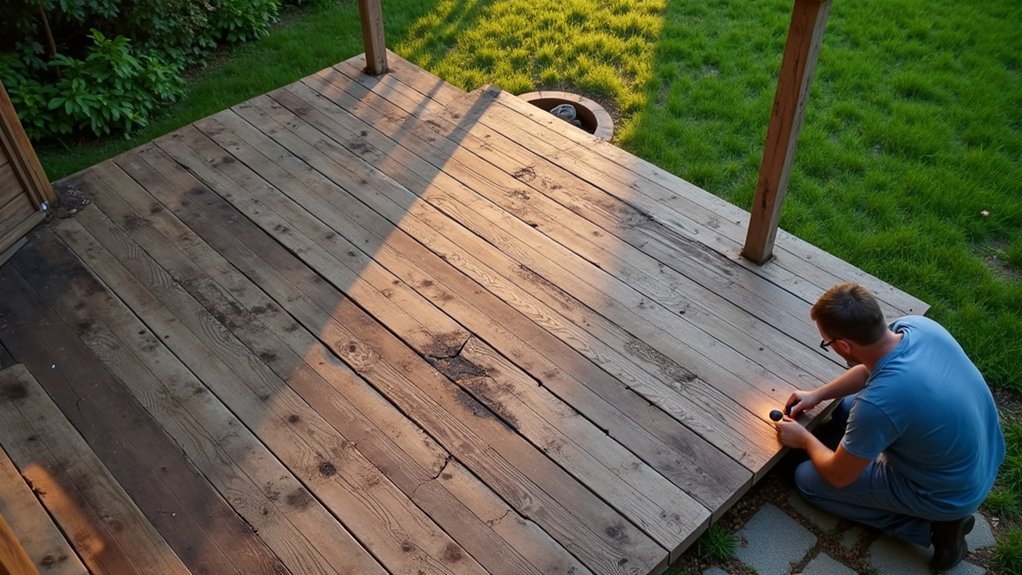
Before you commit to either repairing or replacing your deck, you’ll need to thoroughly evaluate its current structural integrity.
Start by examining the ledger board where your deck attaches to your home. Check for rot, rust, or separation from the house.
The ledger board is your deck’s lifeline to your home—never skip this critical checkpoint during inspection.
Inspect your support posts and joists for signs of decay, insect damage, or warping. Use a screwdriver to probe suspicious areas—soft wood indicates rot that’s compromised the structure.
Look underneath for sagging beams or cracked concrete footings.
Don’t forget the decking surface itself. Count loose boards, note extensive splintering, and identify any sections with significant water damage.
Document everything you find with photos and measurements. This assessment helps you determine whether targeted repairs will suffice or if full replacement makes more financial sense.
Compare Material Costs for Repairs Versus Full Replacement
When you’re weighing repair against replacement, material costs often determine which option makes financial sense for your situation. Pressure-treated lumber for repairs runs $2 to $5 per linear foot, while composite decking costs $20 to $45 per square foot. If you’re replacing a few damaged boards, you’ll spend $100 to $500 on materials alone.
Full replacement changes the equation dramatically. A 300-square-foot deck requires $1,500 to $3,000 in pressure-treated materials or $6,000 to $13,500 for composite. Don’t forget hardware, fasteners, and concrete footings, which add 15% to 20% to your total.
Calculate your repair needs carefully. If damaged areas exceed 25% of your deck’s surface, replacement materials often provide better value than patchwork fixes that won’t match your existing boards aesthetically.
Factor in Labor Expenses and Project Timeline
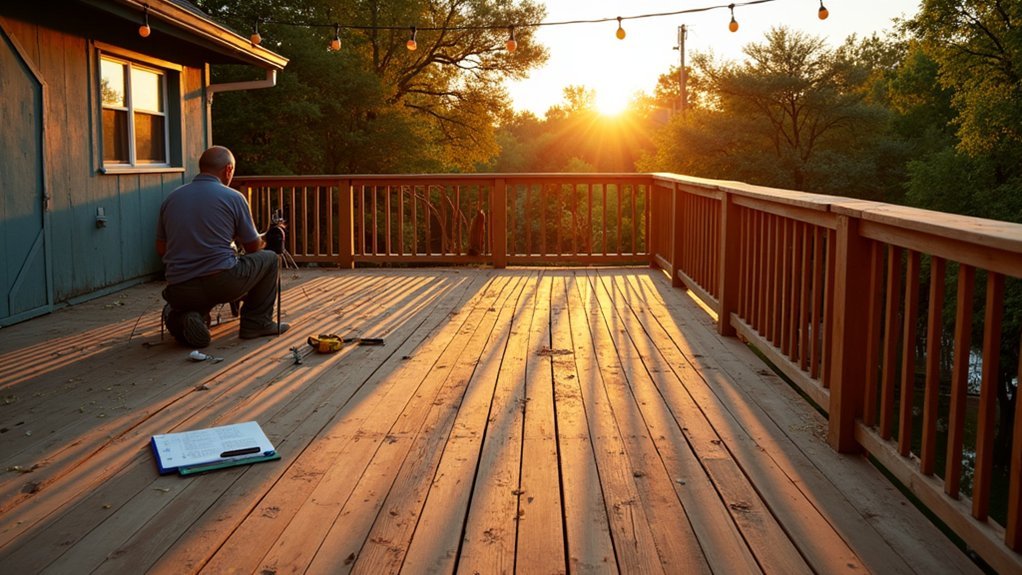
Although material costs grab most of your attention during planning, labor expenses typically account for 50% to 60% of your total project budget. You’ll pay between $15 and $35 per hour for basic repairs, while full replacements demand skilled crews charging $20 to $50 hourly.
Consider these timeline factors when budgeting:
- Simple repairs take one to three days, minimizing labor costs
- Partial replacements require five to seven days of work
- Complete deck builds extend two to four weeks, markedly increasing expenses
Your project timeline directly impacts your wallet. Rushed jobs cost more due to overtime rates. Seasonal demand also affects pricing—contractors charge premium rates during spring and summer. Schedule your project during fall or winter to potentially save 10% to 20% on labor.
Evaluate Long-Term Value and Return on Investment
Beyond immediate costs, your deck project represents a significant investment that affects your home’s overall value. A well-maintained or newly replaced deck typically recovers 65-80% of its cost at resale, making it one of the better exterior improvement investments you can make.
Consider your timeline in this property. If you’re planning to sell within two years, a quality repair might suffice and preserve your equity. However, if you’re staying long-term, replacement with durable composite materials could eliminate ongoing maintenance costs and provide decades of use.
Calculate the total cost of ownership, not just upfront expenses. A $3,000 repair that needs repeating every five years costs more over 20 years than a $12,000 replacement lasting that entire period. Your decision should balance immediate budget constraints against future savings.
Consider Safety Hazards and Building Code Requirements
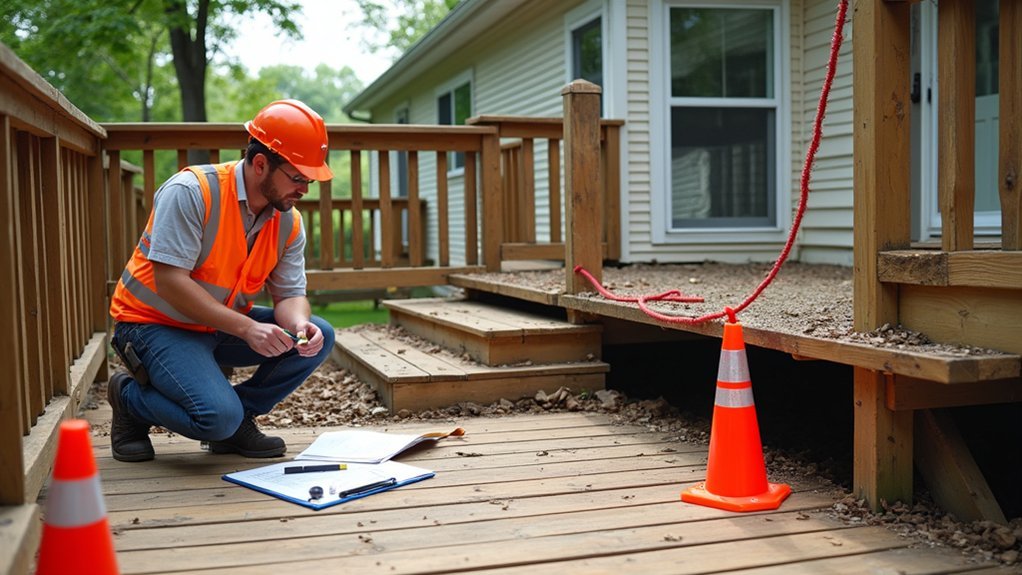
Safety concerns should always override cost considerations in your deck repair versus replacement decision.
Older decks may contain hazardous materials, structural weaknesses, or outdated construction methods that put your family at risk.
Even if repairs seem cheaper, they won’t matter if your deck collapses or fails inspection.
Building codes have evolved markedly over the years.
Your deck must meet current standards for:
- Railing height and baluster spacing to prevent falls
- Ledger board attachment and flashing requirements to make certain structural integrity
- Load-bearing capacity for joists, beams, and footings
If your existing deck can’t be brought up to code through repairs, replacement becomes mandatory.
Check with your local building department before starting any project—unpermitted work can create liability issues and complicate future home sales.
Frequently Asked Questions
Can I Repair My Deck Myself or Should I Hire a Professional?
You can tackle simple repairs like replacing loose boards or tightening screws yourself. However, you’ll want to hire a professional for structural damage, extensive rot, or if you’re uncomfortable working with power tools.
What Time of Year Is Best for Deck Repair or Replacement?
You should schedule deck repair or replacement in late spring or early fall when temperatures are moderate and humidity is low. These conditions help wood acclimate properly and allow stains and sealants to cure effectively.
Do I Need a Permit to Replace My Existing Deck?
You typically need a permit to replace your deck, especially if you’re changing its size, structure, or footprint. Check with your local building department before starting work—they’ll confirm your specific requirements.
How Long Will a Newly Repaired or Replaced Deck Typically Last?
You can expect a newly repaired deck to last 5-10 years, while a full replacement typically lasts 15-30 years depending on your material choice. Pressure-treated wood lasts shorter than composite or hardwood options.
Will My Homeowner’s Insurance Cover Any Deck Repair or Replacement Costs?
Your homeowner’s insurance typically covers deck damage from sudden events like storms or fallen trees. However, it won’t cover repairs needed due to normal wear, aging, or lack of maintenance. Check your specific policy for details.



Leave a Reply