
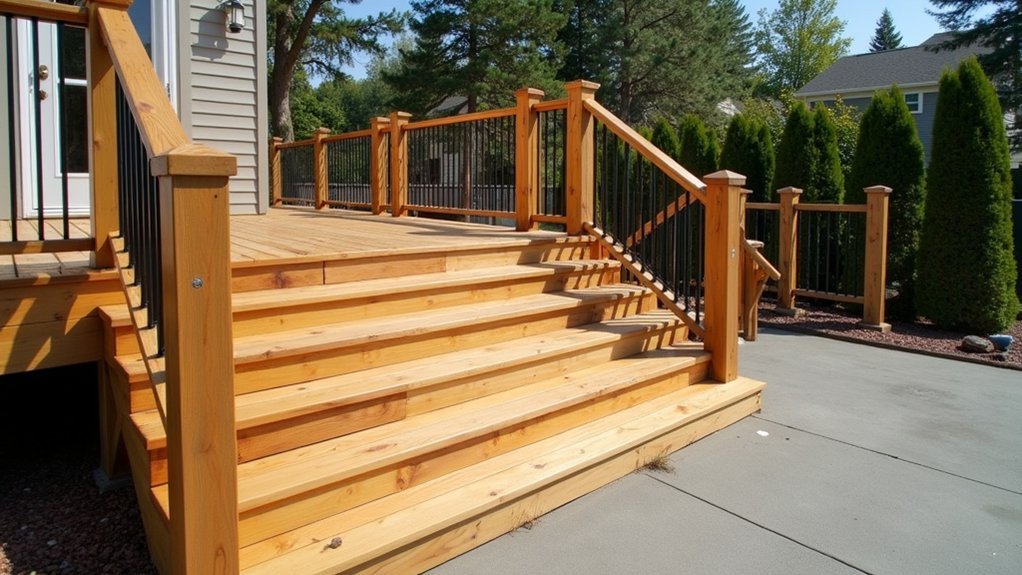
You’ll need to follow ten essential deck stair code requirements to pass inspection. Your treads must be at least 10 inches deep, and risers can’t exceed 7.75 inches in height. Handrails should measure 34 to 38 inches from the stair nosing with a graspable diameter of 1.25 to 2 inches. Stairway width needs a minimum of 36 inches, and landings must extend at least 36 inches in the direction of travel. Each requirement below breaks down exactly what inspectors look for.
Minimum Tread Depth Requirements for Safe Footing
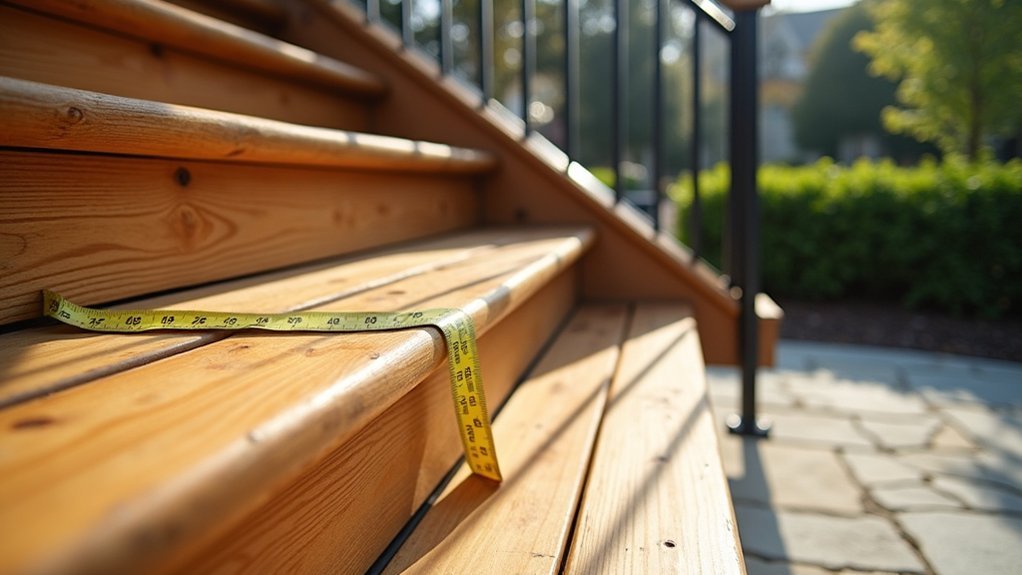
When you’re building deck stairs, the tread depth plays a critical role in preventing slips and falls. According to the International Residential Code, your stair treads must have a minimum depth of 10 inches. This measurement is taken from the front edge of one tread to the front edge of the next, excluding any nosing overhang.
You’ll need to maintain consistent tread depths throughout your entire staircase. The code allows a maximum variance of 3/8 inch between your deepest and shallowest treads. This consistency prevents the tripping hazard that occurs when your foot expects one depth but encounters another.
If you’re adding a nosing, it shouldn’t project more than 1.25 inches beyond the riser. Proper tread depth gives your foot adequate landing space for secure footing.
Maximum Riser Height Standards for Comfortable Climbing
Because the IRC sets strict limits on riser height, you can’t exceed 7.75 inches from the top of one tread to the top of the next. This maximum guarantees you won’t strain your legs while climbing outdoor stairs. Taller risers force unnatural stepping motions that increase fatigue and fall risk.
| Riser Specification | Requirement |
|---|---|
| Maximum Height | 7.75 inches |
| Minimum Height | 4 inches |
| Height Variation | ≤ 3/8 inch |
| Measurement Point | Tread to tread |
| Open Risers | ≤ 4 inch opening |
You’ll need to maintain consistency throughout your staircase. The code allows only 3/8-inch variation between your tallest and shortest riser. When planning your deck stairs, calculate the total rise and divide evenly to achieve uniform riser heights that meet these standards.
Handrail Height and Graspability Specifications
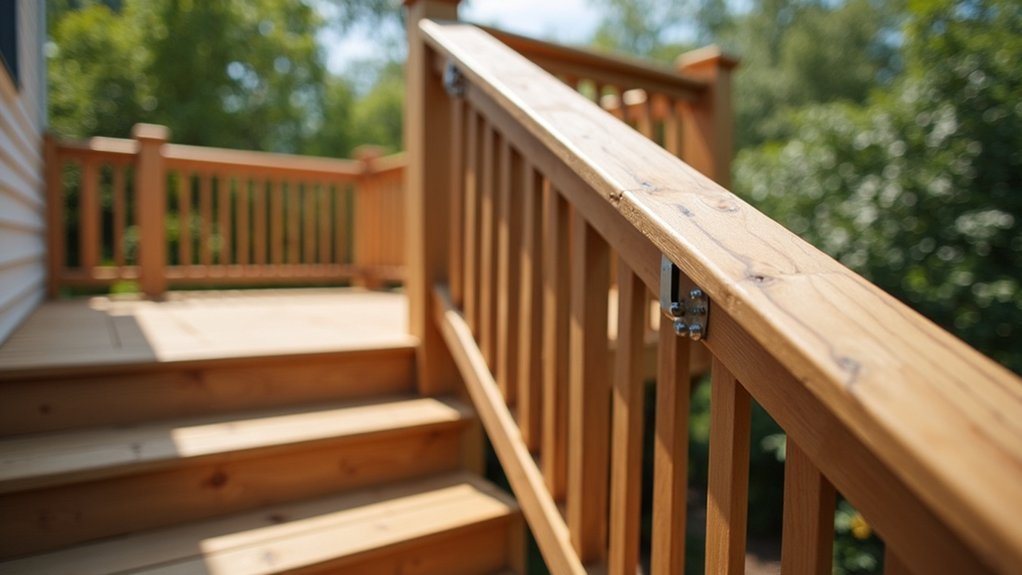
Gripping a properly designed handrail can mean the difference between catching yourself during a stumble and taking a dangerous fall.
A well-designed handrail isn’t just a code requirement—it’s your last line of defense against a serious fall.
Building codes require handrails to measure between 34 and 38 inches high, measured vertically from the stair nosing to the top of the rail.
Your handrail must be graspable along its entire length. For round sections, the diameter needs to fall between 1.25 and 2 inches.
If you’re using non-circular profiles, the perimeter can’t exceed 6.25 inches, and the cross-section must measure between 2.25 and 3 inches.
You’ll also need continuous graspability, meaning no obstructions can interrupt your grip.
The handrail should extend horizontally at least 12 inches beyond the top riser and match the stair slope at the bottom.
Stairway Width Minimums for Proper Access
Beyond handrail specifications, your deck stairs must meet minimum width requirements to guarantee safe passage.
The IRC mandates a minimum clear width of 36 inches, measured between handrails or between the handrail and the opposite wall or guard.
You’ll need to account for handrail projections when calculating this measurement.
Each handrail can project up to 4.5 inches into the required width, but you must maintain that 36-inch clearance for actual walking space.
If you’re building stairs wider than 44 inches, you’ll need handrails on both sides.
This width threshold guarantees people can pass each other safely during emergencies.
Don’t confuse stair width with tread width—they’re separate requirements.
Your local building department may enforce stricter standards, so verify requirements before construction begins.
Landing Size and Placement Regulations
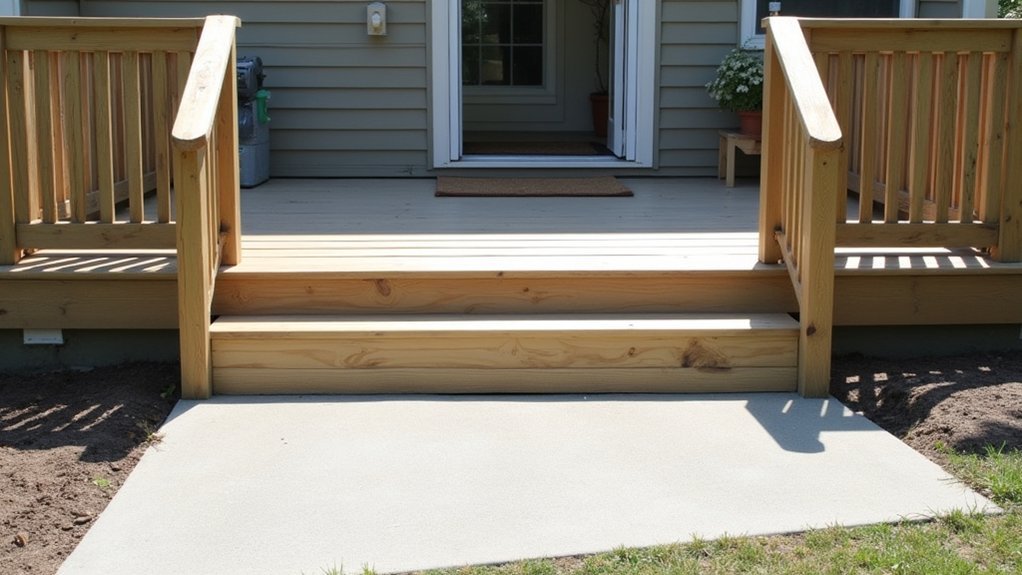
You’ll need to understand landing requirements to guarantee your deck stairs meet code.
Landings must meet minimum dimension standards and be properly positioned at both the top and bottom of your stairway.
The materials you choose for your landing surfaces must also comply with specific safety and durability standards.
Minimum Landing Dimension Requirements
When stairs meet a door at the top or bottom, building codes require a landing that gives you safe, stable footing while operating the door.
The minimum landing dimension must be at least 36 inches measured in the direction of travel.
Your landing width can’t be narrower than the stairway it serves.
If you’ve built 36-inch-wide stairs, your landing must match or exceed that measurement.
For doors that swing over the landing, you’ll need additional clearance to accommodate the door’s arc without creating a tripping hazard.
The landing surface must be level, with a maximum slope of 2 percent for drainage purposes on exterior applications.
You can’t use a step as your landing—it must provide a flat, continuous surface where you can stand comfortably while opening or closing the door.
Top and Bottom Placement
Although landings serve similar safety functions at both the top and bottom of your deck stairs, code requirements treat these locations differently based on traffic patterns and fall risks.
At the top, your landing must align flush with the deck surface, creating a seamless shift that prevents tripping hazards.
Bottom landings require a stable, level surface extending at least 36 inches from the last riser.
You can use concrete, pavers, or compacted gravel that meets local drainage requirements.
The landing must slope slightly away from the stairs to prevent water accumulation and ice formation.
When your stairs discharge onto a walkway, that surface typically satisfies landing requirements if it meets minimum dimensions.
However, you’ll need dedicated landings when stairs terminate on grass or unstable ground.
Landing Surface Material Standards
Building codes specify that landing surfaces must provide secure footing in all weather conditions, which means your material choices directly impact code compliance. You’ll need to select materials that resist becoming slippery when wet, icy, or covered with debris.
Acceptable landing materials include concrete, pavers, composite decking, pressure-treated lumber, and natural stone with textured finishes. If you’re using wood or composite materials, they must meet the same structural requirements as your deck surface. Concrete landings should have a broom finish or exposed aggregate to enhance traction.
You can’t use loose gravel or bare soil as a permanent landing surface since these don’t provide the stable, level footing codes require. Whatever material you choose, make certain it drains properly to prevent water pooling and ice formation.
Guardrail and Baluster Spacing Rules
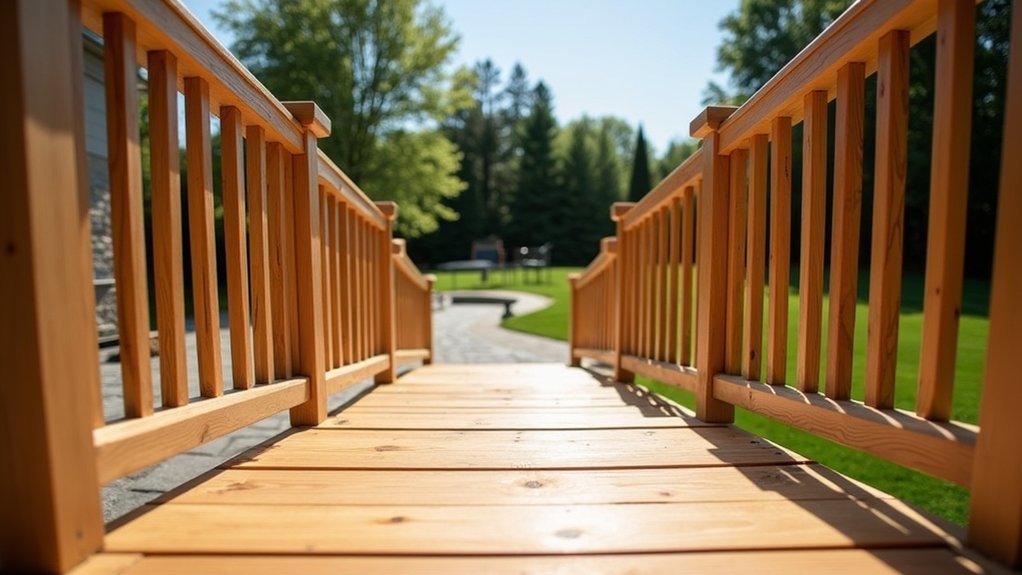
You’ll need to make sure your deck stair guardrails meet specific spacing and height requirements to pass inspection.
The maximum gap between balusters can’t exceed 4 inches, which you can verify using the sphere test—if a 4-inch sphere passes through, your spacing is too wide.
Additionally, your guardrail height must meet the standard minimum of 34 inches for stairs, though some local codes require 36 inches.
Maximum Baluster Spacing Requirements
Balusters serve as the vertical infill members between your stair guardrail posts, and building codes strictly limit the gaps between them.
The maximum allowable spacing between balusters is 4 inches, measured at the widest point. This requirement prevents small children from squeezing through or getting their heads stuck between the uprights.
You’ll need to measure baluster spacing at multiple points along your stair guardrail. On stairs, the triangular opening formed between the bottom rail, the stair tread nosing, and the baluster also can’t exceed 4 inches.
This often requires closer baluster placement near the bottom of angled stair railings.
When installing balusters, account for the width of each baluster itself.
Space them consistently to maintain a uniform appearance while staying within code limits.
Guardrail Height Standards
Guardrail height requirements differ between your deck surface and your stairs. On flat deck areas, you’ll need guardrails at least 36 inches tall, measured from the deck surface to the top of the rail. However, some local codes require 42 inches, especially for commercial properties or elevated decks.
Stair guardrails follow different measurements. You’ll measure the height vertically from the stair nosing to the top of the rail.
- Deck surface guardrails: Minimum 36 inches, with some jurisdictions requiring 42 inches
- Stair guardrails: Minimum 34 inches, measured from the stair nosing
- Graspable handrails: Must be between 34 and 38 inches above the stair nosing
Check your local building codes, as requirements vary by location and deck height.
Sphere Test Compliance
Why does spacing between balusters matter so much in building codes? The answer involves child safety. Building codes require that a 4-inch sphere can’t pass through any opening in your guardrail system. This standard prevents small children from squeezing through gaps or getting their heads stuck between balusters.
You’ll need to space your balusters no more than 4 inches apart, measured from the inside edges. Don’t forget to check the gap between your bottom rail and the stair tread—this opening must also meet the sphere test requirement.
When installing balusters on stairs, remember that the triangular openings formed beneath the angled bottom rail count too. Measure these carefully, as they’re easy to overlook. Code inspectors will test every opening, so verify your spacing before the final inspection.
Uniform Step Dimensions for Consistent Stride
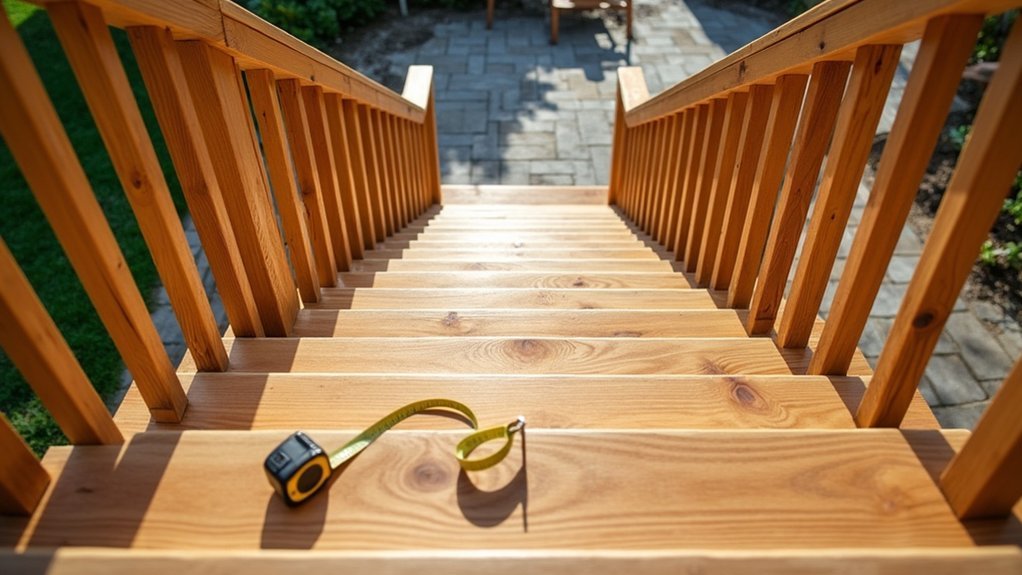
When you’re climbing or descending deck stairs, your body naturally develops a rhythm based on the first few steps you take. If step dimensions vary, you’ll stumble or misstep, creating a serious fall hazard.
Building codes require uniform riser heights and tread depths throughout your entire stairway.
Here’s what you need to know about dimensional consistency:
- Riser heights can’t vary more than 3/8 inch from the tallest to the shortest step in your stairway.
- Tread depths must maintain the same 3/8-inch maximum variation between the deepest and shallowest treads.
- The top and bottom risers require special attention since they’re measured differently when connecting to landing surfaces.
You’ll need to calculate your total rise carefully before construction to make certain each step matches precisely.
Stringer Support and Attachment Guidelines
Your deck stairs can only perform safely if the stringers supporting them are properly secured at both the top and bottom connections.
At the top, you’ll need to attach stringers directly to the rim joist using approved metal connectors or a ledger board with appropriate fasteners. Never rely solely on nails or toenailing for this critical connection.
At the bottom, stringers must rest on a solid concrete pad or footing that extends below the frost line in your area. Use galvanized post anchors to prevent lateral movement and protect against moisture damage.
Code typically requires a minimum of three stringers for stairs wider than 36 inches. Spacing between stringers shouldn’t exceed 18 inches to prevent tread deflection and make certain structural integrity under load.
Lighting Requirements for Nighttime Visibility
Although building codes don’t always mandate lighting for deck stairs, installing proper illumination dramatically improves safety and helps prevent falls after dark. You’ll want to make certain each step is clearly visible without creating harsh glare that could temporarily blind users.
Consider these effective lighting options for your deck stairs:
- Recessed riser lights – Mount these directly into the vertical face of each step for consistent, low-profile illumination.
- Post cap lights – Install on handrail posts to cast downward light across multiple treads.
- Low-voltage step lights – Position along stringers to highlight tread edges without overwhelming brightness.
You should aim for uniform light distribution that eliminates shadows on treads. Motion-activated fixtures offer convenience while reducing energy consumption when stairs aren’t in use.
Load-Bearing Capacity Standards for Structural Safety
Deck stairs must support significant weight loads to guarantee structural integrity and prevent catastrophic failures.
You’ll need to make certain your stringers can handle a minimum concentrated load of 300 pounds on any 4-square-inch area. The IRC requires treads to support this weight without excessive deflection or damage.
Your stair system must also meet a uniform load requirement of 40 pounds per square foot. This accounts for multiple people using the stairs simultaneously during gatherings or emergencies.
You should select stringers that match your stair width—typically 2×12 lumber for spans up to 6 feet. For wider stairs, you’ll need to add a center stringer. Don’t forget that connections matter too; use appropriate joist hangers and fasteners rated for the anticipated loads.
Frequently Asked Questions
Do I Need a Permit to Build Deck Stairs in My Area?
You’ll likely need a permit to build deck stairs, but requirements vary by location. Check with your local building department before starting work—they’ll tell you exactly what’s required in your specific area.
What Materials Are Approved for Outdoor Deck Stair Construction?
You can typically use pressure-treated lumber, cedar, redwood, composite decking, or metal for outdoor deck stairs. You’ll want to check your local building codes since approved materials vary by jurisdiction and climate conditions.
How Often Must Deck Stairs Be Inspected for Code Compliance?
You should check your local building department for specific inspection requirements, as they vary by jurisdiction. Typically, you’ll need inspections during initial construction and when making significant modifications to your deck stairs.
Are Spiral Staircases Allowed for Deck Access Under Building Codes?
You can typically use spiral staircases for deck access, but you’ll need to meet specific code requirements. They must have a minimum 26-inch clear width and consistent tread depths to guarantee safe passage.
What Are the Code Requirements for Stairs Leading to Hot Tubs?
You’ll need to follow standard deck stair codes for hot tub access, including proper riser height, tread depth, and handrails. You should also guarantee slip-resistant surfaces since wet conditions increase fall risks markedly.




Leave a Reply