

You can transform your backyard into an engaging outdoor classroom with games that blend physical activity and academics. Try a nature scavenger hunt to teach biology, math hopscotch with chalk equations, or a geography flag capture game where kids identify countries before scoring. Water balloon counting challenges make number sense exciting, while plant identification memory match builds botanical knowledge. These ten activities work for multiple ages and skill levels, and you’ll find detailed setup tips below.
Nature Scavenger Hunt for Science Exploration
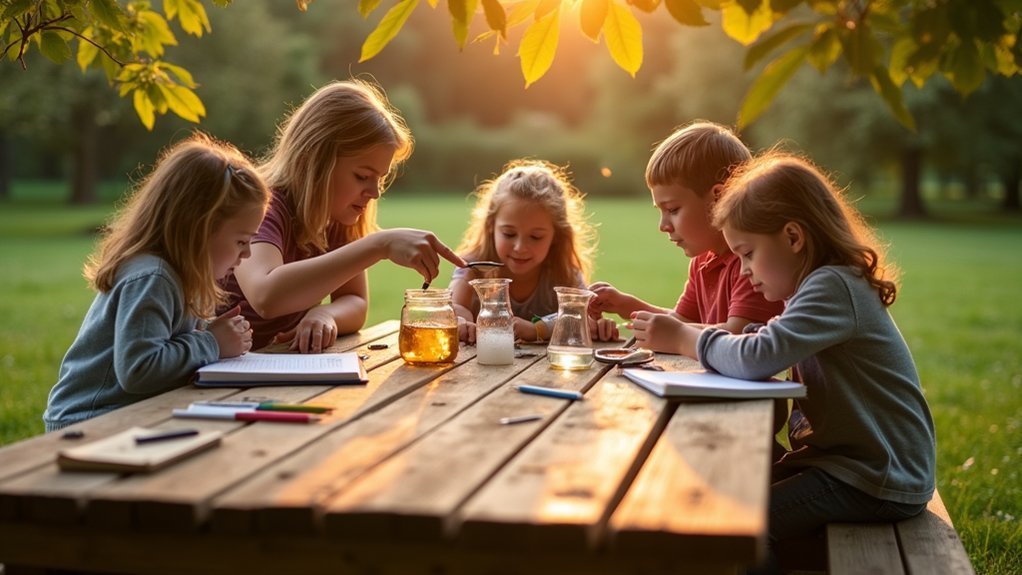
Exploring the natural world becomes an exciting adventure when you transform your backyard into a science laboratory.
Your backyard holds endless discoveries waiting to spark wonder—step outside and let nature become your child’s greatest teacher.
Create a scavenger hunt list featuring items like specific leaf shapes, insect types, bird feathers, or rock formations. Your children will sharpen their observation skills while learning to identify local flora and fauna.
Expand the activity by adding scientific tasks to each find. Ask your kids to sketch specimens, measure leaf dimensions, or document where they discovered each item. They can classify their findings into categories—living versus nonliving, plant versus animal, or by color and texture.
This hands-on approach reinforces biology, ecology, and earth science concepts naturally. You’ll watch your children develop curiosity and critical thinking skills while getting fresh air and exercise in your own backyard.
Alphabet Garden Relay Race
When you combine physical activity with letter recognition, you create a powerful learning experience that sticks with young learners. The Alphabet Garden Relay Race transforms your backyard into an interactive classroom where kids sprint, search, and spell.
Set up this engaging game with these simple steps:
- Scatter letter cards throughout your garden or yard
- Call out a word related to nature, plants, or animals
- Have children race to collect the correct letters in order
- Award points for speed and accuracy
You’ll watch your children develop phonics skills while burning energy. Increase difficulty by using longer words or requiring alphabetical retrieval.
This game works perfectly for multiple age groups—younger kids find single letters while older siblings tackle complete spelling challenges.
Math Hopscotch With Chalk Numbers
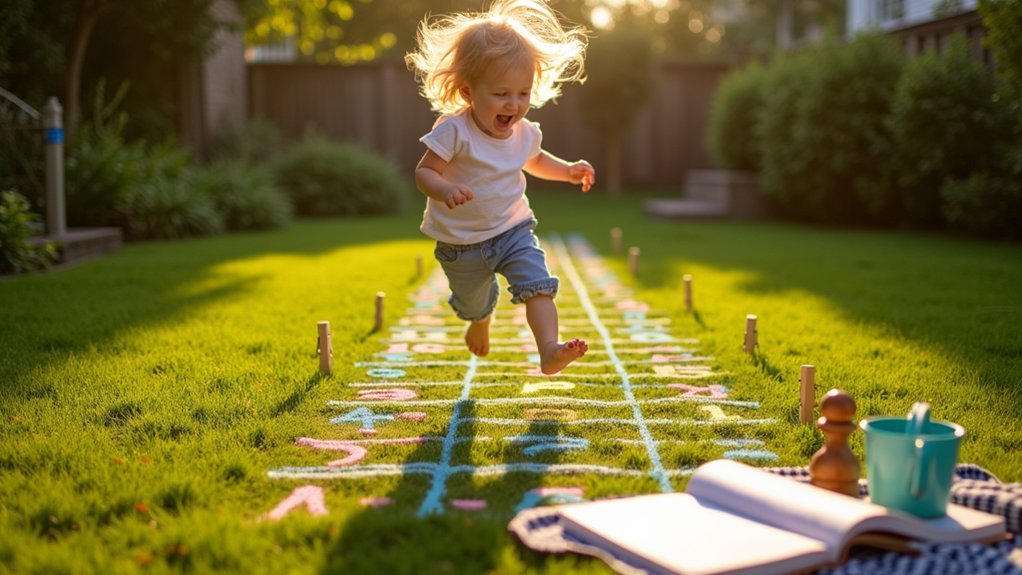
Traditional hopscotch gets a powerful educational upgrade once you grab some sidewalk chalk and add math problems to each square.
Instead of numbering squares one through ten, write simple equations like “3+4” or “12-5” in each box.
Your child must solve the problem before hopping to that square and call out the answer as they land.
You can adjust difficulty based on your child’s level.
Younger kids work with basic addition, while older students tackle multiplication or division.
Create themed rounds focusing on specific skills they’re currently learning.
This game builds mental math speed while burning energy.
The physical movement helps cement mathematical concepts in memory.
You’ll find your children requesting “math hopscotch” because it transforms drill practice into genuine outdoor fun.
Spelling Bee Obstacle Course
Beyond simple word drills, a spelling bee obstacle course combines physical challenges with vocabulary practice to create an unforgettable learning experience.
You’ll watch your children sprint, climb, and jump while reinforcing their spelling skills in ways that stick.
Set up your course using these four essential stations:
- Crawl tunnel – Kids crawl through, then spell a word before advancing
- Balance beam – They walk across while spelling each letter aloud
- Jumping jacks station – One jump per letter keeps energy high
- Target toss – Correct spelling earns a beanbag throw at the target
You can adjust word difficulty based on each child’s level.
The physical movement helps cement vocabulary into long-term memory while burning off excess energy.
Your kids won’t even realize they’re studying.
Geography Flag Capture Game
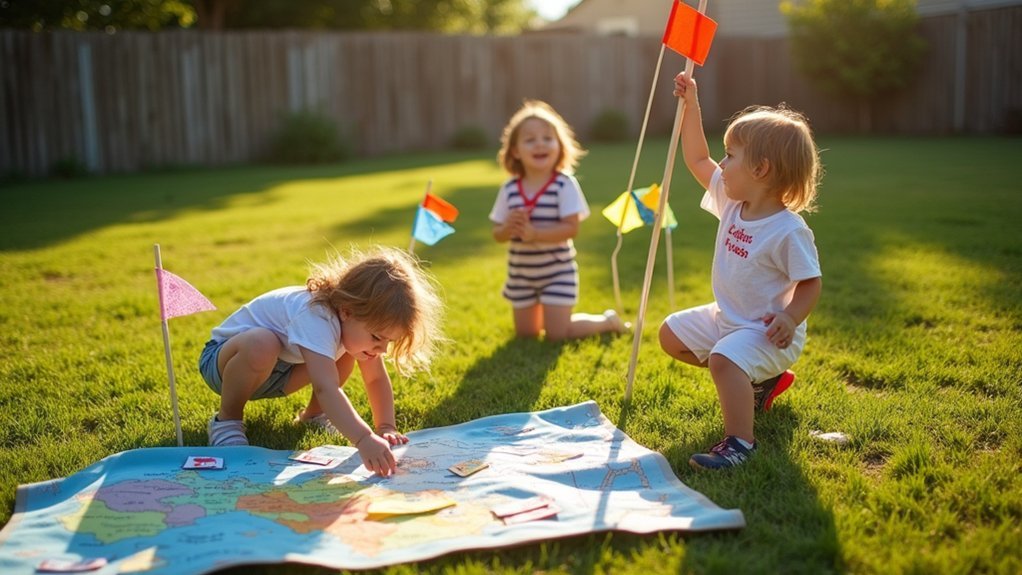
You can transform your backyard into a global learning adventure by setting up clearly marked boundaries and creating designated “country zones” for the Geography Flag Capture Game.
Place printed flags from different nations throughout the play area, challenging your kids to identify each country before they can capture its flag. This active game reinforces geography knowledge while keeping your children moving and engaged outdoors.
Setting Up Boundaries
Before players can race across the yard to capture flags, they’ll need to establish clear territorial boundaries that transform your outdoor space into a geography lesson.
You’ll want to divide your yard into distinct “countries” or “continents” using these simple methods:
- Use chalk lines on pavement or flour lines on grass to mark borders
- Place cones at corner points to define each territory’s shape
- Assign geographical names to each zone based on what you’re studying
- Create a neutral “ocean” zone in the middle where captured players must wait
Make sure each territory has roughly equal space so teams have fair advantages.
Walk the boundaries with your children before starting, reinforcing the geography concepts you’re teaching while ensuring everyone understands the playing field.
Learning Flags Through Play
With your boundaries set, the real geography learning begins when you introduce country flags into the game. Print small flags from different continents and attach them to wooden dowels. Each team protects their assigned flags while attempting to capture opponents’ flags.
Before each round, players must correctly identify the country and continent of any flag they capture. This requirement turns a simple chase game into an active geography lesson.
| Flag Color Clue | Countries to Include |
|---|---|
| Red, white, blue | France, USA, UK |
| Green and white | Nigeria, Pakistan |
| Stars featured | Brazil, China |
| Stripes only | Thailand, Austria |
You’ll find children naturally start memorizing flags they want to capture. Rotate flag sets weekly to expand their knowledge across all seven continents.
History Timeline Treasure Hunt
Turning your backyard into a time-traveling adventure is easier than you’d think with a history timeline treasure hunt. Hide clues around your yard that correspond to different historical periods, and watch your kids piece together the past while racing to find the final treasure.
Transform your backyard into a time machine where kids race through history to uncover hidden treasures.
Here’s how to set up your hunt:
- Choose five to ten historical events spanning different eras
- Write clues that require solving history-based riddles to find the next location
- Place era-appropriate “artifacts” at each station, like toy dinosaurs or replica coins
- Create a simple timeline map your children complete as they discover each clue
This game reinforces chronological thinking and makes memorizing dates feel like an expedition.
You’ll find your kids begging for more history lessons.
Water Balloon Counting Challenge
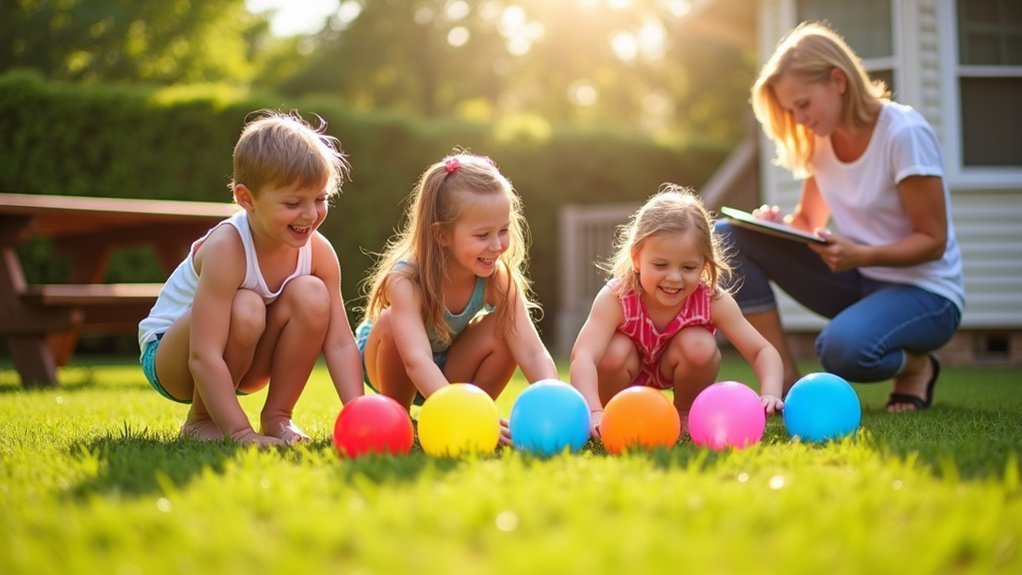
You can transform simple water balloons into powerful math tools that make counting practice irresistible on hot summer days. Set up targets with different point values and have your children tally their scores, adjusting the complexity based on their age and skill level.
Younger kids can count individual balloons while older students calculate multi-digit addition or track running totals throughout the game.
Math Skills Through Play
When summer heat makes indoor lessons unbearable, water balloon math transforms your backyard into an engaging classroom. You’ll find that hands-on counting activities stick with children far longer than worksheet drills.
Set up this simple yet effective learning game:
- Fill 20-30 water balloons and place them in buckets around your yard
- Call out math problems and have your child grab the correct number of balloons
- Let them toss balloons at a target to “check” their answer
- Increase difficulty by introducing addition, subtraction, or multiplication challenges
The splash factor keeps kids motivated while reinforcing number sense. You can adapt this activity for multiple skill levels, making it perfect for families with children of varying ages.
Track progress by noting which operations need more practice.
Age-Appropriate Counting Variations
Tailor your water balloon counting challenges to match each child’s developmental stage for maximum learning impact.
For preschoolers ages 3-5, keep quantities between 1-10 balloons. Have them touch each balloon while counting aloud, reinforcing one-to-one correspondence. Use bright, single colors to minimize distraction.
Children ages 6-8 can handle quantities up to 50. Introduce skip counting by twos, fives, or tens. Challenge them to estimate before counting, then verify their guesses.
For ages 9-12, incorporate multiplication and division. Ask them to divide 36 balloons equally among four buckets or calculate how many dozens they’ve filled. You can also time their counting speed to add excitement.
Adjust difficulty mid-game based on your child’s confidence. When they’re succeeding consistently, increase complexity. When frustration appears, simplify immediately.
Outdoor Story Dice Adventure
Transforming your backyard into a storytelling arena becomes effortless with the Outdoor Story Dice Adventure, a game that sparks creativity while getting kids moving and exploring nature.
Create dice using wooden blocks and draw simple images on each side: animals, weather elements, characters, and locations. Players roll the dice and must incorporate whatever lands face-up into an original story.
Here’s how to maximize the adventure:
- Have children act out their stories using props found in nature
- Set a timer to encourage quick thinking and spontaneous creativity
- Let siblings collaborate on stories, building on each other’s ideas
- Create themed dice sets for different subjects like history or science
You’ll watch vocabulary expand and confidence grow as children discover they’re natural storytellers in their own backyard classroom.
Plant Identification Memory Match
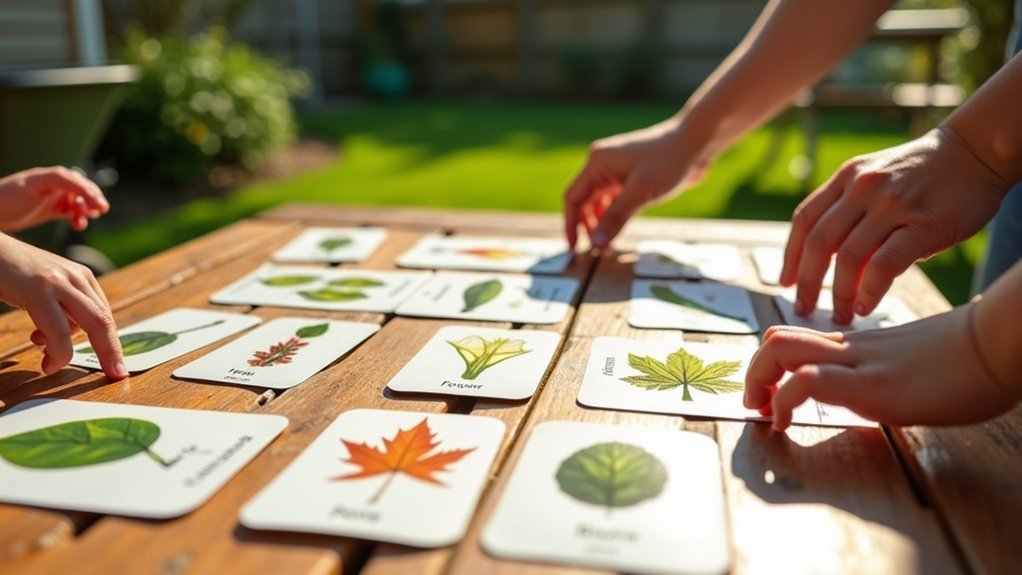
From storytelling adventures to scientific exploration, your backyard offers endless learning opportunities—and Plant Identification Memory Match turns nature study into an engaging game the whole family can enjoy.
Transform your backyard into a living classroom where nature games create lasting memories and botanical knowledge grows naturally.
Start by collecting leaf samples from different plants in your yard. Press them flat, then photograph or sketch each specimen on index cards—creating two matching cards per plant. Laminate the cards for durability, and you’ve built a reusable learning tool.
To play, arrange cards face-down in a grid. Players take turns flipping two cards, trying to match identical plants. When someone finds a pair, they must name the plant or describe one characteristic to keep their match.
This game strengthens visual memory while teaching botanical identification. You’ll find children naturally begin recognizing plants during everyday outdoor time, transforming casual walks into impromptu nature lessons.
Measurement Olympics With Yard Tools
Beyond traditional worksheets, Measurement Olympics transforms everyday yard tools into hands-on math manipulatives that make abstract concepts tangible.
You’ll turn rakes, shovels, and garden hoses into measuring instruments that bring real-world context to your lessons.
Set up these four competitive stations around your yard:
- Long jump measurement – Kids jump, then measure distances using rake lengths before converting to standard units
- Hose circumference challenge – Wrap garden hoses around trees and calculate diameter
- Shadow tracking – Measure shovel shadows hourly to explore time and angles
- Estimation toss – Throw bean bags, estimate distances first, then verify with actual measurements
Award points for accuracy rather than athletic ability.
You’re reinforcing estimation skills, unit conversion, and mathematical reasoning while your children compete enthusiastically outdoors.
Frequently Asked Questions
What Age Groups Are Backyard Learning Games Most Suitable For?
You’ll find these games work best for children ages 4 to 12. You can easily adapt most activities to challenge older kids or simplify them for younger ones, making them perfect for mixed-age sibling groups.
How Can I Adapt These Games for Children With Special Needs?
You can adapt these games by simplifying rules, adding visual cues, incorporating sensory elements, and allowing extra time. You’ll want to focus on your child’s strengths while modifying activities to match their specific learning needs.
What Safety Precautions Should I Take During Outdoor Learning Activities?
You should check your yard for hazards like sharp objects, toxic plants, and uneven ground. Always supervise activities, guarantee proper hydration, apply sunscreen, and keep a first-aid kit nearby for emergencies.
How Do I Keep Kids Engaged When Weather Conditions Are Unpredictable?
You’ll maintain engagement by creating flexible lesson plans with indoor backup activities. Keep portable supplies ready, embrace light rain as a sensory experience, and use weather changes as spontaneous science lessons about meteorology and nature.
Can These Games Count Toward Official Homeschool Curriculum Requirements?
You can often count these games toward curriculum requirements by documenting learning objectives, skills practiced, and time spent. Check your state’s homeschool laws, as requirements vary widely regarding what qualifies as instructional hours.

Leave a Reply