
You can sanitize your hot tub without chlorine using several effective alternatives. Bromine works well in hot water and causes less skin irritation. Saltwater systems generate sanitizer automatically through electrolysis. Ozone generators and UV-C lights destroy bacteria without adding chemicals. Mineral purifiers release silver and copper ions to control bacteria and algae. For best results, you’ll want to combine methods and maintain proper water balance, which we’ll cover below.
Understanding Why Some Hot Tub Owners Avoid Chlorine
Why do so many hot tub owners seek alternatives to chlorine? The reasons vary, but skin sensitivity tops the list. Chlorine can cause itching, rashes, and dryness, especially for those with eczema or psoriasis. You might also notice your hair becoming brittle and discolored after frequent soaks.
The strong chemical odor bothers many users too. That distinctive “pool smell” can linger on your skin and swimwear for hours. Some people experience respiratory irritation, particularly those with asthma or allergies.
You may also have environmental concerns about chlorine byproducts entering wastewater systems. Additionally, maintaining proper chlorine levels requires constant monitoring and adjustment. The chemicals can corrode hot tub components over time, leading to costly repairs. These factors drive many owners toward gentler, more sustainable sanitizing methods.
Bromine as a Popular Chlorine-Free Sanitizer Option
If you’re looking for an effective alternative to chlorine, bromine stands out as one of the most popular choices among hot tub owners.
Unlike chlorine, bromine remains stable at higher temperatures and produces fewer harsh odors, making it ideal for the warm water environment of your spa.
You can apply bromine through floating dispensers, granules, or an automatic feeder system that maintains consistent sanitizer levels with minimal effort.
Bromine Vs Chlorine Differences
Bromine often serves as the go-to alternative for hot tub owners who want to avoid chlorine’s harsh effects. While both chemicals kill bacteria effectively, they work differently in your water.
Bromine remains stable at higher temperatures, making it ideal for hot tubs that typically run between 100-104°F. Chlorine breaks down quickly in warm water, requiring more frequent applications.
You’ll notice bromine produces less odor and causes fewer skin and eye irritations. It also maintains effectiveness across a wider pH range than chlorine does.
However, bromine costs more upfront and dissolves slower than chlorine tablets. You can’t use bromine with shock treatments containing chlorine, or you’ll create chloramines.
Bromine regenerates itself when you add oxidizers, giving you longer-lasting sanitization between treatments. This self-regenerating quality makes maintenance simpler over time.
Bromine Application Methods
For ideal sanitization results, you’ll need to choose the right delivery method for your bromine treatment. Each application method offers distinct advantages depending on your maintenance preferences and schedule.
- Floating dispensers – These affordable devices hold bromine tablets and release sanitizer gradually as water flows through them. You simply adjust the vents to control dissolution speed.
- Inline or offline feeders – Connected directly to your plumbing system, these feeders provide consistent bromine distribution without floating objects in your tub.
- Granular bromine – You’ll add this powder directly to the water for quick sanitization boosts when levels drop unexpectedly.
Most hot tub owners combine methods, using a dispenser for daily maintenance while keeping granules on hand for periodic shock treatments.
Test your water twice weekly to make certain proper bromine levels between 3-5 ppm.
Mineral Purification Systems for Natural Hot Tub Care
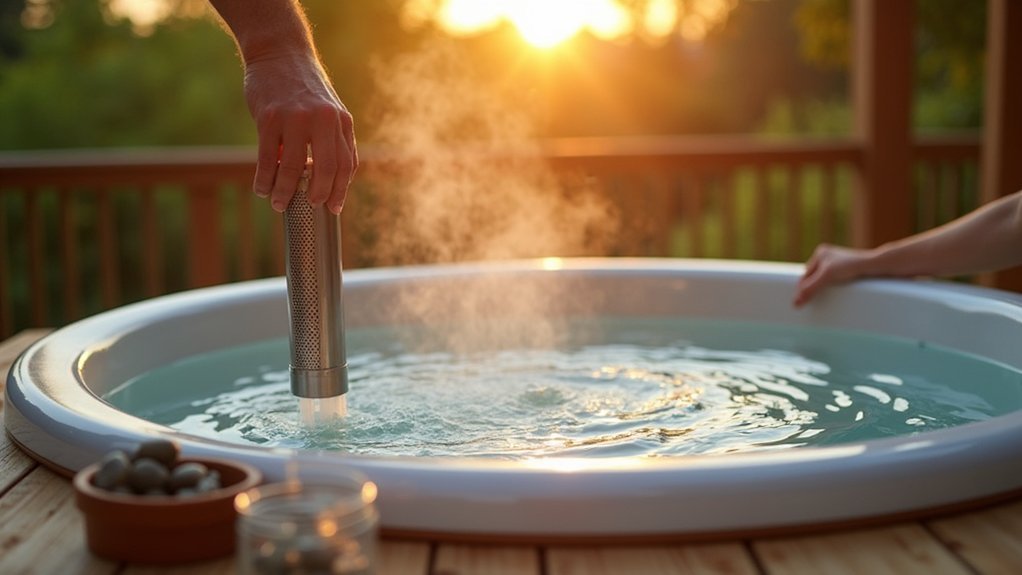
Mineral purification systems offer hot tub owners a gentle yet effective alternative to traditional chlorine-based sanitation. These systems use silver and copper ions to kill bacteria and algae naturally. You’ll find they’re easier on your skin, eyes, and swimwear while reducing chemical odors.
| Mineral Type | Primary Function |
|---|---|
| Silver ions | Kills bacteria |
| Copper ions | Controls algae |
| Zinc | Clarifies water |
| Limestone | Balances pH |
| Ceramic balls | Enhances filtration |
To use a mineral system, you’ll insert a cartridge into your filter area. The water flows through, releasing ions that sanitize continuously. You’ll still need a small amount of oxidizer weekly to break down organic matter, but you’ve drastically reduced your chemical dependency while maintaining crystal-clear water.
Saltwater Systems and How They Work in Spas
Saltwater systems offer you another chlorine-free alternative by using electrolysis to convert dissolved salt into a natural sanitizer that keeps your spa water clean and clear.
You’ll enjoy softer water that’s gentler on your skin and eyes, plus you won’t need to handle or store harsh chemicals.
These systems do require periodic maintenance, including replacing the salt cell every few years to guarantee peak performance.
How Saltwater Systems Work
Unlike traditional chlorine systems where you manually add sanitizer, saltwater systems generate their own chlorine through a process called electrolysis. You’ll add salt to your hot tub water, which passes through a specialized cell containing electrically charged plates.
Here’s how the process works:
- Salt dissolves – You add pool-grade salt to your spa water, creating a mild saline solution
- Electrolysis occurs – Water flows through the generator cell, where electrical current splits salt molecules into sodium and chlorine
- Chlorine sanitizes – The released chlorine kills bacteria and contaminants, then reconverts back to salt
This continuous cycle means you’re not constantly handling harsh chemicals. The chlorine levels stay lower and more consistent than traditional methods, giving you softer water that’s gentler on your skin and eyes.
Benefits Over Traditional Chlorine
Switching over to a saltwater system brings several practical advantages that traditional chlorine can’t match. You’ll notice softer water that’s gentler on your skin, eyes, and swimwear. The consistent chlorine generation means fewer chemical fluctuations and less hands-on maintenance.
| Feature | Saltwater System | Traditional Chlorine |
|---|---|---|
| Skin Feel | Soft, moisturized | Often dry, irritated |
| Chemical Handling | Minimal | Frequent additions |
| Long-term Cost | Lower | Higher |
You won’t need to store harsh chemicals or handle concentrated chlorine products. The system produces sanitizer automatically, so you’re not constantly testing and adjusting levels. Your hot tub stays consistently clean without the strong chemical odor that drives many people away from traditional chlorine systems.
Maintenance and Cell Replacement
Even with the simplified daily routine saltwater systems offer, you’ll still need to maintain the electrolytic cell that makes it all work.
The cell converts salt into chlorine through electrolysis, and over time, calcium and mineral deposits build up on the plates.
Here’s what you should know about cell maintenance:
- Clean the cell every 3-4 months by soaking it in a diluted acid solution to remove scale buildup.
- Inspect the plates regularly for signs of wear, corrosion, or heavy calcification that cleaning won’t resolve.
- Replace the cell every 2-5 years, depending on usage and water chemistry balance.
You’ll extend your cell’s lifespan by maintaining proper pH levels and avoiding extremely high salt concentrations.
Budget for replacement cells when planning your long-term spa costs.
Ozone Generators for Chemical-Free Water Treatment
Ozone generators harness the power of activated oxygen to destroy bacteria, viruses, and organic contaminants in your hot tub water. These systems produce ozone (O3), which oxidizes pollutants on contact, then reverts to regular oxygen, leaving no chemical residue behind.
You’ll need to pair your ozone generator with a secondary sanitizer since ozone dissipates quickly and doesn’t provide residual protection. However, this combination lets you reduce chemical usage by up to 90%.
| Feature | Corona Discharge | UV Ozone |
|---|---|---|
| Output Level | High | Moderate |
| Lifespan | 3-5 years | 1-2 years |
| Energy Use | Higher | Lower |
Install your ozone generator inline with your circulation system for peak results. Run it during filtration cycles to maximize water contact time and sanitization efficiency.
UV Light Sanitization Technology for Hot Tubs
While ozone generators create sanitizing molecules that disperse throughout your water, UV light systems take a different approach by neutralizing contaminants as they pass directly through a specialized chamber.
UV sanitizers work by exposing water to ultraviolet-C light, which destroys bacteria, viruses, and algae at the cellular level. The system integrates into your existing plumbing, treating water as it circulates through the filtration loop.
UV-C light destroys harmful microorganisms at the cellular level as water flows through your filtration system.
Key benefits of UV sanitization:
- Eliminates up to 99.9% of microorganisms without adding chemicals to your water
- Requires minimal maintenance beyond annual bulb replacement
- Produces no harmful byproducts or residual odors
You’ll still need a small amount of residual sanitizer since UV only treats water passing through the chamber, not contaminants introduced between cycles.
Enzyme-Based Hot Tub Cleaners and Their Benefits
Enzyme-based cleaners offer another chemical-free option that works differently from UV systems—rather than killing microorganisms, they break down the organic matter that bacteria feed on. These natural proteins target oils, lotions, sweat, and other contaminants that accumulate in your hot tub water.
You’ll find enzyme cleaners work continuously once added, reducing the biofilm that forms on surfaces and plumbing lines. They’re gentle on your skin and won’t cause the irritation associated with harsh chemicals.
Your water stays clearer longer, and you’ll notice less scum forming around the waterline.
However, enzymes alone can’t fully sanitize your water. You should pair them with another sanitization method like UV or ozone for complete protection. Think of enzymes as maintenance helpers that reduce your primary sanitizer’s workload markedly.
Biguanide Sanitizers as a Gentle Alternative

Considering your skin sensitivity and desire for chlorine-free water, biguanide sanitizers present a compelling option that’s been used in hot tubs since the 1980s.
These polymer-based chemicals kill bacteria by penetrating cell walls, leaving your water gentle on eyes and skin.
Here’s what makes biguanides stand out:
- No harsh chemical odor – You’ll enjoy soaking without the strong smell associated with traditional sanitizers
- Stable in heat – Unlike chlorine, biguanides don’t degrade quickly in warm temperatures
- Won’t bleach swimsuits – Your fabrics stay vibrant longer
You’ll need to pair biguanides with a compatible oxidizer to break down organic contaminants.
Keep in mind that you can’t mix biguanides with chlorine or bromine systems, so you’ll need to drain and refill before switching.
Combining Multiple Non-Chlorine Methods for Best Results
Because no single chlorine-free method handles every aspect of water care, you’ll get the best results by layering compatible systems together.
A popular combination pairs an ozone generator with mineral cartridges—the ozone oxidizes contaminants while silver and copper ions provide residual sanitizing power.
You can also combine UV-C systems with biguanide sanitizers.
The UV light destroys microorganisms on contact, while biguanides maintain ongoing protection between filter cycles.
This approach reduces the amount of chemical sanitizer you’ll need.
When mixing methods, check compatibility first.
Some systems work synergistically, while others can interfere with each other.
Biguanides and bromine don’t mix well, for example.
Test your water weekly and adjust your approach based on bather load.
With the right combination, you’ll maintain crystal-clear water without relying on chlorine.
Maintaining Proper Water Balance Without Chlorine
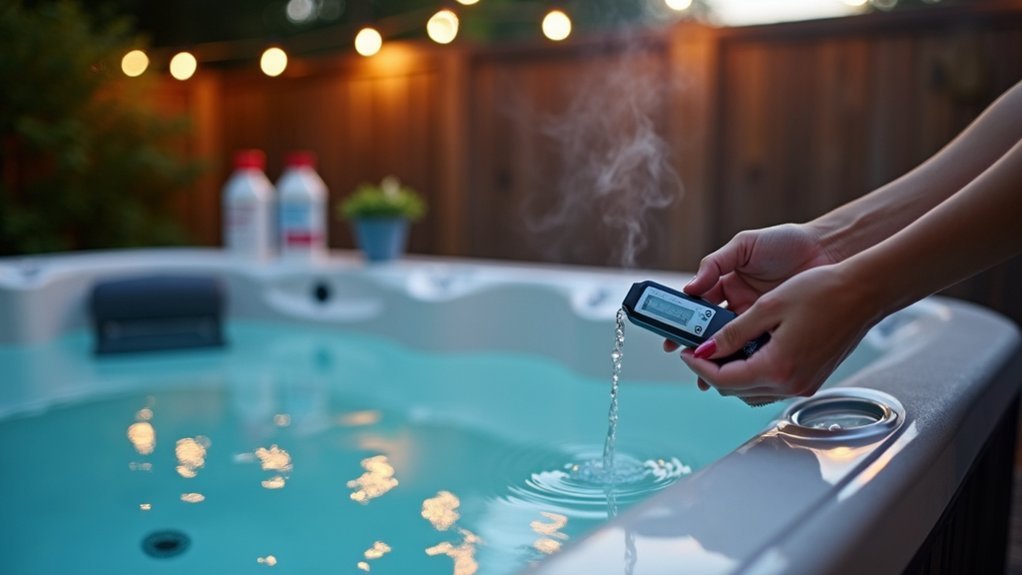
Keeping your water properly balanced matters just as much with chlorine-free systems as it does with traditional sanitizers.
When pH levels drift outside the ideal range of 7.2-7.6, your alternative sanitizer won’t work effectively, and you’ll waste money on products that can’t do their job.
Here’s what you need to monitor weekly:
- pH levels – Test twice weekly and adjust using pH increasers or decreasers to maintain peak sanitizer performance.
- Total alkalinity – Keep it between 80-120 ppm to prevent pH fluctuations that destabilize your system.
- Calcium hardness – Maintain 150-250 ppm to protect equipment and prevent scaling or corrosion.
You should also test your water monthly at a professional pool store.
They’ll identify imbalances your home test strips might miss.
Cost Comparison of Chlorine-Free Hot Tub Sanitization Methods
When you’re considering chlorine-free sanitization, you’ll want to understand both the upfront costs and what you’ll spend over time.
Systems like ozone generators and UV sanitizers require a higher initial investment than traditional chlorine, while mineral cartridges and enzyme-based products start at lower price points.
Your long-term operating expenses will vary markedly based on replacement parts, consumables, and energy usage for each method.
Initial Investment Breakdown
Switching to a chlorine-free sanitization system requires you to take into account the upfront costs before making your decision. Each method carries different price points that’ll impact your budget notably.
Here’s what you can expect to spend initially:
- Ozone generators – You’ll pay between $100-$500 for quality units that attach to your existing system
- UV-C sanitization systems – These run $150-$600 depending on the model and installation requirements
- Mineral cartridges – The most affordable option at $20-$80, though you’ll need replacements every 3-4 months
Salt water chlorine generators represent the highest initial investment, typically costing $500-$2,000 with professional installation. However, they’re often the most hands-off option long-term. Consider your maintenance preferences alongside these costs when choosing your system.
Long-Term Operating Expenses
Running a chlorine-free hot tub system affects your wallet differently depending on which method you’ve chosen. Saltwater systems require periodic cell replacements every 3-5 years, costing $200-$800 per unit. You’ll also spend approximately $20-$50 annually on salt.
Ozone generators demand bulb replacements every 2-3 years at $50-$150 each.
UV systems need annual bulb changes, typically running $80-$200.
Mineral sanitizers require cartridge replacements every 3-4 months, adding $150-$300 yearly to your budget. Biguanide products cost noticeably more than chlorine—expect $40-$60 monthly for chemicals alone.
Energy costs vary too. Ozone and UV systems increase electricity usage slightly, while saltwater systems run their generators several hours daily.
When calculating your true operating expenses, factor in water testing supplies, filter replacements, and potential equipment repairs specific to your chosen system.
Frequently Asked Questions
Can I Switch From Chlorine to a Non-Chlorine Sanitizer Mid-Season?
Yes, you can switch mid-season. You’ll need to drain your hot tub, clean it thoroughly, and refill with fresh water before introducing your new sanitizer system like bromine, salt, or mineral purifiers.
How Long Should I Wait Before Using My Hot Tub After Adding Alternative Sanitizers?
You should wait 15-30 minutes after adding alternative sanitizers before entering your hot tub. Test your water to make sure sanitizer levels are within the safe range recommended by your specific product’s manufacturer.
Are Chlorine-Free Sanitizers Safe for Pregnant Women and Young Children?
You should consult your doctor before using any hot tub while pregnant. For young children, most chlorine-free sanitizers are gentler than chlorine, but you’ll still want pediatrician approval before allowing kids under five.
Will Non-Chlorine Methods Affect My Hot Tub Warranty Coverage?
You should check your specific warranty documentation before switching sanitizers. Most manufacturers won’t void coverage for alternative methods, but some require approved products. Contact your dealer directly to confirm you’re maintaining valid warranty protection.
How Often Should I Drain My Hot Tub When Using Alternative Sanitizers?
You should drain your hot tub every 2-3 months when using alternative sanitizers. However, you’ll need to monitor water quality closely since some non-chlorine methods may require more frequent draining to maintain proper balance.




Leave a Reply