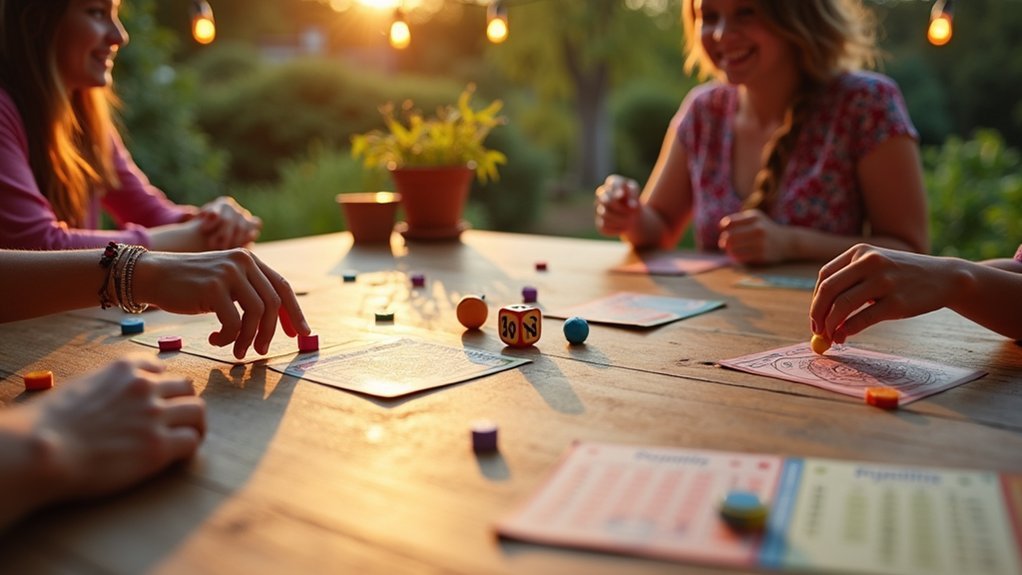
You can transform your backyard into a multilingual playground with games kids already love. Try calling “Luz roja, luz verde” during Red Light, Green Light, or have seekers count in Japanese during Hide and Seek. Simon Says becomes a language lesson when you rotate callers who speak different languages, while international tag variations like Japan’s “Oni Gokko” introduce cultural traditions through play. These seven games turn outdoor fun into natural language learning opportunities for the whole neighborhood.
Red Light, Green Light: Teaching Commands in Multiple Languages
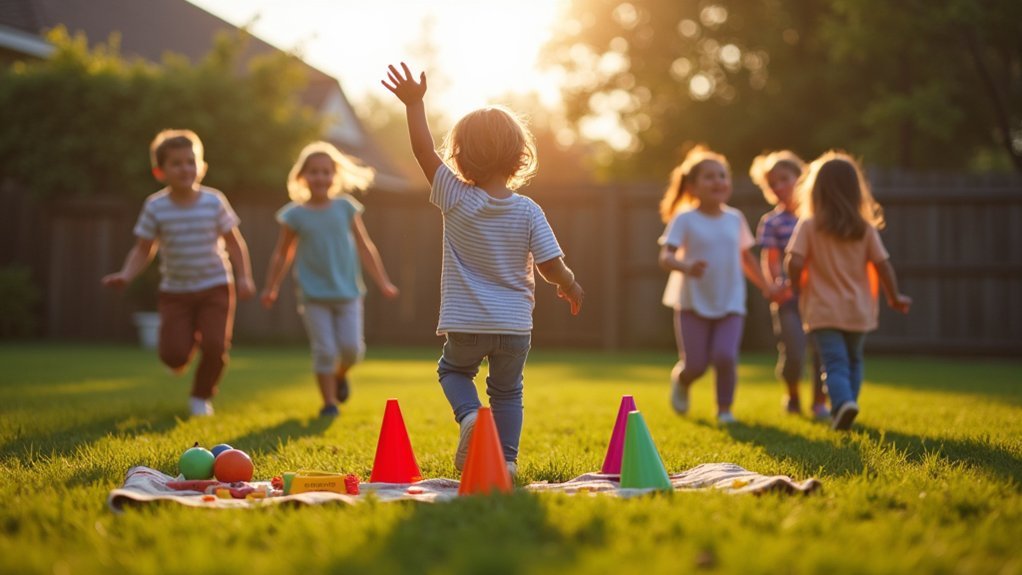
Transform your next game of Red Light, Green Light into a language lesson that’ll stick with kids long after they’ve caught their breath. Start by teaching players the stop-and-go commands in Spanish: “Luz roja” and “Luz verde.”
Once they’ve mastered those, rotate through other languages like French (“Feu rouge, feu vert”) or Mandarin (“Hóng dēng, lǜ dēng”).
You’ll find that physical movement anchors vocabulary in memory far better than flashcards ever could. Kids associate the freeze response with the foreign phrase, creating lasting neural connections.
Mix things up by letting children take turns as the caller. They’ll practice pronunciation while their friends reinforce comprehension through action.
Add more commands like “Yellow light” for slow motion, expanding vocabulary naturally through play.
Multilingual Simon Says for Backyard Language Learning
Simon Says takes the language-learning momentum from Red Light, Green Light and cranks it up several notches. You’re now commanding players to touch their nose, jump twice, or spin around—all in different languages. This variety exposes children to body parts, action verbs, and numbers simultaneously.
Rotate the “Simon” role among players who speak different languages. When Maria calls out “Simón dice toca tus orejas,” everyone learns Spanish ear vocabulary through immediate physical response. This kinesthetic connection cements words in memory far better than flashcards ever could.
You can layer complexity by combining languages within single commands. Try “Simon says hop três times” to blend English and Portuguese. Kids won’t just hear new words—they’ll embody them. The backyard becomes a living language lab where mistakes trigger laughter, not anxiety.
International Tag Variations From Around the World
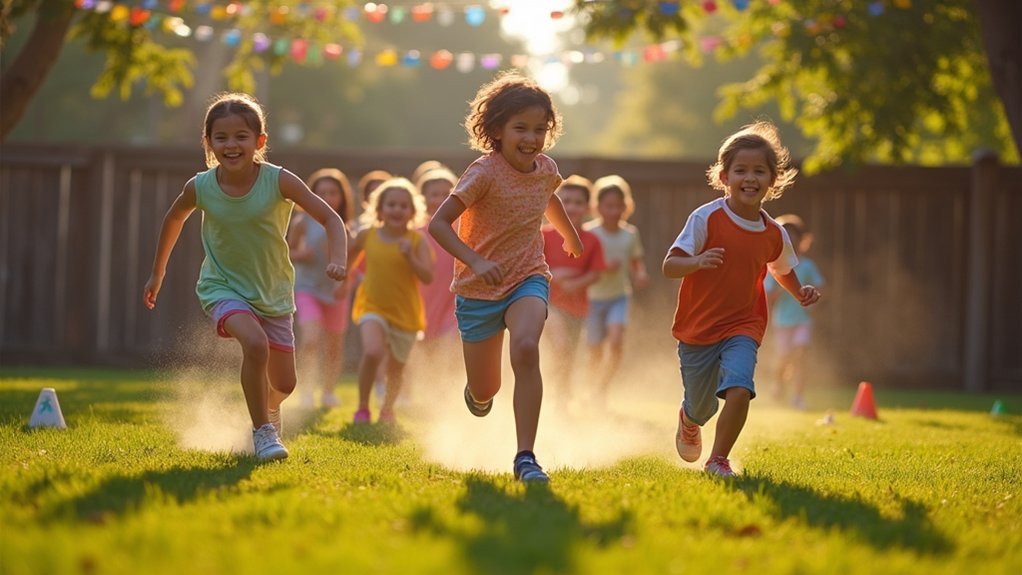
Chase games exist in every culture, and bringing international tag variations to your backyard introduces children to global play traditions while sneaking in language exposure. You’ll find these games spark curiosity about different countries while keeping kids active.
Tag games from around the world turn your backyard into a global playground where kids learn through movement.
Try Japan’s “Oni Gokko,” where the tagger shouts “Oni!” (demon) before chasing. In Spain, “El Pañuelo” combines tag with a handkerchief-grabbing race. Germany’s “Wer hat Angst vorm schwarzen Mann?” requires players to answer questions before running.
You can teach counting in different languages by having taggers count to ten in French, Mandarin, or Arabic before pursuit begins. Kids naturally absorb vocabulary when it’s tied to exciting moments.
Create a rotating schedule featuring one country’s version weekly. Post key phrases on a visible board so everyone learns the essential words together.
Hide and Seek With Counting in Different Languages
You can transform a classic game of hide and seek into a language lesson by having the seeker count in a different language each round.
Children naturally absorb new vocabulary when it’s tied to the excitement of gameplay, making number memorization feel effortless.
From Spanish’s “uno, dos, tres” to Japanese’s “ichi, ni, san,” you’re introducing your kids to cultural counting traditions that have been passed down through generations of play.
Learning Numbers Through Play
Hide and seek opens up a natural opportunity to weave language learning into outdoor play. When you’re the seeker, you’ll count to ten in a new language while others scatter to their hiding spots. Your children absorb pronunciation naturally through repetition, and the excitement of the game reinforces memory retention.
| Language | Count to 5 | Cultural Connection |
|---|---|---|
| Spanish | uno, dos, tres, cuatro, cinco | Connects neighbors across generations |
| Mandarin | yī, èr, sān, sì, wǔ | Builds bridges with Chinese families |
| French | un, deux, trois, quatre, cinq | Honors Francophone community members |
| Arabic | wahid, ithnan, thalatha, arba’a, khamsa | Welcomes Middle Eastern playmates |
Rotate languages each round so everyone teaches and learns. You’re building community while your kids develop multilingual foundations through joyful play.
Cultural Counting Traditions
Beyond simple number sequences, many cultures have developed unique counting rhymes and traditions that transform hide and seek into a richer experience. You’ll discover that counting games carry stories, history, and values passed down through generations.
When you incorporate these traditions into your backyard games, you’re teaching children more than numbers—you’re sharing cultural heritage.
- Japanese “Daruma-san ga koronda” uses a rhythmic phrase instead of numbers, teaching patience and timing
- German counting rhymes often include folk tale references that spark storytelling conversations
- Spanish “El escondite inglés” combines counting with movement rules unique to Latin cultures
- Korean counting songs emphasize group harmony and collective play
- Nigerian counting games frequently incorporate call-and-response patterns that build community connection
Cultural Jump Rope Rhymes and Chants
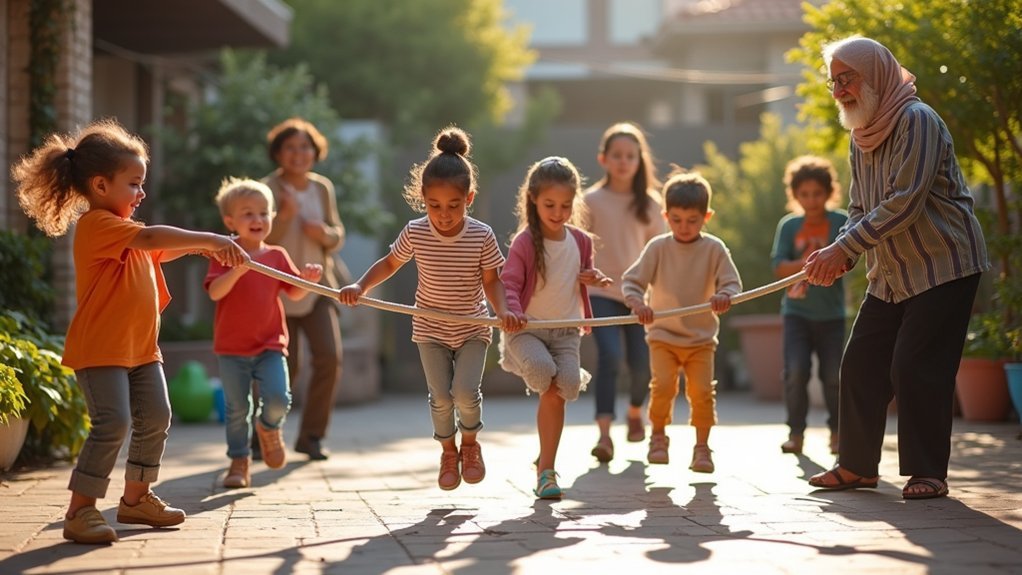
Where did children first discover that rhythmic chanting makes jumping rope infinitely more fun? You’ll find these musical traditions span every continent, with each culture adding unique rhythms and wordplay to the activity.
When you introduce multilingual rhymes to your backyard games, you’re preserving oral traditions while teaching children new languages through play. Kids naturally memorize foreign phrases when they’re set to catchy beats.
| Language | Traditional Rhyme Opening |
|---|---|
| Spanish | “Salta, salta, la ranita” |
| Japanese | “Ichi, ni, san, shi” |
| German | “Eins, zwei, Polizei” |
| French | “Un, deux, trois, soleil” |
| Swahili | “Moja, mbili, tatu” |
You can teach these rhymes progressively, starting with counting sequences before advancing to full verses. Children absorb pronunciation naturally through repetition.
Multilingual Scavenger Hunts for Neighborhood Gatherings
Scattering clue cards in multiple languages across your neighborhood transforms an ordinary scavenger hunt into a cultural adventure. You’ll watch children decode Spanish riddles, follow Mandarin directions, and celebrate when they crack Arabic puzzles. Each clue becomes a mini language lesson wrapped in excitement.
Turning neighborhood scavenger hunts multilingual transforms simple play into doorways of cultural discovery and connection.
Partner with bilingual neighbors to craft authentic clues that reflect genuine expressions. You can color-code cards by difficulty or language family, making the hunt accessible to all ages.
- Build bridges between families who might otherwise never interact
- Celebrate heritage by featuring languages spoken in your community
- Create teamwork as kids with different language skills collaborate
- Normalize multilingualism through play rather than formal instruction
- Generate pride in children who see their home language valued publicly
Global Ball Games That Bridge Language Barriers
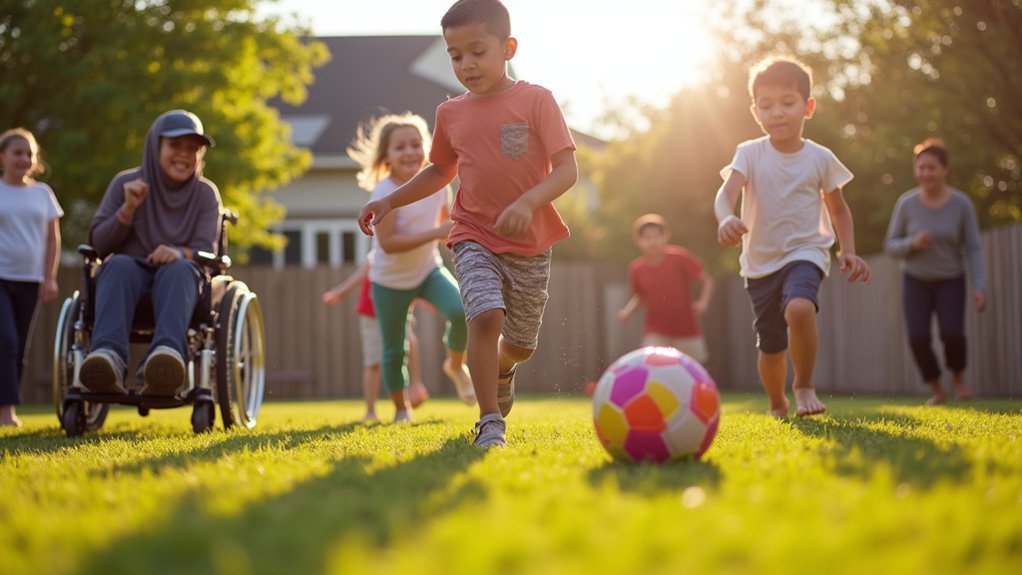
You don’t need a shared language to organize a game of kickball since the rules translate across cultures with simple hand gestures and demonstrations.
Bocce offers another perfect example, as players from Italian nonnas to Brazilian teenagers instantly grasp the objective of rolling balls closest to the target.
These global ball games let your multilingual neighborhood connect through play while spoken words take a backseat to universal competitive fun.
Universal Kickball Rules Work
Because kickball relies on actions rather than words, it naturally transcends language differences and brings players together regardless of their native tongue. You’ll find that pointing to bases, demonstrating kicks, and using simple hand signals communicate everything players need to know. The game’s structure mirrors baseball, making it instantly recognizable across cultures.
You can establish these universal elements to guarantee smooth gameplay:
- Visual demonstrations – Show new players the kicking motion and base-running path instead of explaining verbally
- Numbered bases – Use color-coded or numbered markers that don’t require language comprehension
- Hand signals – Develop consistent gestures for “safe,” “out,” and “foul”
- Rotating positions – Let everyone experience each role naturally
- Celebratory high-fives – Reinforce positive moments through universal physical expressions
Bocce Crosses Cultural Divides
While kickball gets players moving at full speed, bocce offers a slower-paced alternative that bridges language gaps just as effectively.
You’ll find this Italian lawn game requires minimal verbal communication since players simply take turns tossing balls toward a target.
The rules translate across any language: throw your ball closest to the pallino to score points.
You can demonstrate the entire game in under two minutes without speaking a single word.
Players watch, understand, and immediately join in.
Bocce’s turn-based structure creates natural conversation opportunities between throws.
You’ll notice players bonding through gestures, laughter, and friendly competition regardless of their native tongues.
The game’s relaxed tempo lets participants communicate at their own comfort level while still engaging fully.
It’s strategy and socializing combined into one accessible package.
Frequently Asked Questions
How Do I Handle Children With Speech Delays During Multilingual Game Activities?
You’ll want to use visual cues, gestures, and picture cards alongside verbal instructions. Pair children with supportive peers, allow extra response time, and celebrate non-verbal participation. You’re creating inclusive fun when you adapt communication methods flexibly.
What Insurance Considerations Exist When Hosting Multilingual Community Game Events?
You’ll need general liability coverage, participant accident insurance, and potentially event cancellation protection. Don’t forget to verify volunteer coverage and consider additional policies addressing language interpreter services and accessibility accommodations for diverse attendees.
How Can Deaf or Hard-Of-Hearing Children Participate in Language-Based Backyard Games?
You can adapt games using visual cues, flashcards, and hand signals. You’ll want to incorporate sign language elements, use vibrating timers, and create gesture-based rules so everyone’s actively included in the fun.
What’s the Best Way to Resolve Conflicts When Cultural Game Rules Differ?
You’ll want to pause the game and let each child explain their version’s rules. Then, work together to blend elements from both traditions or take turns playing each variation, celebrating the differences.
How Do I Accommodate Children Who Feel Embarrassed About Their Native Language?
You’ll help by celebrating all languages equally during games. Assign multilingual roles where everyone teaches phrases, making each child the expert. You’re normalizing diversity when you incorporate various languages into game instructions and cheers naturally.




Leave a Reply