
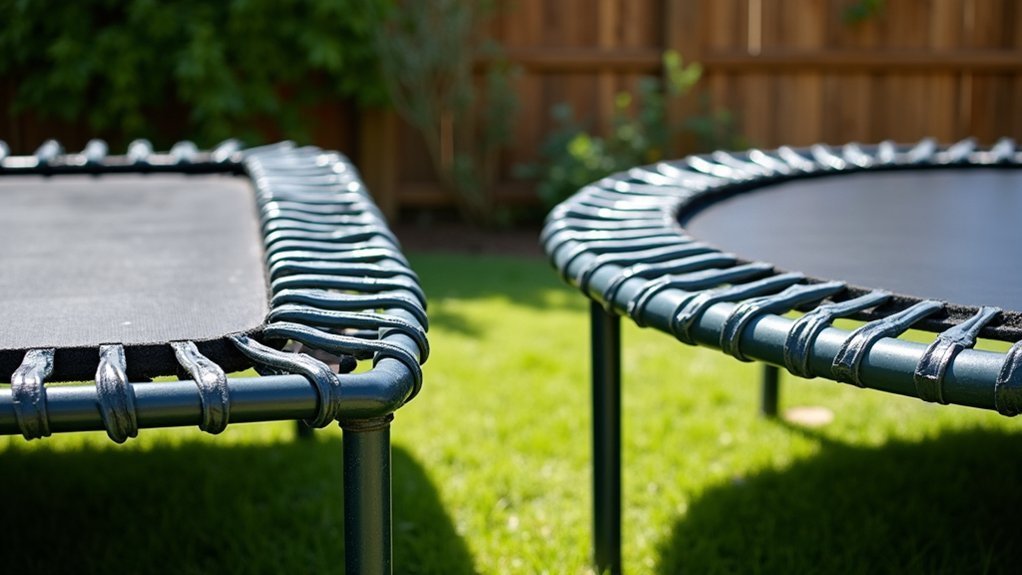
Rectangular trampolines offer more uniform bounce across the surface and greater usable space, while round ones guide jumpers toward the center for enhanced safety. You’ll find rectangles better for serious gymnastics and multiple users with weight capacities up to 800 pounds. Round models fit better in central yard spaces and cost less initially. Rectangles require more level installation but provide longer-term value for growing families. These key differences will help you make the perfect backyard choice.
Bounce Quality and Performance Differences
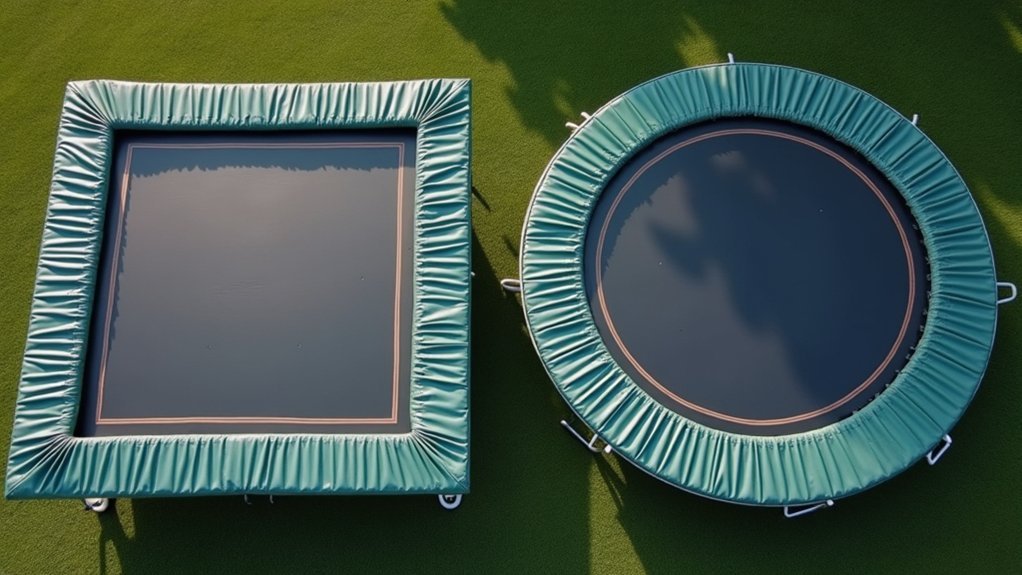
When it comes to trampolines, bounce quality is where rectangular and round models truly differentiate themselves. Rectangular trampolines feature independent springs that deliver consistent jump height regardless of your landing spot, while round trampolines vary in bounce depending on where you land.
You’ll experience higher, more uniform bounce on rectangular models, making them superior for performing tricks and structured workouts. Their design offers more usable jumping space within the same footprint, supporting aerial maneuvers and combination jumps that athletes prefer.
Round trampolines, however, naturally guide jumpers toward the center, creating a safer experience for casual users. Their central spring system means edge jumps won’t provide the same height or responsiveness as center jumps, unlike rectangular trampolines where performance remains consistent across the entire mat.
Frame Structure and Stability Comparison
How does frame design impact trampoline safety and performance? The fundamental differences between rectangular and round trampoline frames directly affect their stability, durability, and bounce consistency. Rectangular frames require more robust engineering to handle the independent spring action that creates their superior bounce profile.
- Structural Integrity – Rectangular trampolines feature reinforced corners and additional support beams to prevent frame warping under pressure, allowing for higher weight capacities (up to 800 pounds in HD models).
- Spring Distribution – The parallel spring arrangement in rectangular designs creates more consistent tension across the jumping surface compared to the radial arrangement in round models.
- Installation Requirements – You’ll need a perfectly level surface for rectangular trampolines, as their rigid frame design doesn’t adapt to uneven ground as easily as round frames.
Usable Jumping Space and Weight Distribution
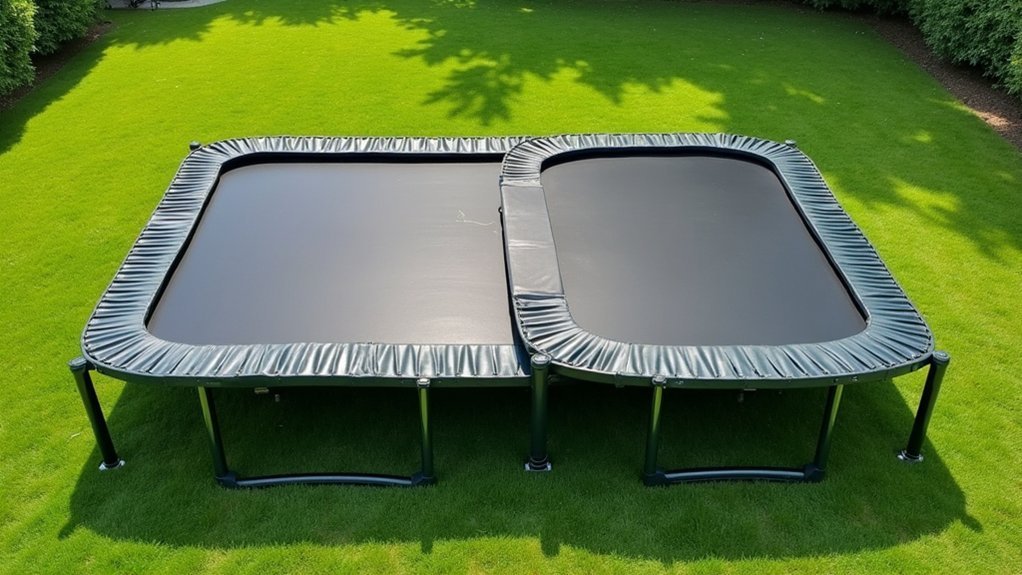
While rectangular trampolines offer more effective jumping space within their footprint, round models concentrate bounce toward the center, limiting peripheral use. You’ll find that weight distribution follows different physical principles—rectangular trampolines spread force more evenly across the surface, whereas round ones naturally direct jumpers toward the middle. This fundamental difference impacts your workout potential and trick progression, especially if you’re practicing gymnastics or need consistent rebound across the entire surface.
Surface Area Differences
Why does surface area matter so much when choosing between rectangular and round trampolines? It directly impacts your jumping experience and safety. Rectangular designs utilize space more efficiently, giving you more usable area for the same footprint.
- Maximum jumping space – Rectangular trampolines offer more usable surface within the same dimensions, allowing for better movement and trick execution compared to round models.
- Consistent bounce quality – With independent springs distributed evenly, rectangular trampolines maintain uniform bounce height across the entire mat, unlike round ones that favor center jumps.
- Performance distribution – Weight is distributed more evenly on rectangular surfaces, creating a more reliable platform regardless of where you land, while round trampolines concentrate force toward the center.
Weight Distribution Physics
The physics of weight distribution creates one of the most significant functional differences between rectangular and round trampolines. When you jump on a rectangular trampoline, each spring works independently, providing consistent bounce regardless of where you land. Round models, however, pull you toward the center due to their circular spring arrangement.
| Feature | Rectangular | Round |
|---|---|---|
| Spring Action | Independent | Interconnected |
| Bounce Consistency | Uniform across surface | Stronger in center |
| Landing Physics | Maintains height anywhere | Redirects to middle |
| Weight Response | Localized to landing area | Distributes force centrally |
This independence gives rectangular trampolines superior weight distribution properties, allowing for more controlled jumps and tricks. You’ll experience more predictable bounce patterns, which is especially valuable during workouts or when practicing aerial maneuvers at various positions across the mat.
Safety Features and Risk Assessment
When considering trampoline safety, shape plays a pivotal role in determining risk factors. Round trampolines naturally guide jumpers toward the center, reducing the chance of falling off the edge, while rectangular models provide more jumping space but require careful supervision, especially with multiple users.
The shape of your trampoline isn’t just about aesthetics—it’s a critical safety factor that influences jumping patterns and supervision requirements.
Both shapes offer comprehensive safety features:
- Enclosure options – High-density safety nets come standard on Atmos and Cirrus models, while Stratos and Orion lines include standard protective netting
- Self-closing entrances minimize the risk of accidental falls during entry and exit
- Protective padding covers springs and frames, with designs specifically engineered to prevent contact with hard poles
You’ll find rectangular trampolines generally offer higher bounce potential, which enhances performance but necessitates additional safety considerations due to the increased height jumpers can achieve.
Price Points and Long-Term Value
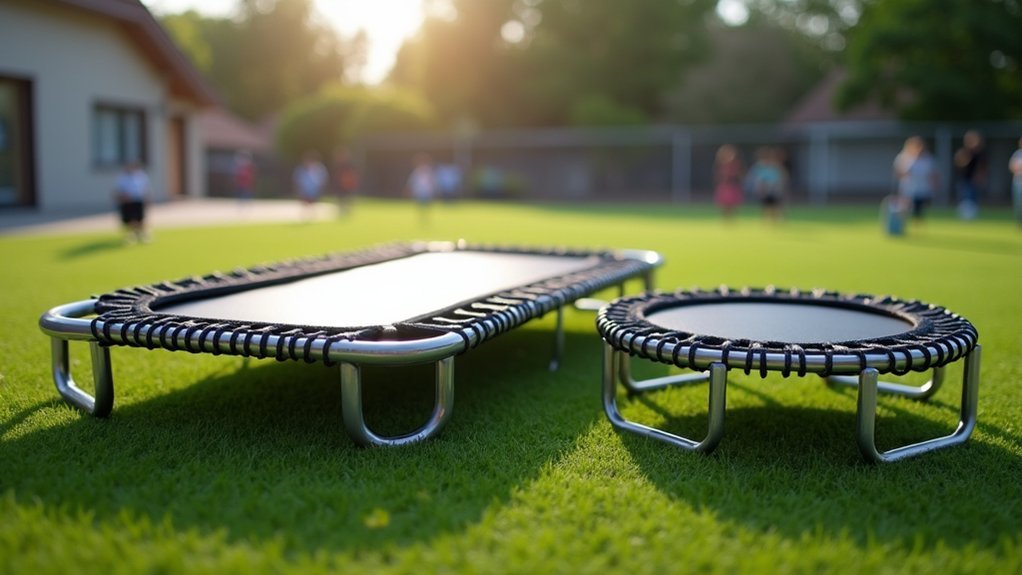
You’ll typically invest more upfront for a rectangular trampoline, but its higher weight capacity and consistent bounce across the entire surface often translate to better long-term value.
The replacement parts for rectangular models cost more than round ones, though both styles require periodic frame inspection and spring maintenance to maximize their 8-10 year potential lifespan.
When comparing total ownership costs, consider how a rectangular trampoline’s ability to accommodate growing children might prevent the need for size upgrades that round trampoline owners frequently face.
Initial Investment Comparison
Comparing price points between rectangular and round trampolines reveals a significant investment gap that buyers should consider before purchase. You’ll typically find rectangular models priced 30-50% higher than comparable round options due to their more complex construction requirements and specialized springs system.
When evaluating your initial investment, consider:
- Size-to-price ratio – Larger trampolines cost more regardless of shape, but round models offer better value per square foot of jumping surface
- Material quality – Premium woven nylon surfaces increase durability but add to upfront costs in both styles
- Intended use – The rectangular premium may be justified if you’re seeking athletic performance versus family recreation
Your budget constraints should be balanced against long-term value, as rectangular trampolines’ superior bounce characteristics might offset higher acquisition costs for serious users.
Replacement Part Costs
How much should you budget for maintenance? When comparing rectangular and round trampolines, replacement part costs vary considerably. Round models typically offer more affordable components due to their standardized designs, while rectangular trampolines often require specialized, pricier replacements.
| Part Type | Round Trampoline | Rectangular Trampoline |
|---|---|---|
| Safety Nets | $70-120 | $100-180 |
| Jump Mats | $80-150 | $150-300 |
| Frame Pads | $60-120 | $100-200 |
| Springs (Set) | $30-60 | $50-120 |
| Enclosure Poles | $40-90 | $80-160 |
Your long-term costs depend on the model line you choose. Premium series like Stratos or Orion have higher-quality but more expensive replacement parts. Keep shipping costs in mind too—many retailers offer free shipping within the continental US, which can save you $20-50 per replacement order.
Lifespan Return Analysis
Beyond replacement part costs, the true measure of a trampoline’s value emerges when analyzing its complete lifespan. When comparing rectangular and round trampolines, you’ll find significant differences in long-term value despite higher initial costs for rectangular models.
- Investment perspective – Rectangular trampolines typically cost more upfront but offer higher weight capacities (300-450 pounds vs. 200-250 pounds for round models) and superior durability, with premium models like ACON tested to withstand up to 800 pounds.
- Growth accommodation – You’ll avoid premature replacement with rectangular models as children grow, since they provide more usable jumping space.
- Material quality trade-offs – Your choice between woven nylon and polyethylene affects both initial price and longevity, with higher-quality materials extending the useful life of either shape.
Space Requirements and Backyard Fit
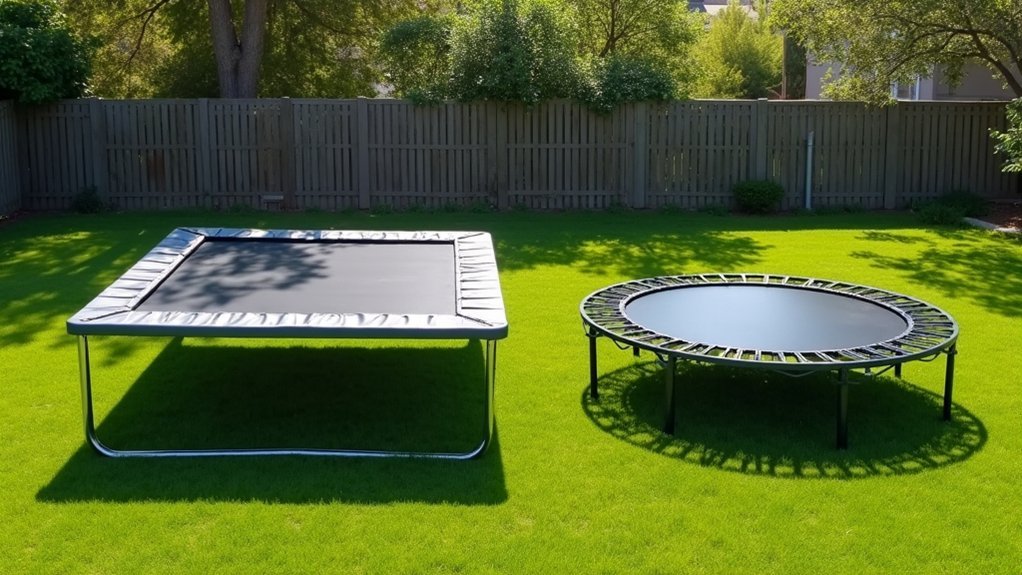
When planning your trampoline purchase, the shape of your yard dramatically influences which model will fit best. Rectangular trampolines excel in long, narrow yards or corner placements, maximizing jumping surface while utilizing otherwise awkward spaces. They’ll require more room overall but deliver superior usable area for the footprint.
Round trampolines work better in central, open spaces where you can maintain the recommended 6.5-foot safety perimeter. Though they might seem more compact, they actually provide less jumping area than similarly sized rectangular models.
For serious jumpers needing practice space for gymnastics or tricks, rectangular designs offer the advantage of consistent bounce regardless of landing position. If you’re simply seeking recreational fun in a smaller yard, a round trampoline will likely serve you well.
Ideal Users and Activity Suitability
The ideal trampoline shape varies considerably based on who’ll be jumping and their intended activities. Rectangular trampolines excel for gymnasts, aerialists, and stunt enthusiasts due to their uniform bounce and higher performance capabilities. With weight capacities ranging from 300-800 pounds depending on the model, they’re built for serious athletic development.
- Performance Athletes – Gymnasts and tumblers benefit from the predictable, independent spring action that allows precise landings regardless of position on the mat.
- Growing Families – If you’re investing long-term, rectangular models accommodate children’s developing skills and increasing weight as they mature.
- Multiple Jumpers – The enhanced spacing and center-focused bounce make rectangular trampolines safer when several people jump simultaneously, reducing collision risk.
If you prioritize athletic progression over casual bouncing, rectangular trampolines offer superior versatility despite requiring more backyard space.
Frequently Asked Questions
Should I Get a Round or Rectangle Trampoline?
Choose a rectangle if you’re training or need equal bounce throughout. Go with round if you’re on a budget or want recreational bouncing that naturally guides jumpers to the center for safety.
What Shape Trampoline Is the Best?
There’s no “best” shape – it depends on your needs. You’ll want rectangular if you’re doing gymnastics or tricks, while round is safer for beginners and casual use. Consider your space and budget too.
What Are the Benefits of a Rectangular Trampoline?
Rectangular trampolines give you consistent bounce across the entire mat, more jumping surface, and higher total bounce. You’ll enjoy better performance for tricks and stunts, making them ideal if you’re practicing gymnastics or athletics.
Why Are Rectangular Trampolines More Expensive?
Rectangular trampolines cost more because you’re paying for complex construction, higher-quality materials, larger frames, more springs, and superior performance. They’re designed for professionals and require sturdier enclosures to support the specialized jumping experience you’ll enjoy.


Leave a Reply