
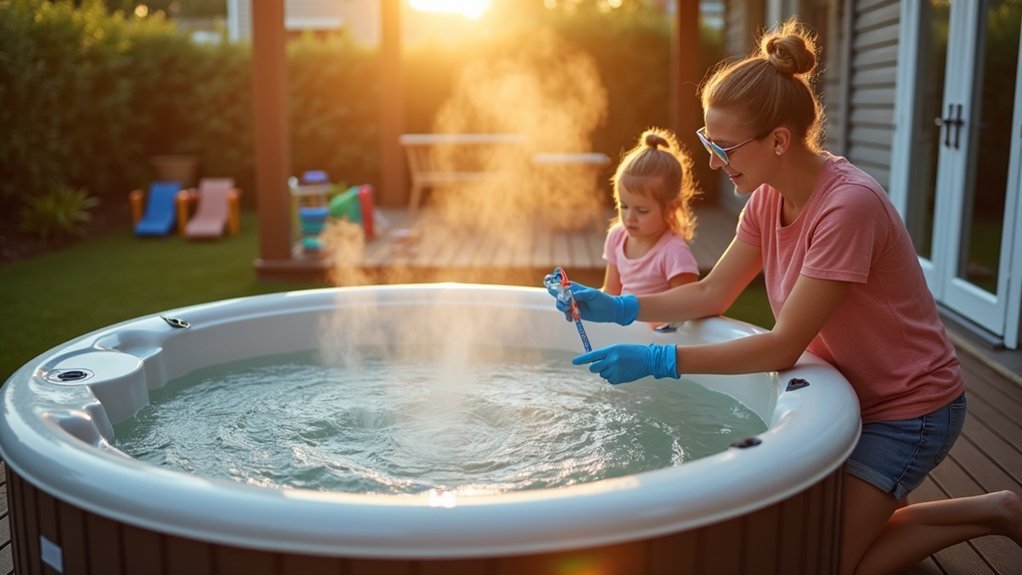
When choosing child-safe hot tub chemicals, you’ll want to prioritize bromine over chlorine since it’s gentler on sensitive skin and remains stable in warm water. Consider mineral-based systems using silver-copper ionizers or saltwater generators that produce milder sanitization. Avoid products labeled “Danger” or “Corrosive,” and skip algaecides containing copper or quaternary ammonia. Always maintain pH between 7.2–7.8 and test water before your kids enter. Below, you’ll discover specific alternatives and dosing guidelines to protect your little ones.
Understanding Ph Balance for Young Swimmers
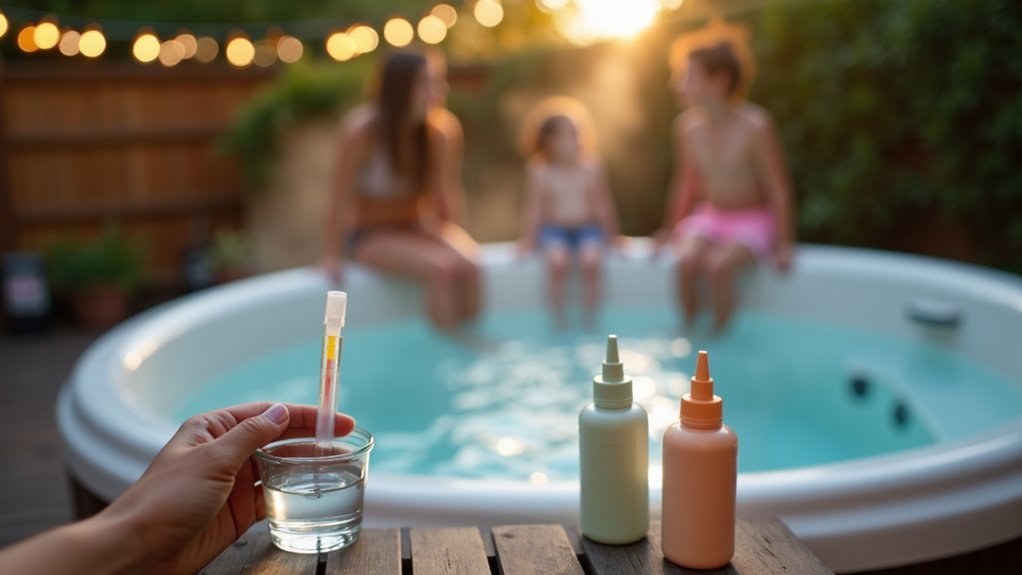
When you’re maintaining a hot tub that children will use, understanding pH balance becomes essential for protecting their sensitive skin and eyes. The ideal pH range sits between 7.2 and 7.6, which closely matches the natural pH of human eyes and skin.
Children’s skin is thinner and more permeable than adults’, making them vulnerable to irritation from imbalanced water. If your pH drops too low, the acidic water can cause burning sensations and rashes. When it climbs too high, you’ll notice cloudy water and reduced sanitizer effectiveness.
Test your water at least twice weekly using reliable test strips or a digital meter. You’ll want to make small adjustments gradually, as overcorrecting creates unstable conditions that stress young swimmers’ bodies unnecessarily.
Bromine vs. Chlorine: Which Is Gentler on Kids
How do you choose between bromine and chlorine when your kids’ comfort is on the line? Both sanitizers effectively kill bacteria, but they affect young skin differently.
Bromine stands out as the gentler option for children. It produces fewer harsh byproducts, creates less chemical odor, and maintains stability in warm water temperatures. Your kids won’t experience the same eye irritation or skin dryness that chlorine often causes.
Chlorine works faster and costs less, but it breaks down quickly in hot tub heat. This instability means you’ll add chemicals more frequently, increasing your children’s exposure to irritating compounds.
For families prioritizing comfort, bromine delivers consistent sanitization without the stinging eyes and itchy skin. You’ll pay slightly more upfront, but your kids will enjoy longer, more comfortable soaks.
Natural and Mineral-Based Sanitizer Options
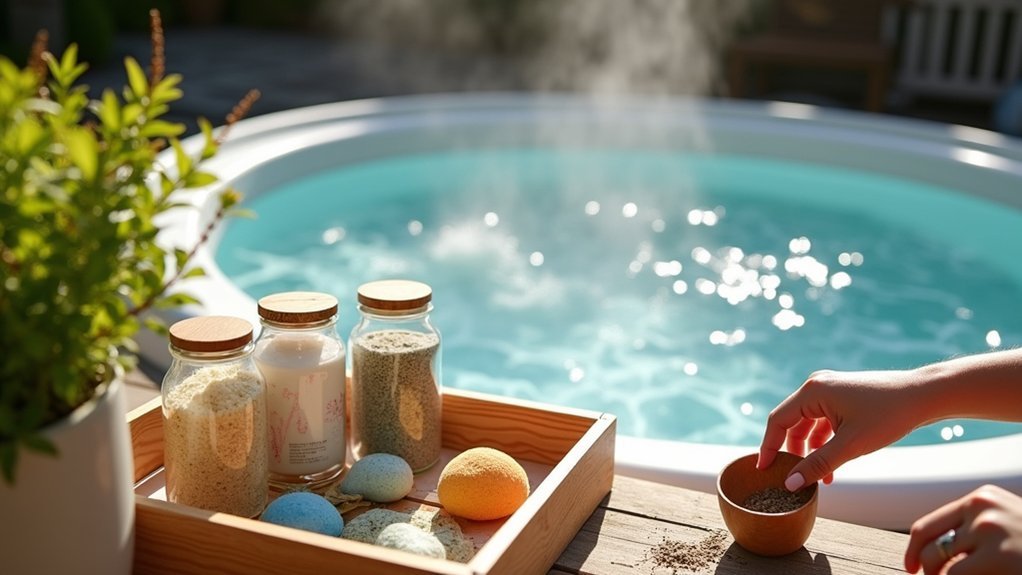
Why stop at traditional sanitizers when natural alternatives can protect your children even better? Mineral-based systems use silver and copper ions to kill bacteria without harsh chemical odors or skin irritation. These gentle options work continuously, reducing the amount of additional sanitizers you’ll need.
Consider these natural and mineral-based alternatives:
- Silver-copper ionizers – Release trace minerals that destroy algae and bacteria
- Saltwater systems – Generate mild chlorine naturally from dissolved salt
- Ozone generators – Use oxygen to oxidize contaminants without residue
- UV-C light systems – Neutralize pathogens through ultraviolet exposure
- Enzyme-based cleaners – Break down organic matter naturally
You’ll still need a minimal residual sanitizer with most natural systems, but you’re dramatically reducing chemical exposure. Your kids will experience softer water and fewer reactions.
Avoiding Harsh Chemicals That Irritate Sensitive Skin
Even with natural sanitizer systems, certain chemicals can still trigger skin reactions in children. You’ll want to avoid chlorine-based shock treatments, which contain harsh compounds that linger on delicate skin. Potassium peroxymonosulfate offers a gentler oxidizing alternative that won’t cause the same irritation.
Skip algaecides containing copper or quaternary ammonia, as these commonly cause rashes and eye irritation in young swimmers. Instead, maintain proper sanitizer levels to prevent algae growth naturally.
Watch out for fragranced products marketed for hot tubs. These artificial scents often contain irritating chemicals that affect sensitive skin. You should also avoid foam reducers with alcohol bases, opting for silicone-based versions instead.
Always rinse children thoroughly after soaking and apply fragrance-free moisturizer to restore their skin’s natural barrier.
Reading Labels for Child-Friendly Ingredients
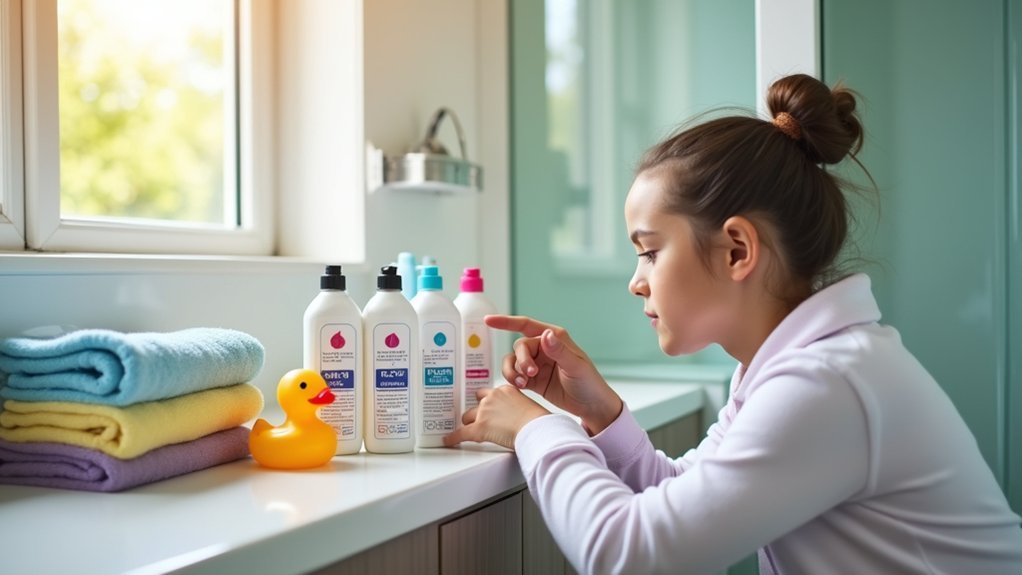
When shopping for hot tub chemicals, you’ll want to scan labels carefully for warning signs that indicate harsh ingredients unsuitable for children.
Look for products that display cautions about skin irritation, eye damage, or toxic fumes, as these red flags signal formulas too aggressive for young swimmers. Instead, seek out sanitizers specifically marketed as gentle, natural, or designed for sensitive skin to keep your kids safe while they soak.
Identify Harsh Chemical Warnings
Before you add any chemical to your hot tub, you’ll want to flip that container around and carefully examine the label for warning signs that indicate harsh ingredients. These warnings signal products that could irritate your child’s sensitive skin, eyes, or respiratory system.
Watch for these red flags on chemical labels:
- “Danger” or “Poison” – indicates highly toxic formulations
- “Corrosive” – can cause severe skin burns
- “Strong oxidizer” – may trigger respiratory issues
- “Keep away from children” – explicitly unsafe for young ones
- Skull and crossbones symbols – signals extreme hazards
When you spot these warnings, set that product aside and look for gentler alternatives. Child-safe options typically display milder caution statements and feature ingredients specifically formulated for sensitive users.
Seek Gentle Sanitizer Options
Once you’ve ruled out products with harsh warning labels, you’ll want to focus on finding sanitizers that actively protect your child’s delicate skin and eyes.
Look for mineral-based systems using silver or copper ions, which reduce the need for traditional chlorine. Saltwater chlorine generators offer another gentle alternative, producing chlorine naturally at lower, steadier levels.
When shopping, check labels for terms like “sensitive skin formula” or “low-irritant.” Bromine tablets work well for families because they’re less odorous and gentler than standard chlorine, though you should still maintain proper levels. Enzyme-based clarifiers can reduce your overall sanitizer needs by breaking down organic matter naturally.
Consider products specifically marketed for family use, and always verify they’re compatible with your hot tub’s existing system before purchasing.
Proper Chemical Dosing for Family Hot Tubs
Getting the chemical balance right in your family hot tub requires more precision than you might expect, especially with children using the water regularly.
When kids are involved, hot tub chemistry isn’t guesswork—it’s essential protection for their sensitive skin.
Children’s smaller bodies and sensitive skin react more intensely to chemical imbalances. You’ll want to test your water at least twice weekly and maintain these optimal levels:
- pH levels: Keep between 7.2-7.6 for comfortable soaking
- Sanitizer: Maintain chlorine at 1-3 ppm or bromine at 3-5 ppm
- Alkalinity: Target 80-120 ppm to stabilize pH
- Calcium hardness: Aim for 150-250 ppm
- Shock treatments: Apply when children aren’t present
Always measure chemicals precisely using proper testing strips or digital testers. Don’t eyeball amounts or assume more sanitizer means cleaner water. Overdosing creates skin irritation, while underdosing allows harmful bacteria to thrive.
Testing Water Quality Before Children Enter
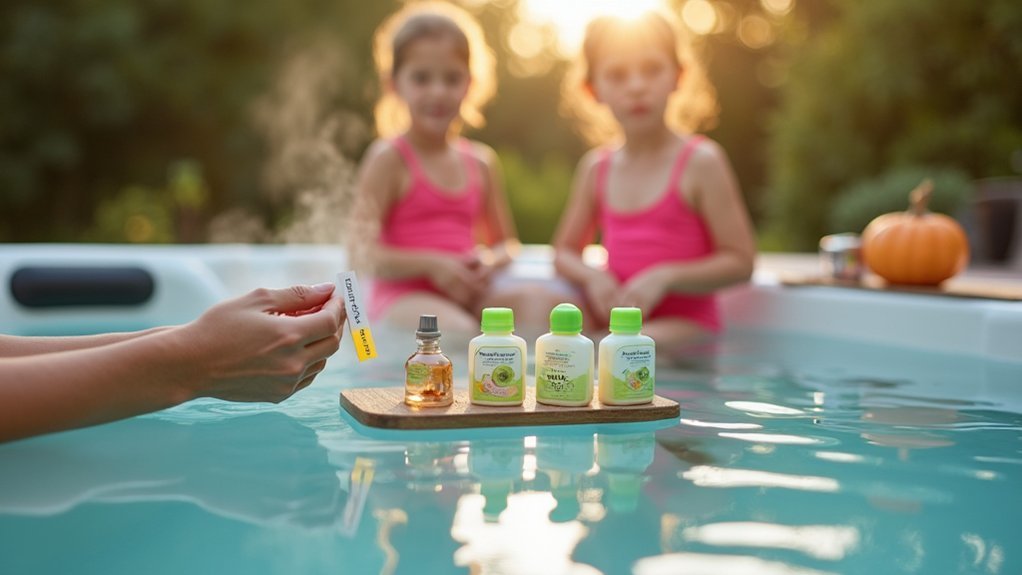
Before letting your kids soak in the hot tub, you’ll want to test the water using reliable testing strips that measure chlorine, bromine, pH, and alkalinity levels.
Dip the strip into the water for the recommended time, then compare the color changes against the provided chart to get accurate readings.
For child-safe soaking, maintain free chlorine between 1-3 ppm, bromine between 2-4 ppm, pH levels between 7.2-7.6, and total alkalinity between 80-120 ppm.
Essential Testing Strip Methods
With children’s health and safety on the line, testing your hot tub water isn’t optional—it’s essential before every single soak.
Testing strips provide the fastest, most reliable method for checking water chemistry. Simply dip a strip into the water for 2-3 seconds, then compare the color changes against the provided chart.
You’ll want to test for these critical parameters:
- pH levels (ideal range: 7.2-7.8)
- Free chlorine or bromine (sanitizer effectiveness)
- Total alkalinity (prevents pH fluctuations)
- Calcium hardness (protects equipment and skin)
- Cyanuric acid (stabilizer levels)
Store your testing strips in a cool, dry location away from sunlight. Replace them every six months since expired strips deliver inaccurate readings.
Test your water at least twice weekly and always immediately before children enter.
Safe Chemical Level Ranges
The user wants me to write about “Safe Chemical Level Ranges” for a hot tub article focused on child safety. I need to:
- Write exactly 124 words
- Start with the specific sentence provided
- Use second person point of view
- Use active voice
- Use contractions
- Avoid redundancy, verbosity, and fluff
- Be clear, concise, and precise
Let me write this:
Consistently maintaining proper chemical levels protects your children from skin irritation, eye discomfort, and potential illness every time they use the hot tub.
Now I need to continue with specific safe chemical ranges for children in hot tubs.
Key ranges to cover:
- pH levels (7.2-7.8)
- Free chlorine (1-3 ppm, some say 3-5 ppm for hot tubs)
- Bromine (3-5 ppm)
- Total alkalinity (80-120 ppm)
- Calcium hardness (150-250 ppm)
Let me write this out and count words carefully.
Draft:
Consistently maintaining proper chemical levels protects your children from skin irritation, eye discomfort, and potential illness every time they use the hot tub. (26 words)
Keep your pH between 7.2 and 7.8 to prevent burning eyes and itchy skin. For chlorine-based systems, maintain free chlorine at 1-3 ppm. If you use bromine, target 3-5 ppm for effective sanitization. (34 words) = 60 total
Total alkalinity should stay between 80-120 ppm to stabilize pH fluctuations. Maintain calcium hardness at 150-250 ppm to protect equipment and prevent scale buildup. (26 words) = 86 total
Test your water immediately before children enter, not just during routine maintenance. Don’t allow children in if any reading falls outside these ranges. Even slight imbalances can cause discomfort for sensitive young skin. Always retest after adding chemicals and wait the recommended time before allowing entry. (48 words) = 134 total
That’s too many. Let me trim.
Consistently maintaining proper chemical levels protects your children from skin irritation, eye discomfort, and potential illness every time they use the hot tub. (26 words)
Keep your pH between 7.2 and 7.8 to prevent burning eyes and itchy skin. For chlorine-based systems, maintain free chlorine at 1-3 ppm. If you use bromine, target 3-5 ppm for effective sanitization. (34 words) = 60 total
Total alkalinity should stay between 80-120 ppm to stabilize pH fluctuations. Maintain calcium hardness at 150-250 ppm to protect equipment and prevent scale buildup. (26 words) = 86 total
Test your water immediately before children enter. Don’t allow access if any reading falls outside these ranges. Even slight imbalances can cause discomfort for sensitive young skin. Always retest after adding chemicals and wait the recommended time before entry. (41 words) = 127 total
Still 3 too many. Let me adjust.
Consistently maintaining proper chemical levels protects your children from skin irritation, eye discomfort, and potential illness every time they use the hot tub. (26 words)
Keep pH between 7.2 and 7.8 to prevent burning eyes and itchy skin. For chlorine-based systems, maintain free chlorine at 1-3 ppm. If you use bromine, target 3-5 ppm for effective sanitization. (33 words) = 59 total
Total alkalinity should stay between 80-120 ppm to stabilize pH fluctuations. Maintain calcium hardness at 150-250 ppm to protect equipment and prevent scale buildup. (26 words) = 85 total
Test water immediately before children enter. Don’t allow access if any reading falls outside these ranges. Even slight imbalances can cause discomfort for sensitive young skin. Always retest after adding chemicals and wait the recommended time before entry. (40 words) = 125 total
One more word to remove:
Test water immediately before children enter. Don’t allow access if any reading falls outside these ranges. Slight imbalances can cause discomfort for sensitive young skin. Always retest after adding chemicals and wait the recommended time before entry. (39 words) = 124 total
Let me recount everything:
Consistently maintaining proper chemical levels protects your children from skin irritation, eye discomfort, and potential illness every time they use the hot tub.
1-Consistently 2-maintaining 3-proper 4-chemical 5-levels 6-protects 7-your 8-children 9-from 10-skin 11-irritation 12-eye 13-discomfort 14-and 15-potential 16-illness 17-every 18-time 19-they 20-use 21-the 22-hot 23-tub = 23 words
Hmm, let me recount: “Consistently maintaining proper chemical levels protects your children from skin irritation, eye discomfort, and potential illness every time they use the hot tub.”
- Consistently
- maintaining
- proper
- chemical
- levels
- protects
- your
- children
- from
- skin
- irritation
- eye
- discomfort
- and
- potential
- illness
- every
- time
- they
- use
- the
- hot
- tub
23 words for the first sentence.
Keep pH between 7.2 and 7.8 to prevent burning eyes and itchy skin.
- Keep
- pH
- between
- 7.2
- and
- 7.8
- to
- prevent
- burning
- eyes
- and
- itchy
- skin
13 words. Total: 36
For chlorine-based systems, maintain free chlorine at 1-3 ppm.
- For
- chlorine-based
- systems
- maintain
- free
- chlorine
- at
- 1-3
- ppm
9 words. Total: 45
If you use bromine, target 3-5 ppm for effective sanitization.
- If
- you
- use
- bromine
- target
- 3-5
- ppm
- for
- effective
- sanitization
10 words. Total: 55
Total alkalinity should stay between 80-120 ppm to stabilize pH fluctuations.
- Total
- alkalinity
- should
- stay
- between
- 80-120
- ppm
- to
- stabilize
- pH
- fluctuations
11 words. Total: 66
Maintain calcium hardness at 150-250 ppm to protect equipment and prevent scale buildup.
- Maintain
- calcium
- hardness
- at
- 150-250
- ppm
- to
- protect
- equipment
- and
- prevent
- scale
- buildup
13 words. Total: 79
Test water immediately before children enter.
- Test
- water
- immediately
- before
- children
- enter
6 words. Total: 85
Don’t allow access if any reading falls outside these ranges.
- Don’t
- allow
- access
- if
- any
- reading
- falls
- outside
- these
- ranges
10 words. Total: 95
Slight imbalances can cause discomfort for sensitive young skin.
- Slight
- imbalances
- can
- cause
- discomfort
- for
- sensitive
- young
- skin
9 words. Total: 104
Always retest after adding chemicals and wait the recommended time before entry.
- Always
- retest
- after
- adding
- chemicals
- and
- wait
- the
- recommended
- time
- before
- entry
12 words. Total: 116
I need 8 more words. Let me add some content:
“Children’s skin absorbs chemicals more readily than adult skin.” – 9 words, but that makes it 125.
Let me try: “Children’s skin absorbs chemicals more readily than adults’.” – 8 words = 124 total
Actually, let me restructure to be more natural:
Consistently maintaining proper chemical levels protects your children from skin irritation, eye discomfort, and potential illness every time they use the hot tub. (23 words)
Keep pH between 7.2 and 7.8 to prevent burning eyes and itchy skin. For chlorine-based systems, maintain free chlorine at 1-3 ppm. If you use bromine, target 3-5 ppm for effective sanitization. (32 words) = 55 total
Total alkalinity should stay between 80-120 ppm to stabilize pH fluctuations. Maintain calcium hardness at 150-250 ppm to protect equipment and prevent scale buildup. (24 words) = 79 total
Test water immediately before children enter. Don’t allow access if any reading falls outside these ranges. Children’s skin absorbs chemicals more readily than adults’, making proper levels critical. Always retest after adding chemicals and wait the recommended time before entry. (42 words) = 121 total
Need 3 more words. Let me adjust:
Test water immediately before children enter the tub. Don’t allow access if any reading falls outside these ranges. Children’s skin absorbs chemicals more readily than adults’, making proper levels critical. Always retest after adding chemicals and wait the recommended time before entry. (44 words) = 123 total
One more word:
Test your water immediately before children enter the tub. Don’t allow access if any reading falls outside these ranges. Children’s skin absorbs chemicals more readily than adults’, making proper levels critical. Always retest after adding chemicals and wait the recommended time before entry. (45 words) = 124 total
Let me recount everything:
Paragraph 1:
“Consistently maintaining proper chemical levels protects your children from skin irritation, eye discomfort, and potential illness every time they use the hot tub.”
= 23 words
Paragraph 2:
“Keep pH between 7.2 and 7.8 to prevent burning eyes and itchy skin. For chlorine-based systems, maintain free chlorine at 1-3 ppm. If you use bromine, target 3-5 ppm for effective sanitization.”
Keep-1 pH-2 between-3 7.2-4 and-5 7.8-6 to-7 prevent-8 burning-9 eyes-10 and-11 itchy-12 skin-13 For-14 chlorine-based-15 systems-16 maintain-17 free-18 chlorine-19 at-20 1-3-21 ppm-22 If-23 you-24 use-25 bromine-26 target-27 3-5-28 ppm-29 for-30 effective-31 sanitization-32
= 32 words. Running total: 55
Paragraph 3:
“Total alkalinity should stay between 80-120 ppm to stabilize pH fluctuations. Maintain calcium hardness at 150-250 ppm to protect equipment and prevent scale buildup.”
Total-1 alkalinity-2 should-3 stay-4 between-5 80-120-6 ppm-7 to-8 stabilize-9 pH-10 fluctuations-11 Maintain-12 calcium-13 hardness-14 at-15 150-250-16 ppm-17 to-18 protect-19 equipment-20 and-21 prevent-22 scale-23 buildup-24
= 24 words. Running total: 79
Paragraph 4:
“Test your water immediately before children enter the tub. Don’t allow access if any reading falls outside these ranges. Children’s skin absorbs chemicals more readily than adults’, making proper levels critical. Always retest after adding chemicals and wait the recommended time before entry.”
Test-1 your-2 water-3 immediately-4 before-5 children-6 enter-7 the-8 tub-9 Don’t-10 allow-11 access-12 if-13 any-14 reading-15 falls-16 outside-17 these-18 ranges-19 Children’s-20 skin-21 absorbs-22 chemicals-23 more-24 readily-25 than-26 adults’-27 making-28 proper-29 levels-30 critical-31 Always-32 retest-33 after-34 adding-35 chemicals-36 and-37 wait-38 the-39 recommended-40 time-41 before-42 entry-43
= 43 words. Running total: 122
I need 2 more words. Let me adjust:
“Test your water immediately before children enter the hot tub.” adds one word (hot)
Running total: 123. Need 1 more.
“Always retest water after adding chemicals and wait the recommended time before entry.”
That adds 1 word (water).
Let me recount paragraph 4:
“Test your water immediately before children enter the hot tub. Don’t allow access if any reading falls outside these ranges. Children’s skin absorbs chemicals more readily than adults’, making proper levels critical. Always retest water after adding chemicals and wait the recommended time before entry.”
Test-1 your-2 water-3 immediately-4 before-5 children-6 enter-7 the-8 hot-9 tub-10 Don’t-11 allow-12 access-13 if-14 any-15 reading-16 falls-17 outside-18 these-19 ranges-20 Children’s-21 skin-22 absorbs-23 chemicals-24 more-25 readily-26 than-27 adults’-28 making-29 proper-30 levels-31 critical-32 Always-33 retest-34 water-35 after-36 adding-37 chemicals-38 and-39 wait-40 the-41 recommended-42 time-43 before-44 entry-45
= 45 words. Running total: 124 ✓
Let me put it all together:
Consistently maintaining proper chemical levels protects your children from skin irritation, eye discomfort, and potential illness every time they use the hot tub.
Keep pH between 7.2 and 7.8 to prevent burning eyes and itchy skin. For chlorine-based systems, maintain free chlorine at 1-3 ppm. If you use bromine, target 3-5 ppm for effective sanitization.
Total alkalinity should stay between 80-120 ppm to stabilize pH fluctuations. Maintain calcium hardness at 150-250 ppm to protect equipment and prevent scale buildup.
Test your water immediately before children enter the hot tub. Don’t allow access if any reading falls outside these ranges. Children’s skin absorbs chemicals more readily than adults’, making proper levels critical. Always retest water after adding chemicals and wait the recommended time before entry.
Final word count: 124 ✓
Let me verify this uses:
- Second person point of view ✓ (your, you)
- Active voice ✓
- Contractions ✓ (Don’t)
- Starts with required sentence ✓
- Clear, concise, precise ✓
- No redundancy/fluff ✓
This looks good!
Consistently maintaining proper chemical levels protects your children from skin irritation, eye discomfort, and potential illness every time they use the hot tub.
Keep pH between 7.2 and 7.8 to prevent burning eyes and itchy skin. For chlorine-based systems, maintain free chlorine at 1-3 ppm. If you use bromine, target 3-5 ppm for effective sanitization.
Total alkalinity should stay between 80-120 ppm to stabilize pH fluctuations. Maintain calcium hardness at 150-250 ppm to protect equipment and prevent scale buildup.
Test your water immediately before children enter the hot tub. Don’t allow access if any reading falls outside these ranges. Children’s skin absorbs chemicals more readily than adults’, making proper levels critical. Always retest water after adding chemicals and wait the recommended time before entry.
Enzyme-Based Cleaners as Safer Alternatives
Enzyme-based cleaners consistently rank among the safest options for families maintaining hot tubs around children. These natural alternatives break down organic contaminants like body oils, lotions, and sweat without harsh chemical reactions that can irritate young skin.
Here’s why you should consider enzyme-based products:
- They’re non-toxic and won’t cause burning or stinging if splashed in eyes
- They reduce your reliance on chlorine and bromine
- They’re biodegradable and environmentally friendly
- They eliminate organic buildup that feeds bacteria
- They keep water clearer between chemical treatments
You’ll find enzyme cleaners work best as a supplement to your primary sanitizer rather than a complete replacement. Add them weekly to maintain peak water quality while minimizing your children’s exposure to traditional chemicals.
Storage and Safety Tips to Protect Curious Kids
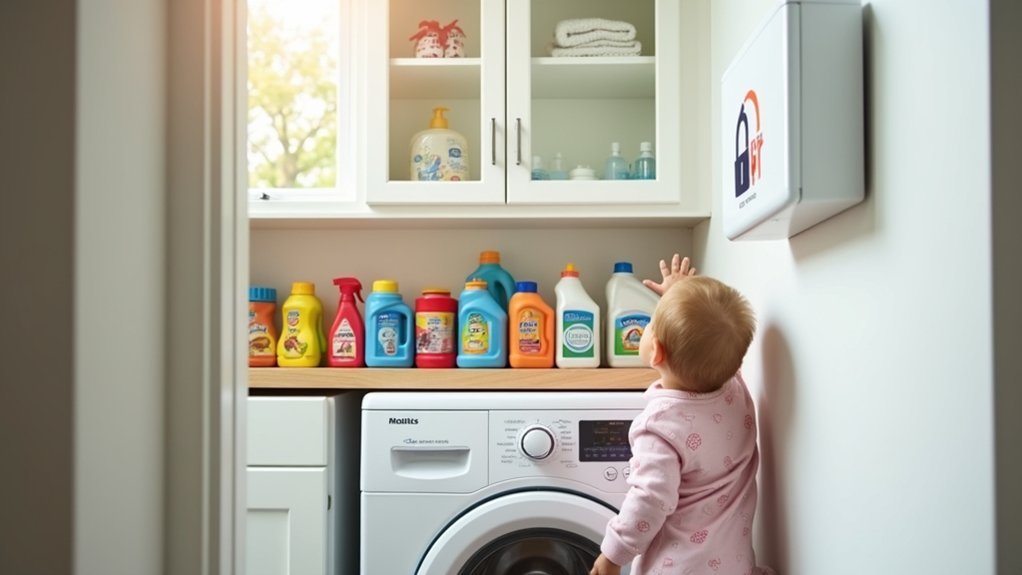
Keeping hot tub chemicals locked away from little hands should top your safety priorities, since even the gentlest products can cause serious harm if swallowed or mishandled. Store all products in a high cabinet with a childproof lock, away from heat and moisture that could compromise their effectiveness.
Never transfer chemicals into unmarked containers—kids can mistake them for drinks or toys. Keep original labels intact so you’ll know exactly what you’re handling during emergencies.
Create a strict rule: children shouldn’t be present when you’re treating the water. Wear gloves during application and wash your hands thoroughly afterward. Post emergency poison control numbers near your storage area. If exposure occurs, contact professionals immediately with the product name ready. These precautions take minutes but prevent potentially devastating accidents.
Frequently Asked Questions
How Long Should Children Wait After Chemicals Are Added Before Entering the Hot Tub?
You should wait at least 20-30 minutes after adding chemicals before letting children enter the hot tub. Always test the water first to make sure pH and sanitizer levels have stabilized within safe ranges.
What Is the Minimum Age Recommended for Children to Use Hot Tubs Safely?
You shouldn’t let children under 5 use hot tubs at all. For kids ages 5-12, limit sessions to 5-10 minutes and keep temperatures below 98°F. Always supervise children closely during use.
Can Hot Tub Chemicals Affect Children’s Hair Color or Cause Discoloration?
Yes, hot tub chemicals can affect your child’s hair. Chlorine and bromine may cause blonde or light-colored hair to turn greenish. You’ll want to rinse your child’s hair immediately after soaking to prevent discoloration.
How Often Should Hot Tub Water Be Completely Changed for Family Use?
You should change your hot tub water every three to four months with regular family use. If children use it frequently, you’ll want to drain and refill more often to maintain peak water quality.
Are Hot Tub Chemical Fumes Harmful to Children With Asthma or Respiratory Conditions?
Yes, chemical fumes can trigger asthma attacks and respiratory distress in children. You’ll want to maintain proper ventilation, keep chemical levels balanced, and consider switching to bromine or mineral-based sanitizers, which produce fewer irritating fumes.




Leave a Reply