

Exercising on trampolines together combines fun with effective workouts. Space rebounders at least 3-4 feet apart, or maintain a two-body-length radius on larger trampolines. Start with a 5-minute gentle bounce warm-up before progressing to partner challenges like mirrored movements or 30-second synchronized bursts. Adapt intensity levels for different abilities while keeping proper form—knees over hips, core engaged. These bouncy workouts burn more calories than walking while protecting your joints from impact.
The Science Behind Trampoline Fitness Benefits

Why has trampoline fitness become more than just a backyard activity? Science reveals it delivers impressive health benefits with less strain. When you bounce, you’ll achieve cardiovascular improvements comparable to jogging, with studies showing similar VO2 max gains at moderate intensity.
Your joints will thank you too—soft-turf rebounders reduce ground reaction forces by 20-35% compared to hard surfaces, maintaining workout intensity while minimizing impact. Each bounce enhances your lymphatic flow and venous return, improving circulation and reducing post-workout swelling.
You’ll also build power efficiently. The trampoline’s plyometric-like action maximizes your stretch-shortening cycle, boosting lower-limb muscular power without excessive joint stress. For weight management, you’ll burn more calories per minute than walking, supporting your metabolic rate based on your workout’s intensity and duration.
Essential Safety Measures for Group Bouncing
You’ll need to maintain a two-body-length radius around each person when bouncing together on rebounders to prevent dangerous mid-air collisions. This safety zone allows everyone to perform dynamic moves without crashing into fellow bouncers or accidentally knocking others off balance. Communicating your space needs with the group and adjusting your position accordingly ensures everyone can enjoy the fitness benefits while minimizing injury risks.
Subheading Discussion Points
When jumping on trampolines with friends or family, safety must come first to prevent injuries and maximize fitness benefits. Always place your rebounder on a flat, non-slip surface and step on/off rather than jumping. Maintain proper form with feet slightly wider than hips, knees bent, and a forward-leaning posture to protect your spine.
| Safety Element | Individual Bouncing | Partner Bouncing | Group Sessions |
|---|---|---|---|
| Space Management | Arm’s length clearance | 3-4 feet between rebounders | Staggered formation |
| Communication | Set personal pace | Establish verbal cues | Designate a leader |
| Timing | 1-minute intervals | Synchronized movements | 20-second transitions |
| Cool Down | Step off carefully | Help each other dismount | Spread out for stretching |
Remember to breathe deeply during transitions and avoid sudden stops to support gradual heart rate recovery.
Spacing Prevents Collision Injuries
Maintaining proper spacing during group trampoline workouts dramatically reduces the risk of collision injuries that can sideline your fitness goals. Always establish a two-step safety buffer between participants and create a clear turn-taking system to manage entry and exit from the rebounder.
- Place visible boundary markers around the workout area to reinforce safe spacing
- Wear non-slip, flat-soled shoes on a stable, level surface to prevent tipping
- Keep your movements controlled with consistent pacing to avoid unexpected contact
- Follow the one-at-a-time protocol when entering or exiting the trampoline
- Maintain awareness of your position relative to others throughout the session
Setting Up Your Backyard Trampoline Workout Zone
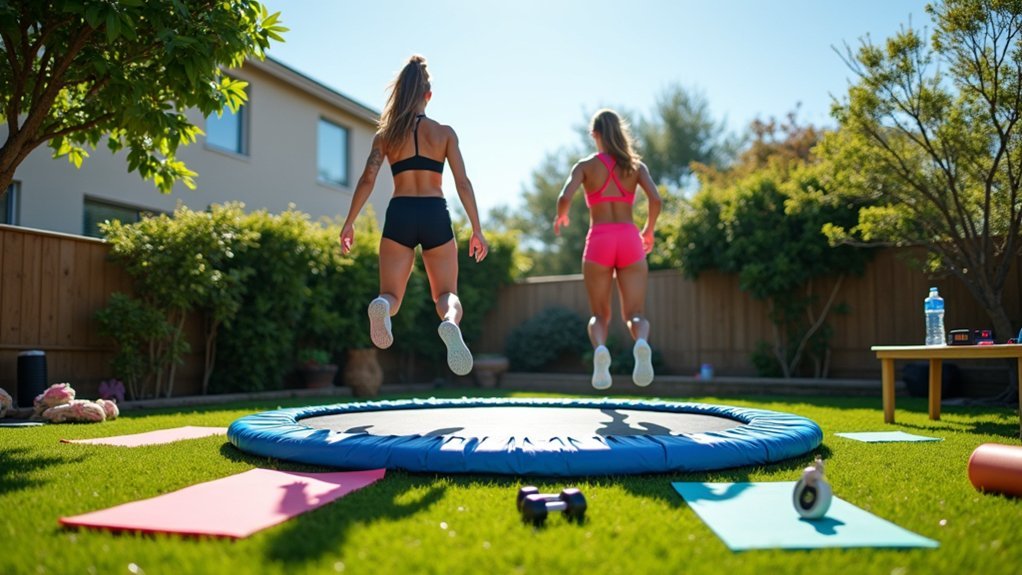
Creating a dedicated trampoline workout zone in your backyard requires thoughtful planning for both space and safety, proper equipment, and weather considerations.
You’ll need to position your trampoline on flat terrain with adequate clearance, equip the area with essentials like water bottles and first-aid supplies, and establish clear boundaries using cones or tape.
Don’t forget to consider how different weather conditions might affect your setup, ensuring your workout zone remains safe and functional year-round.
Space and Safety Requirements
Where you set up your backyard trampoline can make or break your workout experience. Choose a flat, non-slip surface with at least 6 feet of clearance around all sides to prevent accidents during your bouncing routines. Your trampoline must support both your weight and the additional force from jumping—look for one rated at 250-300 pounds minimum.
Before each workout, ensure your space meets these safety standards:
- Area free from sharp objects, pets, and loose items that could cause trips or mat punctures
- Weather-resistant location or protective cover to shield from environmental damage
- Sturdy mat with intact springs and frame with no bent legs
- No gaps larger than 1 inch between the enclosure net and mat
- Stable setup that won’t shift during energetic movements
Equipment and Accessories
A well-equipped trampoline workout zone transforms your backyard into a fitness sanctuary. Select a trampoline with weight capacity exceeding your combined weights—typically 250-350 pounds minimum for multiple users. Position it on flat, non-slip terrain away from hazards, adding safety nets and anchor systems for stability.
| Essential Items | Safety Features | Comfort Elements |
|---|---|---|
| Water bottle holder | Safety enclosure/net | Small towel rack |
| Interval timer/app | Anti-slip mats | Weather protection |
| Non-slip footwear | Weekly inspection kit | Exercise chart |
Perform weekly safety checks on the frame, springs, and mat, replacing damaged components immediately. For optimal performance, either go barefoot with clean feet or wear athletic shoes with good grip. Avoid loose clothing that might catch on springs. Keep your setup minimal but functional—water, towel, and timer within easy reach.
Weather-Proof Your Setup
Your outdoor trampoline workout zone demands strategic weather-proofing to ensure year-round fitness opportunities. Select a level, wind-protected area on grass or pavement to maximize stability during bouncing sessions. Safety comes first with a high-visibility enclosure and non-slip mat beneath your trampoline to prevent accidents in damp conditions.
- Create a sheltered rest station with a foldable chair and water bottle within reach
- Install a UV-resistant tarp or waterproof covering when the trampoline isn’t in use
- Check weather forecasts before planning workout sessions
- Avoid training during rain, strong winds, or lightning storms
- Position your setup away from areas prone to gusts that could destabilize your rebounder
Weather awareness protects both your equipment investment and ensures your trampoline workouts remain safe and effective throughout changing seasons.
5-Minute Warm-Up Routines for All Ages

Why rush into trampoline exercise when a proper minute-long warm-up can prevent injuries and enhance your session? Start with 30 seconds of gentle bouncing to establish rhythm and activate your cardiovascular system.
Next, spend 15 seconds performing dynamic hip and arm circles while maintaining a slight knee bend to loosen your joints. Then transition to 15 seconds of light marching in place, keeping your toes tucked and lifting knees to hip height to gradually elevate your heart rate.
Throughout your warm-up, focus on controlled breathing—inhale through your nose and exhale through your mouth to maintain a steady tempo. Finish with 10-15 seconds of marching knee drives to engage your core before moving into more challenging exercises. This quick sequence prepares everyone’s body, regardless of age.
Family-Friendly Trampoline Exercise Circuits
Now that your muscles are warmed up, let’s explore how the whole family can enjoy an effective workout together. Our 11-minute circuit includes 10 one-minute moves with brief transitions, perfect for maintaining everyone’s interest while delivering real fitness benefits.
- Scalable variations – Adjust scissors, front-back jumps, and side-to-side movements to match each family member’s abilities
- Safety first – Keep knees over hips, engage your core, and land gently to protect joints
- Tempo control – Alternate between slower movements for beginners and more dynamic ones for advanced jumpers
- Balance challenges – Incorporate high knee balancing to improve coordination for all ages
- Proper cool-down – End with gentle stretches after stepping off the rebounder to prevent falls and promote recovery
Partner Challenges to Boost Motivation

Working out with a partner considerably amplifies both the effectiveness and enjoyment of trampoline exercises. Pair up for synchronized bounce drills, alternating 30-second bursts with 15-second rests to build tempo and accountability between you.
| Challenge Type | Benefits | Implementation |
|---|---|---|
| Mirror Reps | Coordination & Focus | One person leads, other copies movements |
| Shared Goals | Mutual Accountability | Track combined 5-minute sumo squat totals |
| Contingency Swaps | Sustained Momentum | Switch to basic bounces when partner tires |
| Synchronized Bursts | Rhythm & Timing | 30 seconds on, 15 seconds rest together |
| Cool-down Stretches | Recovery & Bonding | 2-minute partner stretches on mat |
Try companion challenges where you mirror each other’s movements within a controlled range, and don’t forget to end with a partner stretch to reinforce teamwork while recovering.
Adapting Moves for Different Fitness Levels
Trampolining together doesn’t mean everyone needs to perform at the same intensity level. Whether you’re a beginner or more advanced, you can modify moves to match your fitness capabilities while still enjoying the shared experience.
Bounce together, shine individually — each jumper can tailor their workout while sharing the trampoline joy.
- Beginners: Keep your pace slow, knees bent, and hips back to maintain balance while using smaller ranges of motion
- Advanced: Increase intensity with larger movements and faster tempo while maintaining core engagement
- Balance challenges: Start with feet closer together, then gradually widen stance as stability improves
- Move progression: Work through Scissors, Front-Back, Side-to-Side, High Knee, and Double-Up sequences
- All levels: Use the basic bounce as your comfort baseline and shorten recovery periods between moves as fitness improves
Fun Games That Double as Workouts

Why settle for a boring routine when your trampoline can transform into a playground for fitness games? Challenge each other with the scissors drill, alternating foot taps for 60 seconds to boost footwork and cardio simultaneously.
Turn up the intensity with the front-back progression game – two quick taps forward, two back, then gradually increase the tempo to elevate your heart rate while improving balance.
Side-to-side slides develop lateral stability as you hop from center to edge, expanding your range as confidence grows.
For a core-strengthening challenge, try the high knee balance exercise, maintaining an upright position on one leg for 60 seconds per side.
Create peak intervals with double-up rounds by repeating each move at a faster pace or with doubled repetitions to maximize endurance and movement precision.
Tracking Progress and Celebrating Achievements Together
While fun games keep your trampoline sessions exciting, measuring your improvement adds another dimension to your shared fitness journey. Documenting your rebounds transforms casual bounces into measurable fitness growth that you can celebrate together.
- Record reps, duration, and perceived exertion for each move, then compare week-to-week to identify improvements
- Set quantitative targets like increasing tempo by 5-10 BPM or extending hold times by 5-10 seconds per session
- Maintain a shared log where everyone rates their fatigue, confidence, and balance stability after workouts
- Celebrate meaningful milestones such as completing a full 10-move sequence or advancing from basic to tempo-ed moves
- Schedule regular 4-week check-ins to recap achievements, adjust goals, and highlight individual improvements in technique
Frequently Asked Questions
How Long Does It Take Two People to Put Together a Trampoline?
You’ll need 30 minutes to 2 hours to assemble a trampoline with a partner. Most medium-sized models take 45-90 minutes, but having tools ready and organizing parts will speed up the process.
What Is 10 Minutes on a Trampoline Equivalent To?
Ten minutes on a trampoline equals a brisk walk or light cycle in calorie burn (80-140 calories). You’ll elevate your heart rate to 70-85% max, similar to a short jog but with less joint impact.
How to Get Fit on a Trampoline?
You’ll get fit on a trampoline by doing 10-minute sessions of varied bounces like high knees, scissors, and side-to-side movements. Keep proper form, engage your core, and gradually increase intensity for maximum benefits.
What Are Common Rebounding Mistakes?
You’ll want to avoid letting your knees collapse inward, leaning too far forward, neglecting core engagement, doing shallow bounces, and skipping cool-downs. These mistakes reduce benefits and increase injury risk during rebounding.


Leave a Reply