
You’ll transform your outdoor audio by spacing speakers opposite each other across your yard instead of clustering them on one side. Position them 10–12 feet apart and angle them toward your central listening zone for balanced coverage. Mount speakers 8–10 feet high under eaves or awnings to enhance bass and shield from weather. This cross-coverage strategy eliminates dead zones and harsh sound walls. There’s much more to optimizing your system’s full potential ahead.
Our Recommended Product on Amazon

As an Amazon Associate we earn from qualifying purchases.
Avoid One-Directional Speaker Placement
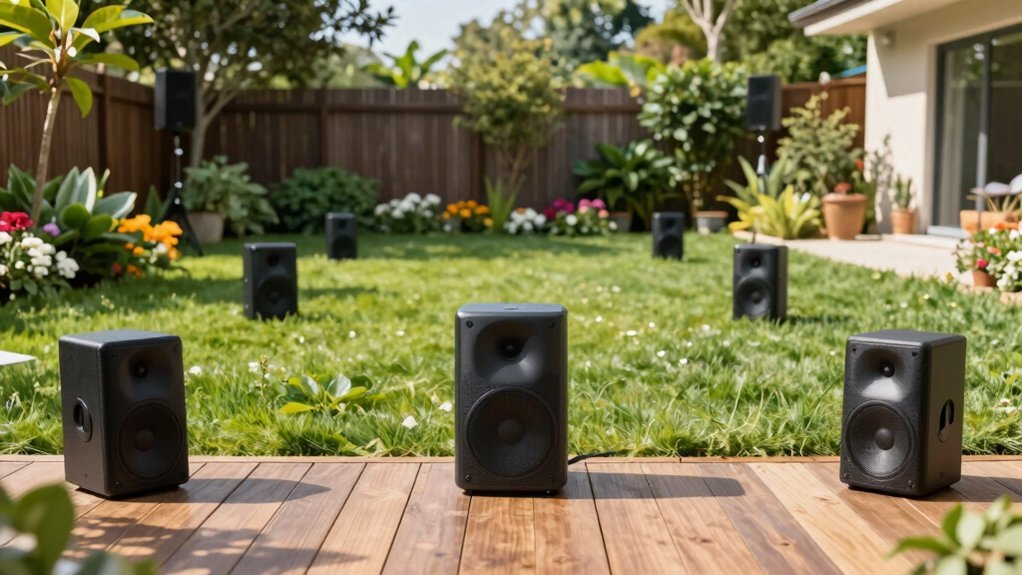
Why do so many outdoor audio setups fall flat? You’re likely placing all your speakers on one side of your space, creating an uneven listening experience. When you cluster speakers together, you generate harsh walls of sound that don’t distribute evenly across your area.
Instead, you’ll want to position speakers opposite each other and angle them toward your central listening zone. This cross-coverage approach ensures sound reaches every corner consistently. By spreading your speakers across different locations, you avoid one-directional bias that leaves some guests stranded in acoustic dead zones.
Maintain at least 10 to 12 feet between each speaker and roughly 12 feet from speakers to your listening area. This spacing prevents interference while balancing reach. Your outdoor setup will sound balanced and immersive when you prioritize strategic placement over convenience.
Plan Your Layout Weeks in Advance
When should you start mapping out your outdoor speaker strategy? You’ll want to begin several weeks before your warm-weather gatherings arrive. This advance planning ensures you’ll cover your full backyard lifestyle area without relying on just one or two speakers.
| Planning Phase | Timeline | Action Items |
|---|---|---|
| Initial Assessment | Weeks 1-2 | Measure yard dimensions and identify zones |
| Speaker Selection | Weeks 2-3 | Choose appropriate speaker types and quantities |
| Layout Design | Weeks 3-4 | Map placement points and test configurations |
Start by dividing large yards into multiple zones, then tailor speaker placements to each space’s specific dimensions. This methodical approach prevents coverage gaps and maximizes audio quality throughout your outdoor entertainment area. Additionally, plan for future expansion with scalable system growth in mind.
Maximize Bass Performance Outdoors
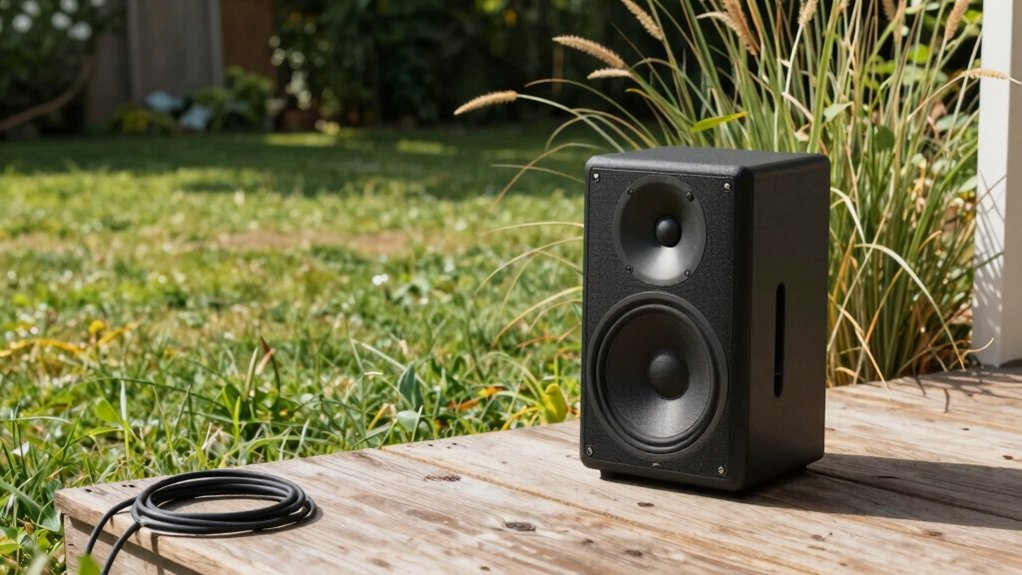
You’ll find that open-air environments naturally weaken bass frequencies, making a quality outdoor-rated subwoofer essential for full-range sound. Strategic subwoofer placement—experimented with across different locations and heights around 10 feet above ground—dramatically improves bass reach and prevents muddiness. Pairing your subwoofer with multiple outdoor speakers distributes low frequencies evenly, giving you balanced rhythm for everything from background music to dancing.
Bass Limitations in Open Spaces
One of the biggest challenges with outdoor audio is that bass frequencies simply don’t carry well in open environments—they dissipate quickly without walls or structures to contain them. You’ll notice that outdoor bass feels thin and weak compared to indoor setups, even with powerful speakers.
| Challenge | Impact | Solution |
|---|---|---|
| Open air dissipation | Bass loses energy | Add quality subwoofer |
| Lack of reflective surfaces | Reduced low frequencies | Mount speakers at 10 feet |
| Wide coverage areas | Uneven bass distribution | Use multiple speakers |
To combat these limitations, you’ll need to supplement standard speakers with an outdoor-rated subwoofer that boosts low-frequency response. Experiment with subwoofer placement—positioning significantly affects bass reach and balance. Consider mounting speakers under eaves or awnings to contain bass while protecting equipment from weather.
Subwoofer Integration and Placement
Since standard outdoor speakers can’t deliver adequate bass in open air, adding a quality subwoofer becomes your most effective strategy for restoring low-frequency impact.
You’ll want to experiment with placement to find your sweet spot. Consider these proven approaches:
- Under-eave mounting to leverage overhead surfaces for bass reinforcement
- Positioning near reflecting surfaces that naturally enhance low-frequency perception
- Elevating approximately 10 feet above ground to balance reach without thinning overall output
Pair your subwoofer with weather-resistant main speakers, ensuring your amplifier handles the added low-frequency load without distortion. For expansive areas, distribute bass energy across multiple zones using dedicated subwoofers per section. This approach maximizes bass coverage while maintaining clean, undistorted sound throughout your outdoor space.
Strategic Speaker Mounting Height
How high should you mount your outdoor speakers? You’ll want to aim for about 10 feet above ground to balance broad coveragE with output quality. This height helps you direct sound toward your listening area while preserving bass impact—critical for outdoor enjoyment.
Mounting too high thins your audio and weakens low-frequency coupling to your audience. Position speakers under eaves or awnings when possible; these reflective surfaces reinforce bass and provide weather protection.
Angle your speakers slightly downward from their mounting points. This technique focuses low frequencies toward listeners and minimizes unwanted sound spillage to surrounding areas. For open spaces, avoid clustering speakers on one side; instead, stagger them with opposing angles to maintain even bass distribution across your entire outdoor venue.
Choose Adequate Amplification for Your System
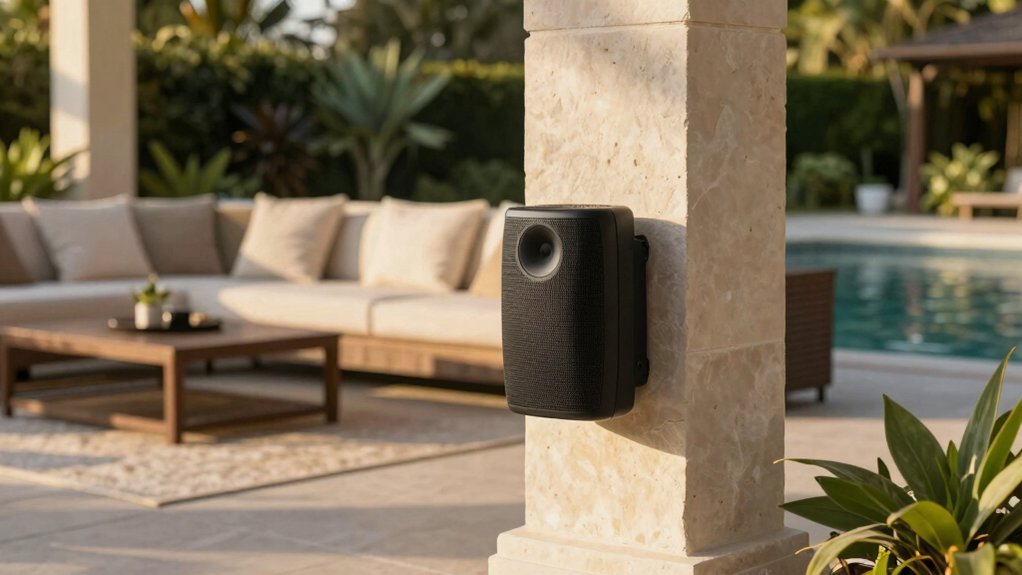
What’s the foundation of a quality outdoor audio system? Adequate amplification. You’ll need an amplifier delivering at least 80–100 watts per channel to properly drive multiple outdoor speakers without distortion in open-air environments.
Here’s what you should prioritize:
- Keep your amplifier indoors and protected from weather rather than exposing it to the elements outdoors.
- Use appropriate wiring—16-gauge direct-burial cable works well—and ensure your amp handles the total speaker load without strain.
- If you’re expanding to multiple zones, invest in a multi-channel or multi-zone amplifier designed specifically for outdoor distribution.
Underpowering your system invites distortion and potential speaker damage. Don’t compromise here. Proper amplification ensures even coverage and longevity across your entire outdoor space.
Determine the Right Number of Speakers for Your Space
Getting speaker quantity right makes the difference between immersive sound and frustrating dead zones. For spaces between 200–400 square feet, two outdoor speakers will suffice. However, if you’re working with a larger area, you’ll need additional speakers to maintain even coverage throughout.
Rather than maxing out volume on just two speakers, you’re better off distributing the audio load across multiple units. This approach prevents overpowering listeners near the speakers while extending reach to distant areas. For substantial backyards, consider dividing your space into multiple zones with dedicated speaker setups tailored to each section.
The key is strategic distribution. Spread your speakers across the space instead of clustering them together, ensuring balanced sound quality everywhere your guests gather.
Mount Speakers at Optimal Heights and Angles
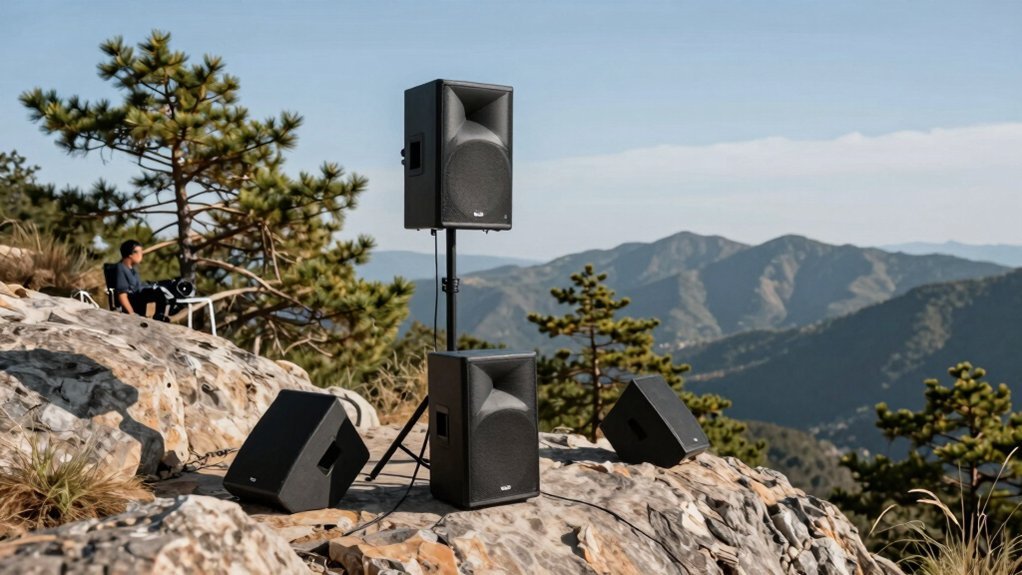
Once you’ve determined your speaker count and placement zones, elevation and angle become critical factors in achieving balanced sound coverage. You’ll want to mount speakers 8–10 feet high and angle them slightly downward toward your listening area for optimal clarity and dispersion.
Consider these placement principles:
- Space speakers 10–12 feet apart and point them toward a central area to prevent harsh sound walls
- Elevate or angle speakers to enhance bass projection while maintaining even coverage across open-air environments
- Test placements before permanent installation, adjusting height, angle, and distance for best stereo imaging
For larger spaces, create a multi-zone layout using more speakers rather than relying on a two-speaker setup. This strategic approach ensures balanced, immersive sound throughout your outdoor area.
Separate Speakers for Even Sound Distribution
You’ll want to space your speakers no more than 20 feet apart and maintain 10 to 12 feet between each speaker and your central listening area for balanced sound dispersion.
Avoid clustering multiple speakers on one side of your space, as this creates harsh sound walls and uneven coverage that’ll compromise your audio experience.
Angle each speaker toward a central convergence point so the sound blends seamlessly across your entire outdoor area.
Spacing and Distance Guidelines
How do you achieve balanced sound across your outdoor space? Strategic spacing and distance measurements ensure even coverage without harsh sound walls.
Follow these guidelines for optimal placement:
- Space speakers 10 to 12 feet apart to prevent audio buildup and maintain clarity throughout your listening area
- Position each speaker approximately 12 feet from your listening zone’s center to guarantee balanced sound dispersion in all directions
- Angle speakers toward the center while placing them opposite each other, avoiding clustering on a single side
Before drilling any holes, test your speaker placements by listening carefully to how sound travels across your space. Adjust angles and positions until you’ve confirmed optimal acoustics. This preparation prevents costly mistakes and ensures your outdoor entertainment area delivers professional-quality audio.
Avoiding Clustered Sound
What’s the most common mistake when installing outdoor speakers? Clustering them together. When you bunch speakers on one side, you’ll create harsh sound walls and uneven coverage that leaves dead zones in your space.
Instead, spread your speakers out strategically. Place them opposite each other and angle them toward your central listening area for balanced dispersion. This approach ensures sound reaches every corner evenly.
| Problem | Solution | Result |
|---|---|---|
| Clustered speakers | Spread across space | Even coverage |
| Unbalanced sound | Opposite placement | Balanced dispersion |
| Dead zones | Strategic spacing | Complete area coverage |
Maintain 10 to 12 feet between speakers and keep them roughly 12 feet from your central listening area. For larger spaces, use multiple zones to distribute sound effectively rather than relying on two speakers alone.
Protect Your Equipment Year-Round
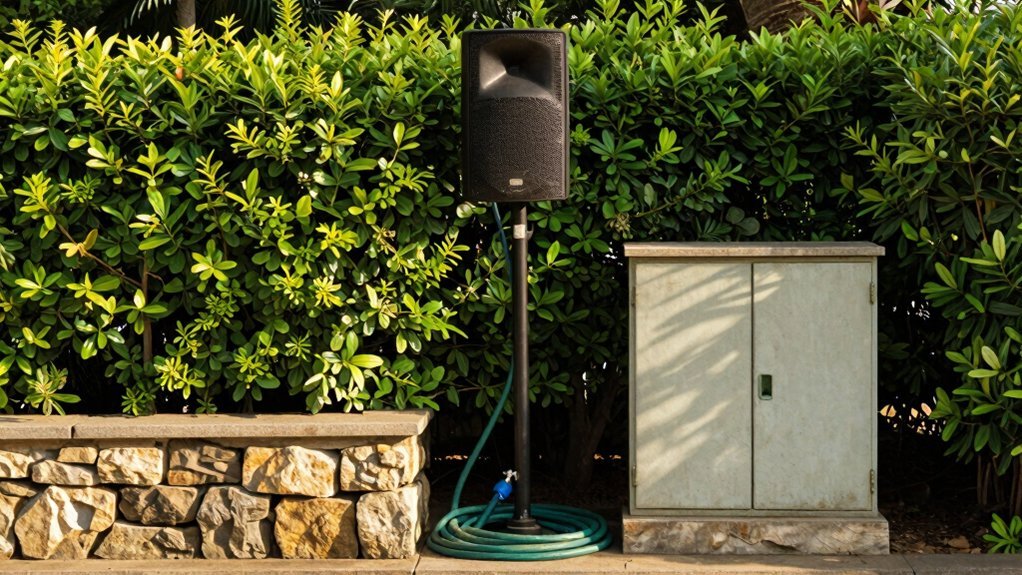
Keeping your outdoor speakers safe from the elements requires both smart placement and protective gear. You’ll extend your equipment’s lifespan by implementing strategic protection measures.
- Mount strategically – Position speakers under eaves, awnings, or wind-blocking locations to shield them from rain, snow, and UV rays while enhancing bass response.
- Choose durable materials – Select weather-resistant units with UV-resistant enclosures and robust construction that withstand prolonged outdoor exposure without degradation.
- Use protective covers – Store components indoors or cover them when not in use, following your installation manual’s specific weather exposure guidelines.
You shouldn’t leave speakers unprotected during off-seasons. By combining smart placement with appropriate protective gear, you’ll maintain optimal performance and prevent costly damage year-round.
Frequently Asked Questions
Where to Position Outdoor Speakers?
You’ll want to space your speakers 10–12 feet apart, mount them 8–10 feet high, and angle them slightly downward toward a central point. Position them opposite each other for balanced stereo coverage, then test from your seating areas before finalizing placement.
What Is the Golden Rule for Speaker Placement?
You’ll achieve optimal sound by positioning speakers opposite each other around your listening area. You should space them 10-12 feet apart and angle them toward your central seating zone. You’ll want to avoid clustering speakers on one side.
What Is the 83% Rule for Speakers?
You’ll apply the 83% rule by positioning yourself roughly 83% of the distance between two speakers. If your speakers are 12 feet apart, you’re ideally about 10 feet from each one, creating balanced, even sound coverage throughout your outdoor space.
What Is the 38% Rule Speaker Placement?
You’ll position your outdoor speakers so they cover about 38% of your listening area directly between them. This approach helps you achieve even stereo imaging across your entire space, ensuring balanced sound without dead zones or harsh coverage gaps.