
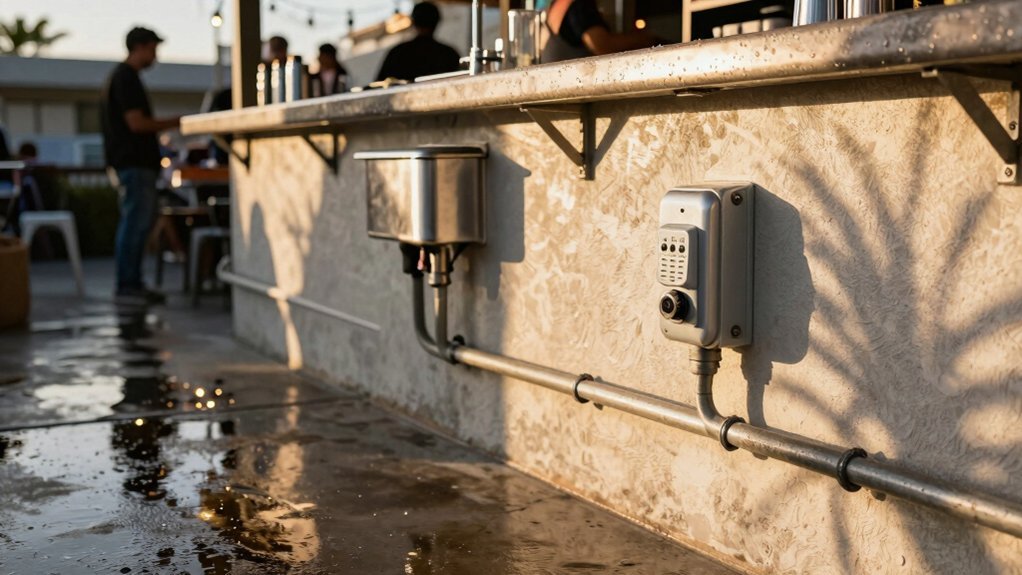
You need special electrical codes for outdoor bars because moisture, weather, and heavy use can turn ordinary wiring into safety hazards. The NEC requires GFCI protection, weatherproof enclosures, and proper waterproofing to prevent shocks, fires, and corrosion. Plans must include load calculations, dedicated circuits, and correct breaker sizing, especially near pools or wet areas. You also must follow call-before-you-dig rules and local interpretations. If you keep going, you’ll pick up steps to do it safely.
What Is the National Electrical Code (NEC) and Its Purpose for Outdoor Wiring

The National Electrical Code (NEC) sets safety standards for electrical installations, and its purpose for outdoor wiring is to prevent hazards while guiding your compliance with local requirements. Adoption varies by region, so you should verify the version with a licensed electrician or local inspector. Defined by NFPA, the NEC provides consolidated guidelines for one- and two-family dwellings and emphasizes residential wiring safety. Its key purposes are to prevent hazards, ensure local compliance, and adapt to new technologies in electrical installations. GFCI protection for outdoor receptacles and weatherproofing for exterior installations are essential focuses you should remember. It also covers receptacle placement, load planning, and combinations of circuits to prevent overloading in outdoor settings. Ask a professional about local code cycles and updates soon.
Outdoor Receptacle Requirements and Mandatory GFCI Protection
You must have GFCI protection for all receptacles, with weather-resistant 125/250 V models installed per 210.8(A) for outdoor use. You must place receptacles at the front or rear to be readily accessible from ground level and not more than 6.5 feet above grade. In damp locations, use weatherproof enclosures when the cover is closed, and in wet locations choose weather-resistant receptacles with weatherproof in-use covers; you should plan placements so extension cords aren’t relied on.
GFCI Required Outdoors
Outdoor receptacles must have GFCI protection installed, including 125/250V outlets used outdoors per NEC. You must use weather-resistant receptacles, and when you cover them for protection, use weatherproof in-use covers for sealed protection when cords are plugged in.
Receptacles on damp locations require weather-resistant enclosures, while those on wet locations must be weather-resistant with weatherproof in-use covers. NEC mandates GFCI protection for outdoor receptacles at front and rear of dwellings, and for 125/250V outlets serving outdoor areas like porches, decks, garages, and exterior walls. For outdoor kitchen planning, if the area is treated as a kitchen, the receptacles must meet related spacing and protection standards with GFCI as applicable. These rules protect guests and equipment while keeping outdoor bars compliant and safe for everyone.
Receptacle Placement Rules
Where should you place outdoor receptacles, and what protections do you need? You install them at the front and rear of your dwelling, no higher than 6.5 feet, and easily reachable from the ground. Every receptacle must have GFCI protection, and 125/250V outlets should use weather-resistant construction for outdoor use. In damp locations, use weatherproof enclosures with weatherproof in-use covers to seal cords when plugged in. In wet locations, choose weather-resistant design with proper sealing for exposure. If you treat outdoor areas as a kitchen, follow kitchen rules, including SABC considerations and adequate circuit loading, which dictates count and placement.
- Front and rear placement
- Ground level reachability
- Weatherproof protection
- Damp or wet location integrity
Keep paths clear, cords off walkways, and check inspections regularly.
Weather-Resistant Vs Weatherproof Receptacles for Damp and Wet Locations
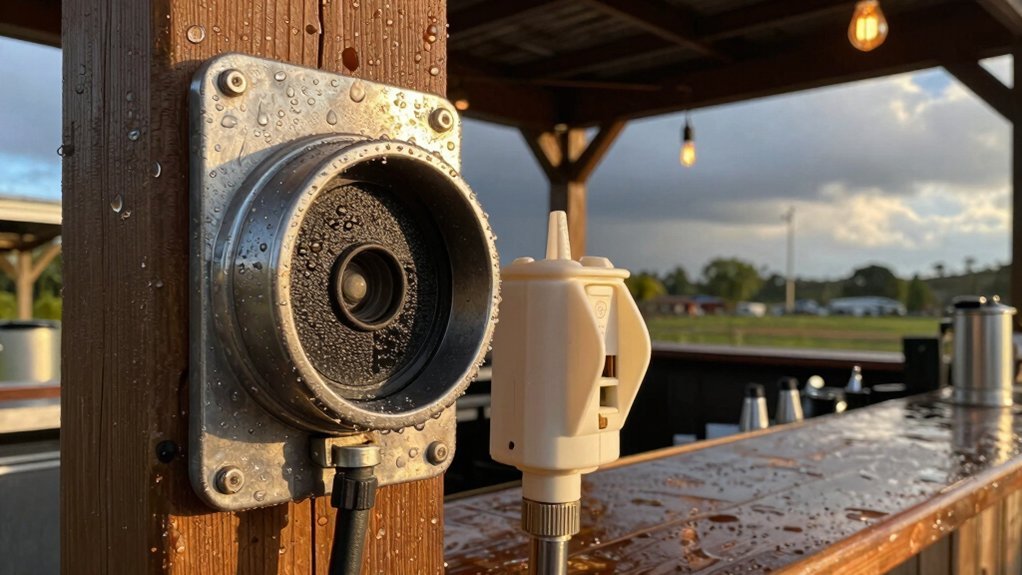
When you’re wiring outdoor bars, you’ll want to distinguish weather-resistant from weatherproof receptacles and match them to damp versus wet locations. Weather-resistant means the device resists moisture during use, but you still choose weatherproof enclosures and in-use covers for sealed protection in damp or wet areas; for true wet locations, pick listings suitable for wet environments and sturdy, raintight enclosures. In any case, ensure proper enclosures and weatherproof covers when not in use, and verify GFCI protection remains for safety.
Weather-Resistant Vs Weatherproof
How do weather-resistant and weatherproof receptacles differ in damp and wet locations? You want safety first, so choose weather-resistant outlets with weatherproof in-use covers in damp areas and weatherproof covers for sealed protection in wet spots. All outdoor receptacles must be GFCI-protected, regardless of location, to reduce shock hazards. Lighting and receptacle installations in damp or wet areas require fixtures and enclosures rated for those moisture exposure conditions. Weatherproof (weathertight) covers help maintain protection when outlets aren’t in use and prevent moisture intrusion. Tamper-resistant and weatherproof outdoor outlets are recommended to enhance safety against moisture and accidental contact.
- GFCI-protection for all outdoor receptacles
- Covers appropriate for location
- Fixtures and enclosures rated for moisture exposure
- Tamper-resistant and weatherproof outlets
These choices protect guests and staff.
Damp Vs Wet Distinctions
Damp locations require weather-resistant receptacles with weatherproof in-use covers that seal when cords aren’t plugged in, while wet locations demand weather-resistant outlets paired with weatherproof enclosures that stay sealed even when exposed or covered. For safety, all outdoor receptacles must be GFCI-protected, ensuring shock protection in moisture-prone conditions. Outdoor light fixtures in wet or exposed areas must be listed for use in wet locations, while damp areas require listings for damp locations. Exterior surface-mounted boxes must be raintight to prevent moisture intrusion in exposed wiring. These weatherproofing requirements guide where outlets go on decks, porches, and around pools, shaping both safety and functional accessibility in damp versus wet environments. Stay mindful of moisture sources, and assess locations before installation to ensure ongoing protection consistently.
Enclosures and Covers
Where you install receptacles matters: damp locations need weather-resistant outlets with weatherproof in-use covers, while wet locations require weatherproof outlets paired with sealed enclosures that stay shut even when exposed. Outdoor receptacles must be weather-resistant and protected by GFCI per NEC 210.8 for safety on 125/250V outlets. Receptacles in damp areas with protective covers require WR weatherproof enclosures; those in wet locations need WR and in-use covers for continuous moisture protection. Exterior lighting fixtures and outlets in exposed areas must use weather-appropriate enclosures and raintight surface boxes to keep moisture out. Tamper-resistant WR receptacles are recommended to withstand outdoor conditions and prevent moisture-related malfunctions.
- Check WR enclosures seal properly
- Use in-use covers in damp
- Use WR with sealed wet
- Prefer tamper-resistant WR receptacles today
Receptacle Placement Guidelines Around Decks, Pools, and Exterior Spaces

Outdoor receptacles should be placed at the front and rear of your dwelling where they’re readily reachable from ground level, with a maximum height of 6 1/2 feet.
Receptacles near decks or balconies with interior access must be no higher than 6 1/2 feet above the deck or balcony surface.
Receptacles in outdoor wet locations require weather-resistant, weatherproof in-use covers to seal cords when plugged in.
For pool or spa areas, install GFCI-protected outlets 6 to 20 feet from the pool edge and keep the height at 6 1/2 feet.
Pool/spa pump receptacles follow distance rules from pool walls (no closer than 10 feet if not-GFCI; 6 feet if GFCI) and must serve no other devices.
These placements prevent hazards around decks and pools.
Outdoor Lighting: Wet/Damp Location Listings and Weatherproof Fixtures
For your outdoor bars, choose fixtures with Wet Location Listings where they’ll face direct rain and Damp Location Compliance for areas with humidity.
Make sure surface-mounted exterior boxes are raintight and weatherproof to protect exposed wiring.
Use weatherproof exterior fixtures, and ensure any low-voltage systems are listed as a complete assembly or from listed components for integrated safety.
Wet Location Listings
When you install outdoor lighting, make sure the fixtures you choose are properly rated for the environment: wet-location fixtures must be listed for wet use, while damp-location fixtures must be listed for damp use.
1) Wet-location listings cover the entire installation against rain, splashes, and humidity.
2) Surface-mounted exterior boxes must be raintight and weatherproof to block moisture intrusion.
3) Exterior fixtures don’t require GFCI protection, but housings and enclosures must stay weatherproof outdoors.
4) For low-voltage systems, list the entire setup or use listed components to guarantee safety and moisture resistance, plus weatherproof in-use covers for outdoors.
Damp Location Compliance
Damp-location rated fixtures matter near entrances, decks, and other covered areas where occasional moisture can occur. In damp zones, choose fixtures labeled damp and install them with proper mounting and seals. Surface-mounted exterior boxes and light fixtures must be raintight or weatherproof to withstand outdoor conditions. Weatherproof covers help keep wiring dry at junctions, extending fixture life in humidity.
Unlike receptacles, exterior light fixtures don’t require GFCI protection, so you rely on listed construction and weatherproofing. If you use low-voltage lighting, treat it as a whole system or assemble from listed components to meet standards. Use weatherproof enclosures to protect connections and ensure covers are in place before energizing. Damp-location rules emphasize listing and enclosure integrity to keep outdoor lighting reliable in moisture daily.
Weatherproof Exterior Fixtures
Weatherproof exterior fixtures must be listed for wet locations if installed in exposed, wet areas, or damp locations if the area is damp. You must follow listing requirements to prevent moisture issues in outdoor lighting.
- Ensure surfaces are raintight and weatherproof to protect connections from moisture.
- Use surface-mounted exterior boxes that are raintight and weatherproof to guard against moisture intrusion.
- Note that exterior light fixtures don’t require GFCI protection, but they must meet the correct listing for their location (wet or damp).
- For low-voltage systems, ensure the entire system or assembled listed components to guarantee safety and reliability.
Weatherproofing and proper enclosure ratings prevent moisture ingress and corrosion for outdoor lighting installations. Choose fixtures rated for harsh environments to ensure longevity and safety.
Burial Depths and Conduit Requirements for Outdoor Wiring
How deep should outdoor wiring be buried and what kind of conduit protects it? Direct-bury UF cables are rated for outdoor use and require a burial depth of 24 inches, unless they’re under a concrete slab with GFCI protection. If you’re using conduit, choose rigid metal conduit for at least 6 inches of cover, or PVC conduit for at least 18 inches. PVC-buried installs must hit 18 inches, galvanized metal conduits at least 6 inches. Low-voltage wiring (≤30 V) gets buried at 6 inches, with transitions protected in conduit or meeting depth rules. Backfill should be smooth granular material, free of rocks, to prevent damage and ensure burial protection. Keep transitions tight and verify coverage with a depth gauge during installation and testing.
Direct Burial Versus Conduit: When Each Is Required
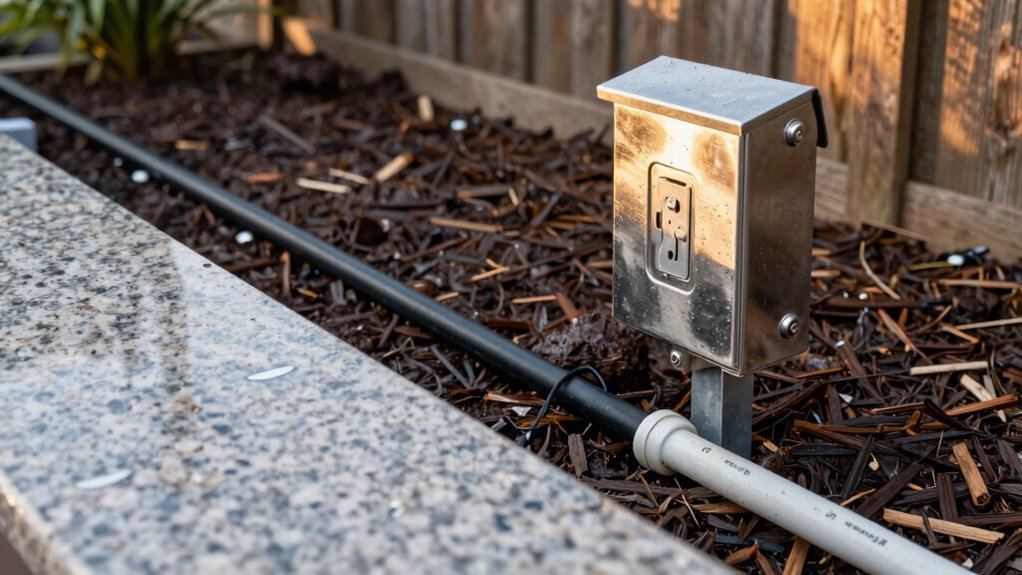
Direct burial is the simplest option when the cable is labeled for it, letting you bury UF cable at 24 inches (unless it sits under a concrete slab with GFCI protection). If it isn’t labeled for direct burial, you’ll need conduit, with burial depths of 6 inches for RMC/IMC and 18 inches for PVC. If you use PVC, go 18 inches; with galvanized metal, you’ll only need 6 inches of cover. Low-voltage landscape wiring stays at least 6 inches deep, and applies different rules than standard 120/240 V circuits.
1) Direct burial is used when labeled.
2) Conduit is required if not labeled.
3) PVC requires 18 inches; galvanized 6 inches.
4) Backfill must be smooth granular material and use waterproof junction boxes.
Backfill around buried runs should be free of rocks, and splices belong in waterproof boxes to maintain integrity. Keep things orderly. Always.
Low-Voltage Landscape Lighting: Transformers, Systems, and Safety Rules
Is your outdoor low-voltage landscape lighting compliant and safe to install? Make sure your setup is assembled from listed components or a listed complete system. The transformer must stay at least 5 feet away from any pool or water area, per 680.22(A)(6).
Use only Class 2 compliant transformers and power supplies for landscape lighting.
For direct burial wires, bury them at least 6 inches deep; 12V and 24V systems may be buried without conduit if connected to a listed transformer.
Ensure every direct burial wire and transformer uses proper enclosures and weatherproofing to meet NEC outdoor installation requirements.
When planning, verify components’ listings and secure weatherproof connections to reduce shock and fire risks.
This keeps your outdoor bar area compliant and safer for guests.
Safe Clearances Around Pools, Spas, and Water Features
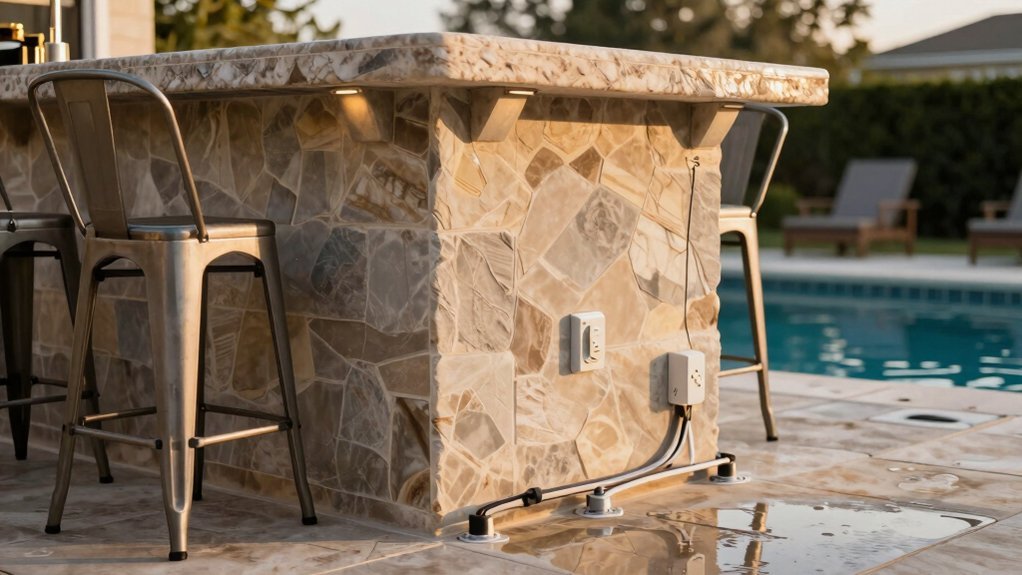
To keep your outdoor setup safe around pools, spas, and water features, follow strict clearance and equipment requirements: service wires overhanging water must be at least 22.5 feet above the surface, and data transmission wires need to stay a minimum of 10 feet away from water; use receptacles near pools and decks with GFCI protection and weather-resistant enclosures to prevent moisture shocks; ensure pool/spa lighting transformers are listed for pool/spa use and that low-voltage outdoor transformers maintain minimum clearances from water areas; and make sure outdoor lighting systems are listed as a complete system or assembled from listed components to ensure safe operation near water features.
- Keep service clear above water.
- GFCI outlets near decks.
- Use listed pool/spa transformers.
- Maintain minimum clearances for lighting.
Protecting Buried Wiring: Conduit, Junction Boxes, and Proper Backfill
After addressing safe clearances around water features, protecting buried wiring involves selecting the right materials and proper burial practices. You’ll use listed conductors, like UF cable, for direct burial and avoid NM cable, with 24 inches of soil depth unless concrete is involved. If you choose conduit, rigid metal requires at least 6 inches of cover; PVC needs 18 inches outdoors. Protect from rocks by smooth granular backfill and install watertight junction boxes for all splices in buried runs. Direct burial typically requires 24 inches of soil cover, while slabs may allow shallower depths with GFCI protection.
| Material | Requirement |
|---|---|
| UF direct burial | 24 in soil depth |
| NM cable | not for direct burial |
| RMC conduit | min 6 in cover |
| PVC conduit | min 18 in cover |
Planning Outdoor Bar Circuits: Load Calculations and Breaker Considerations
How do you size outdoor bar circuits and select breakers to handle multiple appliances safely? You’re wiring for heavy loads, so plan a dedicated circuit, typically a 50-amp 125/250V run, to power grills, refrigerators, and blenders without nuisance trips. Receptacles outdoors must be GFCI-protected and weather-resistant, which drives breaker protection and how many outlets you place. Load planning should count multiple plug-in appliances and avoid overloading; count circuits and size breakers accordingly. Perimeter and countertop receptacles, with required GFCI, affect distribution to keep power accessible and code-compliant.
- Estimate total wattage and convert to amperage with headroom.
- Reserve a dedicated outdoor circuit for all appliances.
- Include GFCI and weather-resistant outlets in exposed areas.
- Check AFCI requirements per AHJ for kitchen-like outdoor spaces.
Test before hosting.
Call Before You Dig: 811 Process and Verifying Local Codes
Before you start digging for any outdoor bar project, 811 process helps protect buried utilities. It’s not NEC, but you should call 811 at least three days before digging to have lines marked. The process keeps work within 24 inches of lines to hand digging, reducing strikes. 811 also provides location information and defensive markings to help you avoid surprises. This guidance stresses verifying AHJ interpretations since adoption varies by region. Always check with your inspector or licensed electrician to confirm project requirements before excavation.
| Topic | Key Point |
|---|---|
| Call before you dig | Contact 811 at least three days before digging. |
| Hand digging | Within 24 inches of lines, use hand digging. |
| Local codes check | Verify AHJ interpretations and local requirements. |
Respect local rules; stay safe.
Compliance and Testing: UL Listings, Moisture Resistance, and Corrosion Protection
Why do outdoor setups demand UL listings and robust moisture protection? You’re designing a bar that withstands rain, splashes, and humidity, so you need components that are UL-listed and corrosion-resistant, with tests confirming durability. Moisture protection isn’t optional—weather-resistant receptacles and weatherproof enclosures guard damp or wet locations. When cords stay plugged, weatherproof in-use covers seal out moisture. Lighting fixtures and exterior boxes must be listed for wet or damp locations and raintight, ensuring moisture resistance. Low-voltage systems outdoors demand pool/spa listing and Class 2 compliance, marking safety across components.
1) UL listings confirm safety and long-term performance worldwide
2) Moisture protection prevents corrosion and electrical failure
3) Proper enclosures and weatherproofing keep water out and outlets reliable
4) System testing ensures safe operation in rain, splashes, and humidity
Frequently Asked Questions
What Are the NEC Requirements for Outdoor Connections?
Outdoor connections must be GFCI-protected and weather-resistant, with 125/250V receptacles on wet locations having weatherproof in-use covers. Keep receptacles accessible within 6 1/2 feet, install on damp locations with WR enclosures, and you’ll ensure pool setbacks.
What Are the Requirements for Outdoor Electrical Conduit?
You must use outdoor conduit listed for outdoor use, bury 6 inches for rigid metal and 18 inches for PVC, with moisture-resistant components, waterproof splices in buried runs, and GFCI protection per local code today.
Is Romex Approved for Outdoor Use?
Is Romex approved for outdoor use? No—NM cable isn’t rated for outdoor exposure. If you install outdoors, run UF cable or protect NM in approved conduit with burial depth and waterproof, junction boxes for splices.
What Type of Electrical Wire Is Used for Outdoors?
Outdoor wiring uses outdoor-rated conductors like UF cable or conduit-filled runs with THHN/THWN in wet-rated conduits. You choose direct burial UF or buried conduit meeting depth requirements, plus protected transitions to above-ground components and outlets.


Leave a Reply