

Essential safety guidelines for outdoor play equipment include proper installation with secure anchoring systems, maintaining at least 12 inches of protective surfacing that extends 6 feet around equipment, and regular inspections for loose hardware, cracks, or rust. Choose age-appropriate equipment, enforce consistent supervision, and establish clear usage rules. During extreme weather, check equipment temperature and dryness before use. These fundamental practices will help you create a safer playground environment for children.
Proper Equipment Installation and Anchoring
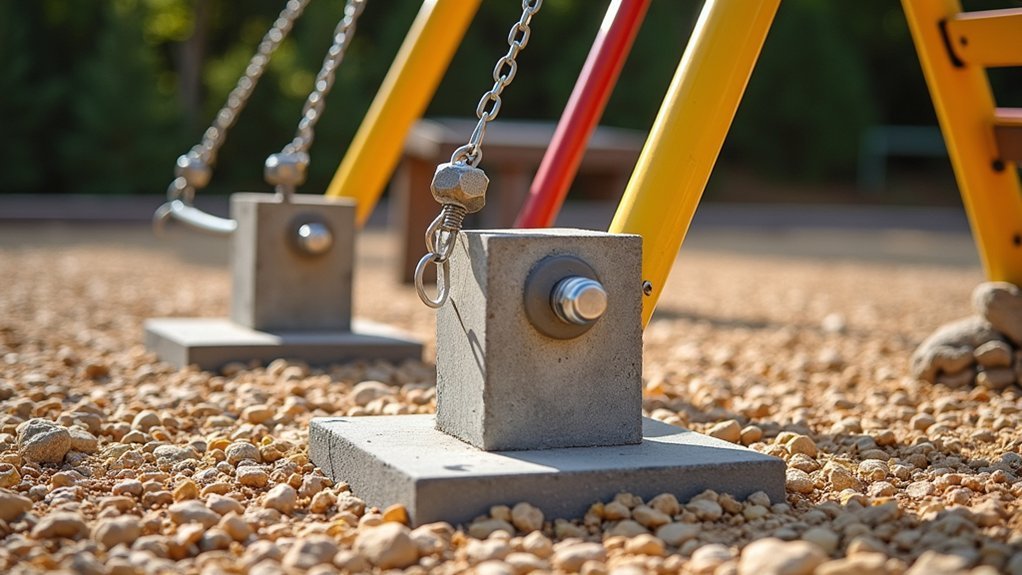
When it comes to playground safety, proper installation and anchoring serve as the foundation for all other safety measures. You’ll need to follow manufacturer guidelines precisely regarding anchor types, depth, and embedment to ensure equipment remains securely attached to soil or concrete surfaces.
Always install playground equipment with appropriate anchoring systems to meet safety standards and prevent dangerous movement during use. After installation, conduct thorough torque and stability tests to verify structures don’t tilt, shift, or loosen under typical play conditions.
Choose fasteners and ground anchors that resist corrosion, weather damage, and vandalism for long-term stability. Don’t skip professional inspections after installation and following major weather events to confirm your equipment maintains proper anchoring and continues to provide a safe play environment.
Maintaining Adequate Safety Surfacing
Beyond proper installation, the surface beneath and around playground equipment forms your next critical safety barrier. You’ll need to maintain at least 12 inches of protective surfacing using approved materials like wood chips, mulch, sand, pea gravel, or safety-tested rubber mats.
Ensure your safety surface extends a minimum of 6 feet in all directions from play equipment. For swings, the coverage area should extend twice the height of the suspending bar both in front and behind the swing set. Never use cement, grass, or dirt as playground surfacing—these provide inadequate fall protection.
Check your surfacing regularly to maintain consistent 12-inch depth throughout the play area. Loose materials will compact over time and need redistribution to preserve their shock-absorbing qualities.
Regular Equipment Inspection Procedures
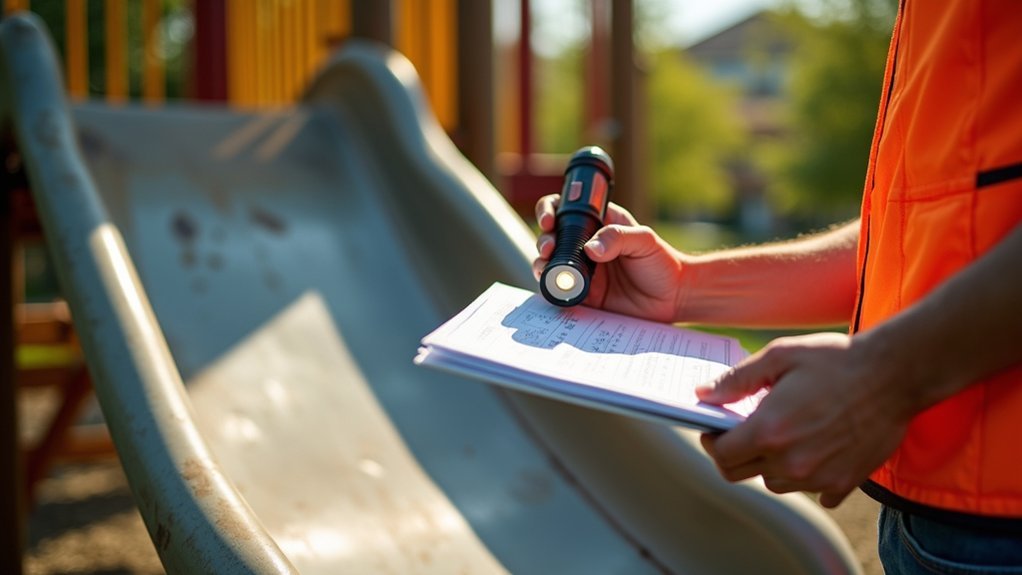
Despite having proper surfacing, your outdoor play equipment requires systematic inspection to remain safe for children. Conduct thorough examinations at least annually and after severe weather, looking for breaks, cracks, splinters, rust, or loose components.
Check for protruding hardware like S-hooks and bolt ends, promptly repairing or replacing dangerous parts. Ensure all guardrails, openings, and ladder rungs meet safety dimensions—gaps should be less than 3.5 inches or more than 9 inches to prevent entrapment.
Inspect equipment regularly—eliminate protruding hardware and ensure all gaps meet safety specifications to protect children from entrapment hazards.
Remove or fix sharp edges, splinters, worn surfaces, and cracked plastics to maintain smooth, rounded edges throughout the equipment.
Always maintain a detailed written log documenting inspection dates, findings, corrective actions, and scheduled follow-ups. This documentation proves essential for compliance and tracking maintenance history.
Age-Appropriate Equipment Selection
When selecting playground equipment for your child, consider their developmental stage to ensure they can safely navigate and enjoy the structures designed for their age group (typically 6-23 months, 2-5 years, or 5-12 years).
Always check the equipment’s weight and height safety limits, keeping younger children away from structures that exceed their physical capabilities or require skills they haven’t yet mastered.
You’ll need to adjust your supervision level based on your child’s age—constant supervision for toddlers, regular monitoring for preschoolers, and periodic check-ins for older, more experienced children.
Developmental Stage Considerations
Why does age-appropriate equipment matter so much for outdoor play? It’s fundamentally about matching physical capabilities with appropriate challenges to ensure both safety and developmental benefits.
When selecting playground equipment, consider these critical developmental factors:
- Motor skill alignment – Equipment height, grip size, and complexity should correspond directly to children’s physical abilities at each age range (6-23 months, 2-5 years, 5-12 years)
- Clear age labeling – Look for equipment with visible age recommendations to quickly assess appropriateness
- Separation by age groups – Keep younger children on smaller structures away from equipment designed for older children
- Safety-first selection – When uncertain, choose equipment with enhanced safety features and simpler navigation for younger users to minimize fall risks
Weight/Height Safety Limits
Selecting outdoor play equipment that respects specific weight and height limitations isn’t just about preventing structural damage—it’s critical for your child’s safety. Always match equipment to your child’s age group: 6-23 months, 2-5 years, and 5-12 years should use separate, appropriately rated structures.
Check manufacturer specifications before use and never allow children on equipment beyond its designed capacity. This ensures proper fall protection and appropriate gripping surfaces. Make sure climbers, slides, and swings are proportioned to your child’s height to prevent entrapment hazards.
For swings, verify that seat height and frame clearance accommodate your child’s size to reduce entanglement risks. Don’t permit younger children to use taller, more advanced equipment—only allow progression to higher structures when your child has developed appropriate skills under proper supervision.
Supervision Requirements
How effectively you supervise children during outdoor play depends largely on selecting age-appropriate equipment. Proper supervision requires understanding which structures suit different developmental stages while maintaining clear sightlines to monitor all children simultaneously.
For optimal playground supervision:
- Separate play areas by age groups (6-23 months, 2-5 years, and 5-12 years) and ensure younger children don’t access equipment designed for older kids
- Verify equipment matches children’s abilities before allowing play and check that there’s adequate space around structures to prevent collisions
- Position yourself strategically to maintain visibility of all areas and quickly respond to unsafe behavior
- Implement a structured supervision plan that focuses on identifying potential hazards and intervening promptly when children use equipment inappropriately
Always remember that proper equipment selection significantly reduces supervision challenges and injury risks.
Supervision Requirements for Different Play Structures
Active supervision requires you to continually scan play areas, position yourself strategically, and immediately address unsafe behaviors, while passive supervision won’t adequately protect children on complex structures. You’ll need to adjust your monitoring approach based on equipment height, moving parts, and the age of users, with toddlers requiring constant attention near even low platforms.
Your supervision strategy should match the specific risks of each structure type, providing closer oversight at climbing equipment and swing areas than at static ground-level play components.
Active vs. Passive Supervision
When does playground supervision shift from casual observation to necessary intervention? Active supervision requires you to continuously scan play areas with strategic positioning that covers multiple structures simultaneously, not just from a single vantage point.
Implement these practices to move beyond passive observation:
- Adjust your supervision level based on risk – high-activity zones like swings need constant attention while low-risk elements require less intensive monitoring
- Establish clear distance rules such as the arm’s reach standard for younger children
- Rotate your attention systematically to eliminate blind spots in your supervision
- Intervene quickly when you observe pushing, running or unsafe behavior before incidents occur
Document these practices in a formal supervision plan to ensure consistent coverage across all play areas.
Age-Appropriate Monitoring Needs
Effective supervision extends beyond basic vigilance to include specific monitoring tailored to each play structure. You’ll need to match your supervision intensity to both the equipment design and children’s ages. Keep younger children (6-23 months) on simpler, low-height equipment while allowing older children (5-12 years) to explore more complex structures—always with appropriate oversight.
Maintain clear sight lines to all equipment areas, particularly slides, swings, and climbing features. Separate play areas by age groups to prevent dangerous interactions between different developmental stages. For each structure, enforce specific safety rules: one child at a time on swings, feet-first seating on slides.
During supervision, regularly verify that children are using equipment as designed and that the structures remain appropriate for their age groups.
Weather-Related Safety Precautions
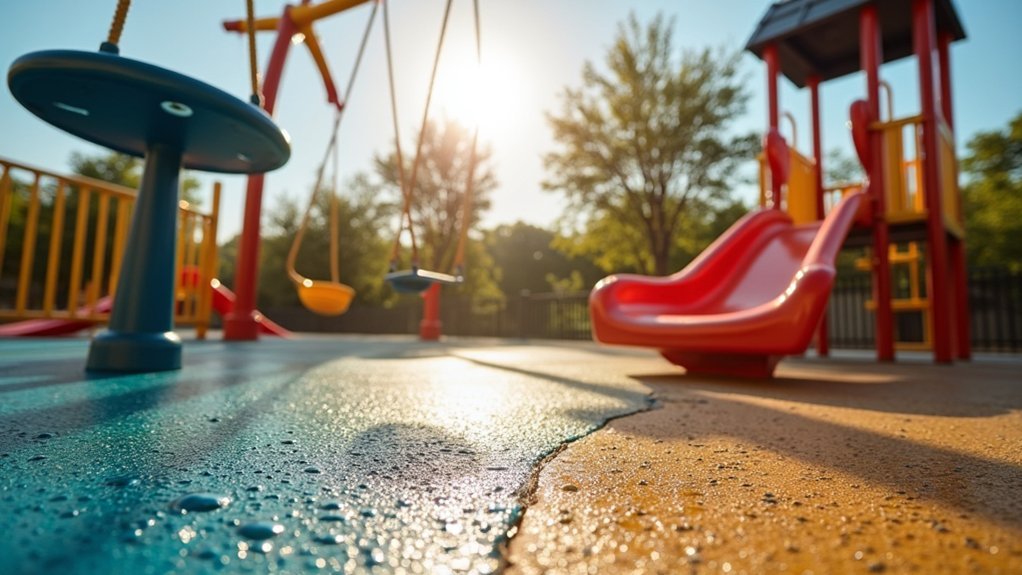
How often do parents consider weather conditions before sending children to play outdoors? Weather significantly impacts playground safety and requires your vigilance to prevent injuries.
- Heat danger: When the heat index exceeds 90°F, always check equipment surfaces before allowing children to play. Metal slides, swings, and dark-colored equipment can cause thermal burns.
- Storm safety: Stay alert to changing weather conditions and immediately move children to safety when severe weather approaches.
- Post-rain hazards: Wet equipment dramatically increases slip and fall risks, even when you’re being careful. Wait for surfaces to dry completely.
- Preparation matters: Plan playground visits during dry conditions when possible. Bring towels to wipe down equipment if necessary, especially after morning dew or light rain.
Trampoline-Specific Safety Measures
Trampolines, despite providing hours of enjoyment and exercise, require strict safety protocols to prevent serious injuries that occur all too frequently in backyard settings. Always maintain constant supervision and enforce a one-jumper rule to avoid dangerous collisions.
Install a complete safety enclosure with no gaps, and surround your trampoline with a padded, non-slip mat. Ensure at least 6-8 feet of clearance from all structures and equipment.
Before each use, inspect the trampoline for wear and damage. Replace frayed netting, rusted hardware, and worn springs or mats immediately. Don’t allow risky behaviors like flips or somersaults, and prohibit use during windy or wet conditions when surfaces become slippery. These precautions will significantly reduce the risk of trampoline-related injuries.
Swing Set Safety Guidelines
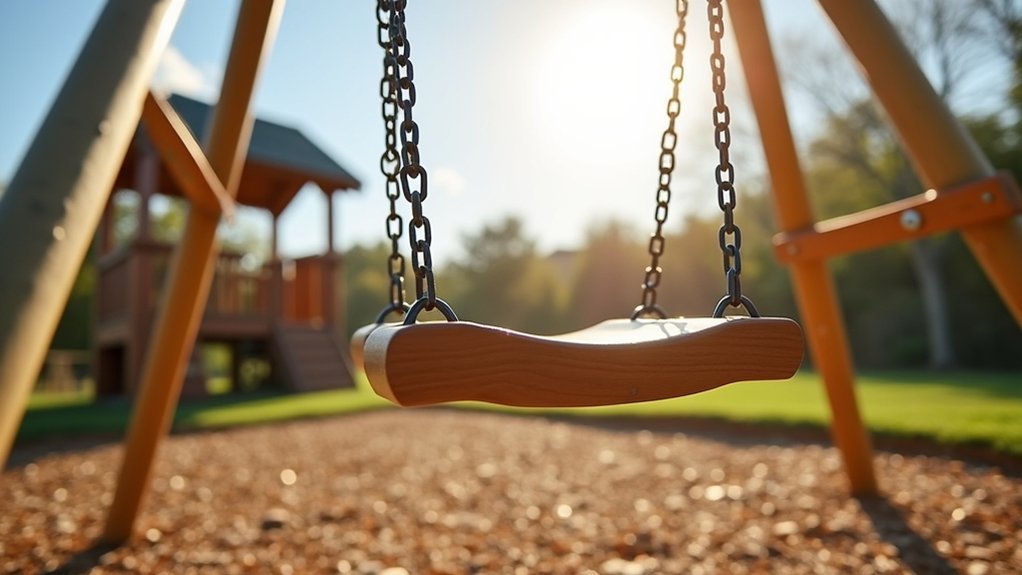
Why do swing sets consistently rank among the most beloved playground equipment while simultaneously presenting significant injury risks? Proper safety protocols can dramatically reduce accidents while maintaining the fun.
To ensure swing set safety:
- Position correctly – Establish a clear, debris-free zone extending at least 6 feet in all directions with appropriate surfacing, and prevent children from running near moving swings.
- Use proper technique – Have children sit on the seat, hold chains with both hands, and swing straight rather than side-to-side to prevent collisions.
- Match equipment to age – Verify children can reach the ground or use height-appropriate swing seats.
- Remove hazards – Take off loose clothing, drawstrings, and jewelry that could catch on chains or hardware during use.
Creating Safe Clearance Zones Around Equipment
You’ll need to establish proper fall zones around all playground equipment, extending at least 6 feet in all directions and twice the suspension bar height for swings.
Your protective surfacing within these zones should consist of materials like engineered wood fiber, rubber mulch, or pea gravel that can effectively absorb impact from falls.
Don’t forget to regularly check these areas for hazards such as exposed concrete footings, rocks, or tree stumps that could cause injuries during play.
Measuring Proper Fall Zones
Creating adequate fall zones around play equipment isn’t merely a suggestion—it’s a critical safety requirement that can prevent serious injuries. When measuring proper fall zones, you’ll need to follow specific guidelines based on equipment type and height.
- Maintain a minimum of 6 feet of protective surfacing in all directions from equipment edges
- For swing sets, extend surfacing twice the height of the suspending bar in front and behind swings
- Install at least 12 inches of protective material depth using loose-fill materials like wood chips, mulch, or safety-tested rubber mats
- Keep a minimum of 9 feet between structures taller than 30 inches to prevent fall zone overlap
Remember that protective areas must be continuous around all play elements without gaps to ensure maximum safety during potential falls.
Surface Material Requirements
While proper spacing provides the foundation for playground safety, the actual surface material beneath and around equipment plays the most critical role in preventing serious injuries. You’ll need protective surfacing extending at least 6 feet in all directions from play equipment to create effective clearance zones.
| Surface Type | Required Depth | Safety Rating |
|---|---|---|
| Wood Chips/Mulch | 12 inches | High |
| Sand/Pea Gravel | 12 inches | Medium-High |
| Rubber Mats | Safety-tested thickness | Highest |
For swing areas, extend surfacing in front and behind swings to twice the height of the suspending bar. Never use concrete, grass, or dirt as primary surfaces – they don’t provide adequate impact protection. Instead, choose loose-fill materials or safety-tested rubber mats that properly absorb falls and prevent serious injuries.
Protective Clothing and Accessories
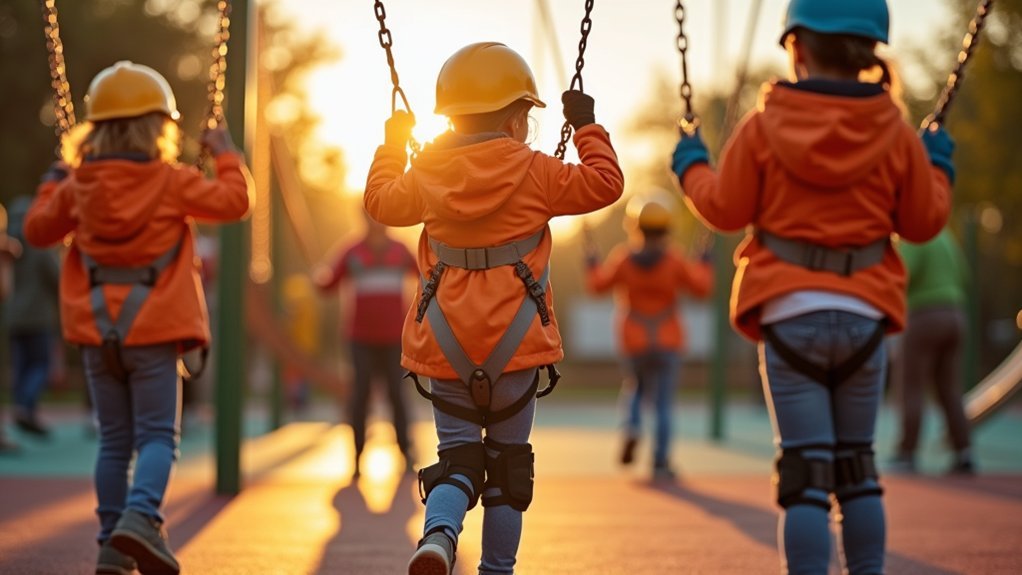
What children wear during playground activities can be just as important as the equipment they’re using. Proper clothing choices can prevent accidents and injuries while allowing for unrestricted movement during play.
When preparing your child for playground activities:
- Remove all jewelry including necklaces and earrings that could catch on equipment and create strangulation hazards
- Choose snug-fitting clothing like sweatpants without drawstrings, cords or loose elements that might snag on slides or climbing structures
- Ensure proper footwear with closed toes and secure laces to prevent tripping and protect feet from injuries
- Check for entanglement risks by avoiding clothes with loose hems, ties, or accessories that could become trapped in equipment gaps
These simple precautions significantly reduce accident risks while maintaining comfort during active play.
Teaching Children Proper Equipment Use
Beyond dressing children properly for playground safety, parents and caregivers must teach youngsters how to correctly use the equipment they encounter. Show children how to use slides feet-first and swings with both hands firmly gripping the chains. Emphasize that only one child should use equipment at a time.
| Age Group | Equipment Guidelines | Supervision Needs |
|---|---|---|
| 6-23 months | Simple, low structures | Constant hands-on |
| 2-5 years | Small slides, low platforms | Direct supervision |
| 5-12 years | Challenging equipment | Periodic monitoring |
Don’t let children run in front of or behind moving swings, and discourage side-swinging behaviors. Remind kids to check for wet surfaces before playing, as slippery equipment increases fall risks. Consistently teach that if they can’t climb down safely, they shouldn’t climb up in the first place.
Seasonal Maintenance and Storage Protocols
How often do you perform essential safety checks on your children’s outdoor play equipment? Seasonal maintenance is vital for preventing injuries and extending equipment life.
Follow these indispensable protocols:
- Inspect equipment at the start of each season, looking for cracks, rust, and loose hardware—tighten connections that may have loosened during temperature fluctuations.
- Maintain protective surfacing at a 12-inch depth, replenishing after heavy rain or snow melt that can compact or wash away material.
- Store portable equipment properly during off-seasons in dry, protected areas to prevent damage from moisture and pests.
- Verify that all safety features meet standards after seasonal ground shifts—check guardrails, openings between components, and swing support structures.
Develop a maintenance calendar with specific tasks for each season.
Frequently Asked Questions
What Are 10 Basic Safety Rules?
Use age-appropriate equipment. Check for other children. Keep your head up. Stay clear of swings. Avoid wet equipment. Don’t wear loose clothing. Remove jewelry. Wait your turn. Hold handrails. Don’t climb on wet surfaces.
What Rules and Regulations Must Be Followed in the Playground?
You must follow S.A.F.E. guidelines: ensure active supervision, use age-appropriate equipment with proper labels, maintain adequate fall surfacing (12+ inches deep), and remove recalled equipment immediately. Don’t forget to check for hazards regularly.
What Are the Factors of Safety for Playground Equipment?
You’ll need proper impact surfaces, age-appropriate equipment, adequate fall zones, regular inspections, secure guardrails, swing clearances, and no entrapment hazards. These factors prevent injuries and ensure children’s safety during play.
What Are the Safety Measures for Safety in the Playground Give?
You’ll need proper surfacing, age-appropriate equipment, regular inspections, hazard-free zones, and active supervision. Maintain 6-foot cushioning zones, fix damaged parts promptly, and implement clear supervision plans to keep children safe.


Leave a Reply