
You’ll create dense shade by layering fast-growing vines like Clematis, Honeysuckle, and Bougainvillea across your pergola’s vertical posts and horizontal beams. These climbers form a living canopy that substantially reduces direct sunlight and lowers outdoor temperatures. Pair vigorous varieties with slower-growing options like Climbing Hydrangea to avoid gaps. Choose evergreen or deciduous types based on your climate and year-round coverage needs. Discover which specific vine combinations work best for your unique space.
Why Climbing Plants Create Natural Shade
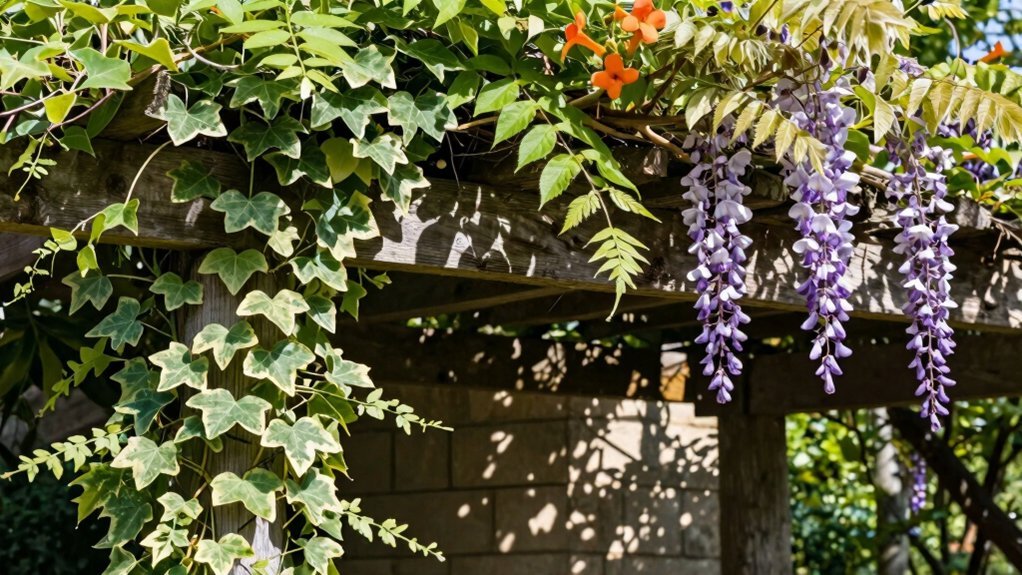
Why do climbing plants create such effective shade? You’ll find the answer in their unique growth pattern. Climbing vines cover pergola structures both vertically and horizontally, forming a dense living canopy overhead. This layered foliage significantly reduces direct sunlight penetration, which lowers outdoor temperatures and establishes a cooler microclimate beneath your pergola.
The effectiveness depends on foliage density. Thicker vine coverage blocks more sunlight, creating deeper shade. Fast-growing varieties like clematis, bougainvillea, and climbing roses establish substantial coverage quickly, though you’ll need regular pruning to maintain airflow and structural integrity.
Unlike solid structures, climbing plants offer natural flexibility. You control shade intensity through selective pruning and training. As seasons change, deciduous varieties adjust their coverage, allowing seasonal light variation while consistently reducing heat and glare year-round.
Fast-Growing Vines for Immediate Coverage
If you’re looking to establish shade quickly rather than wait years for slower climbers to mature, fast-growing vines are your best choice. Clematis varieties like Jackmanii and Sweet Autumn deliver rapid coverage with continuous blooms from spring through fall.
Honeysuckle combines speedy growth with intoxicating fragrance, especially fragrant at dusk. For maximum impact in full sun, consider Rangoon Creeper, which climbs rapidly while producing vibrant orange flowers with minimal maintenance once established.
Bougainvillea offers vigorous growth and brilliant bracts but requires sturdy structures to support its heavy, thorny vines. Akebia Quinata rounds out your options with quick growth, fragrant early-spring flowers, and straightforward care requiring only regular watering. Each option provides substantial shade within a single growing season.
Fragrant Options for Year-Round Interest
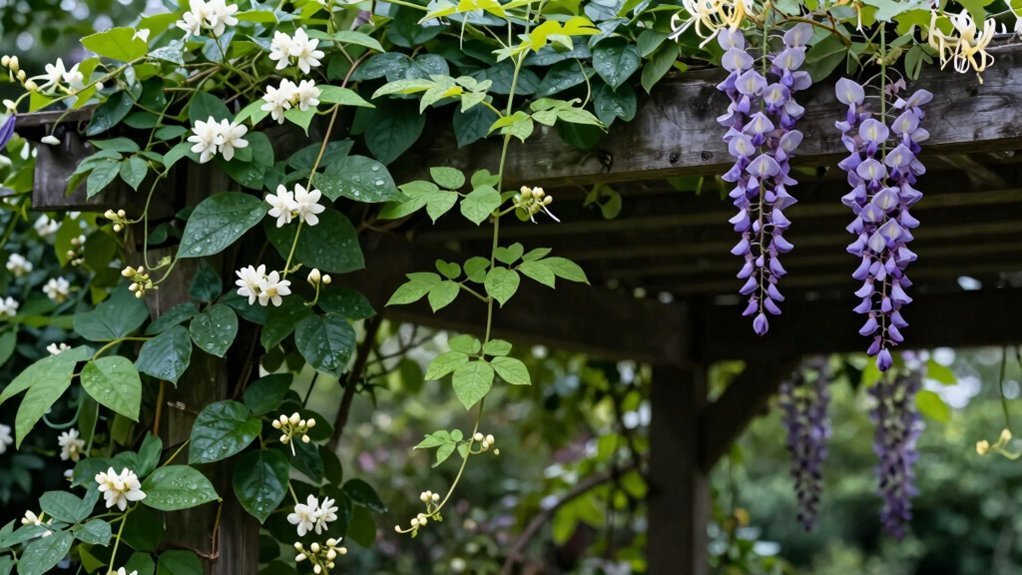
You can create year-round sensory interest by selecting fragrant climbers that peak at different seasons and times of day.
Plant Akebia quinata for early-spring blooms, Madagascar Jasmine for extended growing-season scent, and Honeysuckle to capture evening fragrance when its perfume intensifies at dusk.
Star Jasmine and Don Juan Rose round out your selection, delivering consistent aromatic coverage through every season on your pergola.
Spring Fragrance Peak Season
When does your pergola smell its sweetest? During late spring to early summer, when several fragrant climbers reach their peak blooms simultaneously.
Akebia quinata kicks off the season with early-spring fragrance and vigorous growth that quickly blankets your structure. Honeysuckle intensifies its strong scent as dusk approaches, making evening hours particularly aromatic. Star Jasmine delivers its signature sweet perfume alongside evergreen foliage, extending visual interest beyond the bloom window.
Don Juan rose and Mandevilla contribute notable fragrance during their spring-to-summer peak, thriving in shaded but sunlit pergola areas. By strategically combining these varieties, you’ll create layered scent that peaks in late spring. This timing transition your pergola to transitions from subtle early-spring notes to robust mid-summer fragrance, maximizing your outdoor enjoyment during the season’s warmest months.
Evening Scent Intensification
As spring’s peak fragrance settles into summer’s rhythm, evening aromatics take center stage. You’ll find honeysuckle delivers intensifying scent as dusk arrives, making it perfect for your pergola seating area. Jasmine varieties, particularly Star Jasmine, consistently perfume warm evenings with white blossoms that reward your outdoor relaxation. Rangoon Creeper releases fruity, floral notes as its orange-red flowers open at sunset, enhancing your evening ambiance. For year-round interest, Sweet Autumn Clematis combines fragrant blooms with evergreen presence, ensuring scent accompanies you through seasons. Each vine targets specific evening hours, layering your pergola’s aromatic profile. By selecting multiple varieties, you create overlapping fragrance windows that maximize your sensory experience throughout the day’s transition into night.
Year-Round Aromatic Coverage
How can you maintain continuous fragrance across all seasons? Layering complementary vines ensures year-round aromatic coverage. Start with Honeysuckle, which delivers fragrance throughout the year with intensified scent at dusk. Add Akebia quinata for early-spring interest before other plants fully emerge. Star Jasmine (Trachelospermum jasminoides) provides creamy-white blooms and persistent aroma from spring through early summer, enhancing your pergola’s scent profile during peak growing months. For summer through fall, Mandevilla vines offer continuous flowering and fragrance without interruption. Finally, incorporate Clematis varieties like ‘Sweet Autumn’ to boost scent in late summer and fall when other plants fade. This strategic combination creates uninterrupted aromatic interest from winter through autumn.
Flowering Vines for Visual Appeal

Why settle for plain green coverage when you can transform your pergola into a blooming showcase? Flowering vines deliver stunning visual appeal while providing shade and structure to your outdoor space.
Transform your pergola into a blooming showcase with flowering vines that deliver stunning visual appeal and seasonal shade.
Clematis produces continuous spring-to-fall blooms that cascade beautifully across your pergola, thriving in well-drained soil.
Climbing roses combine romance with fragrance, offering late spring through early fall color that rewards regular pruning with fuller coverage.
For year-round vibrancy, bougainvillea excels in hot climates under full sun, though its heavy vines demand sturdy support.
Honeysuckle adapts to various light conditions while delivering rapid growth and dusk-time fragrance.
Rangoon creeper adds vibrant orange flowers with strong scent, growing quickly in full sun with proper drainage.
You’ll create a dynamic, colorful retreat that blooms throughout the seasons.
Edible Climbing Plants for Dual Benefits
Imagine harvesting fresh fruit from the same vines that shade your pergola. You can transform your outdoor space into a productive garden by selecting edible climbing plants that deliver both shade and sustenance.
Concord grapes grow rapidly and produce dark purple fruit by late summer, making them ideal for pergolas. Akebia quinata, or Chocolate Vine, offers fragrant flowers and edible fruit when you plant both male and female specimens together. Climbing kiwis cover structures quickly while yielding nutritious fruit, and they’re remarkably hardy. For warm climates, passionflower varieties provide fast growth alongside edible passion fruits.
These dual-benefit climbers eliminate the need to choose between aesthetics and functionality. You’ll enjoy shade overhead while harvesting fresh fruit throughout the growing season.
Selecting the Right Vine for Your Climate
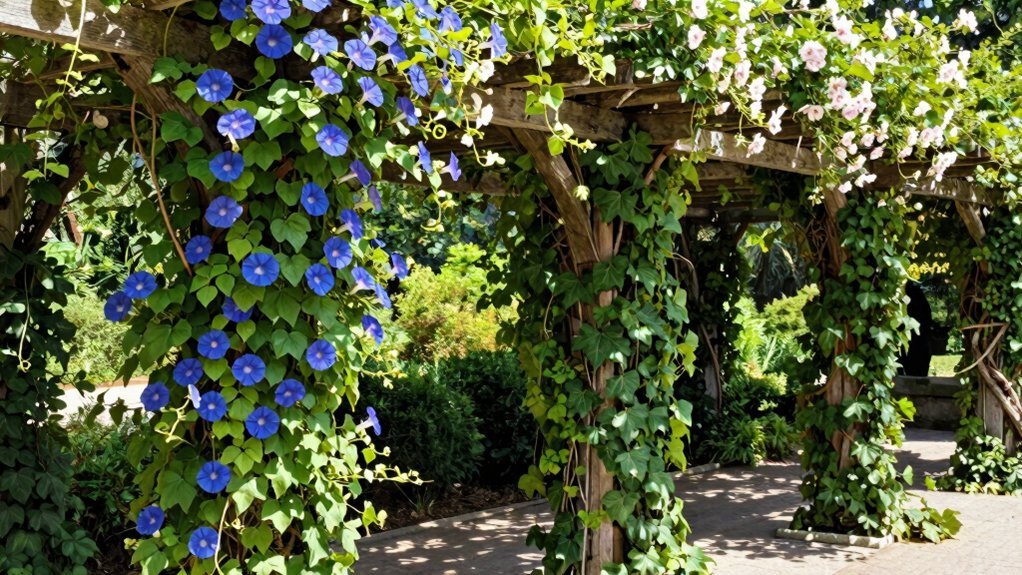
You’ll want to match your vine’s growth habit to your climate zone to ensure it thrives with minimal intervention. Selecting a species native to your region provides the best adaptation, requiring less maintenance while delivering reliable performance. By aligning climate compatibility with your pergola’s specific conditions, you’ll achieve both optimal shade coverage and plant longevity.
Climate Zone Compatibility
How do you know which climbing plant will actually survive and thrive on your pergola? Your USDA hardiness zone determines everything.
If you’re in zones 9–11, you’ll find success with heat-loving species like Bougainvillea and Cypress Vine, both demanding full sun for robust flowering. In cooler zones 4–8, Concord Grapes and Wisteria macrostachya Betty Matthews reliably establish and flourish. Climbing Hydrangea thrives in shadier, moisture-rich conditions across temperate ranges.
Consider frost tolerance carefully. Some vines like Akebia quinata and Star Jasmine span broader regions but may need winter protection in colder areas.
Before planting, assess your zone’s winter chilling requirements and summer heat tolerance. Determine whether you need evergreen coverage year-round or deciduous vines that shed seasonally. This strategic approach ensures your pergola remains lush and functional.
Growth Habit Matching
Once you’ve confirmed your hardiness zone, matching a vine’s growth habit to your climate becomes the next critical step. In hot, sunny locations, you’ll want fast-growing, sun-loving species like Bougainvillea, Clematis, and Concord Grapes that rapidly develop dense canopy coverage. These vigorous climbers thrive in full sun and deliver quick shade results.
For cooler or partially shaded sites, choose slower, shade-tolerant varieties such as Climbing Hydrangea and Akebia Quinata. They’ll steadily establish substantial coverage without excessive heat stress.
You should also consider your preference for evergreen foliage versus seasonal leafiness. Most flowering climbers favor deciduous growth patterns, though evergreen options exist if year-round coverage matters to you.
Finally, verify mature dimensions—Clematis reaches 3–20 feet, while Concord Grapes stretch 15–20 feet—ensuring your selection fits your pergola’s size and structural capacity.
Planting and Training Vines on Your Pergola
Getting your climbing plants established on a pergola requires a strategic approach from the start. You’ll guide growth along beams using soft ties or strips, directing vines upward strategically. Spring planting maximizes coverage by your first full growing season.
| Task | Timing | Purpose |
|---|---|---|
| Initial training | Spring planting | Establish directional growth |
| Regular pruning | Growing season | Prevent crowding and maintain shade |
| Structural checks | Before planting | Ensure pergola supports mature weight |
You’ll need well-drained soil and a sturdy pergola structure capable of supporting heavy, mature branches. Regular pruning during growth prevents tangling and ensures even shade distribution. By maintaining consistent training early on, you’ll achieve full canopy coverage efficiently and create the natural shade you’re seeking.
Seasonal Care and Maintenance Guide
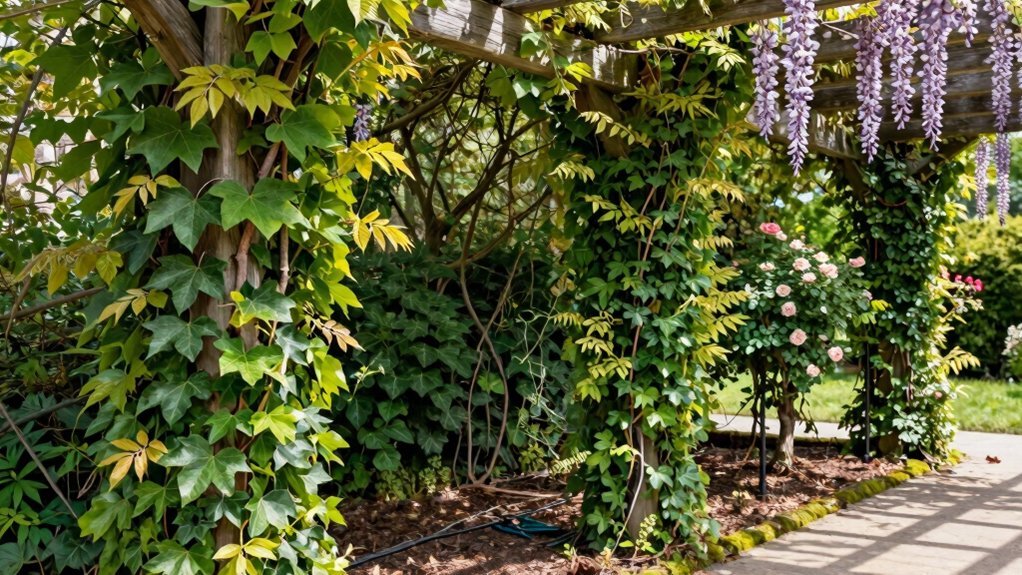
Why does seasonal timing matter so much for pergola plants? Different vines demand distinct care schedules to thrive year-round. Spring requires pruning climbing roses and clematis to encourage robust flowering. You’ll need to deadhead spent blooms throughout summer to promote continuous flowering.
In fall, you should reduce watering for most varieties as growth naturally slows. Bougainvillea demands consistent full sun exposure and sturdy support year-round due to its heavy growth pattern. Honeysuckle needs regular watering during dry months and benefits from pruning to maintain shape.
Winter care varies by climate—tender plants like Rangoon Creeper need protection in cooler regions. You’ll want to monitor soil drainage after heavy rains and adjust your watering schedule accordingly. Establishing these seasonal routines ensures healthy, abundant coverage throughout the year.
Combining Multiple Vines for Enhanced Shade
You’ll maximize your pergola’s shade by layering vines with complementary growth patterns—pairing fast-growing Clematis with slower climbers like Climbing Hydrangea ensures you don’t sacrifice long-term density for quick coverage.
Staggering plants across different planes of your pergola structure, from vertical posts to crossbeams, lets you capture shade at multiple heights and spreads as each vine reaches its potential.
This strategic combination gives you extended seasonal coverage while preventing any single plant from monopolizing resources or creating bare patches.
Layering for Maximum Coverage
While a single climbing vine can provide decent shade, combining multiple vines with different growth rates and canopy densities creates a progressively denser coverage that’s far superior. You’ll want to pair fast-growing sun-tolerant climbers like Bougainvillea or Clematis with evergreen options such as Climbing Hydrangea for year-round protection.
Train vines on successive vertical supports and horizontal pergola beams to form multi-tiered shade layers from top to bottom. Stagger your planting so quick-covering species establish first, allowing slower climbers time to gain grip and height while ensuring continuous seasonal coverage.
Vary leaf textures and colors—large green leaves paired with variegated or small-leaf varieties—to achieve deeper visual shade and richer understory color that enhances both function and aesthetics.
Complementary Growth Patterns
Layering creates the foundation for dense coverage, but it’s the strategic pairing of vines with different growth patterns that truly maximizes your pergola’s shading potential.
You’ll achieve optimal results by combining complementary species that work together rather than compete. Consider these effective pairings:
- Vigorous climbers with upright trainers: Pair fast-growing bougainvillea with clematis or wisteria to fill gaps at multiple heights
- Foliage-heavy species with flowering vines: Mix climbing hydrangea or ivy with honeysuckle or passionflower for continuous canopy and seasonal blooms
- Vertical climbers with ramblers: Let one species dominate upper reaches while another nests into lattice work below
Maximizing Pergola Comfort With Proper Vine Selection
How can the right climbing plant transform your pergola into a genuinely comfortable outdoor retreat? By selecting vines that match your climate and maintenance capacity, you’ll create optimal shade and airflow.
In hot climates, prioritize Bougainvillea and Star Jasmine—both tolerate full sun while delivering dense coverage on sturdy structures. For fragrant comfort, combine fast-growing Akebia Quinata or Rangoon Creeper with spring-blooming Climbing Hydrangea. This layered approach ensures year-round density without sacrificing cooling breezes.
Regular pruning and training prove essential. Clematis, Honeysuckle, and Climbing Roses respond well to shaping, allowing you to maintain dense foliage while preserving comfortable temperatures underneath. You’ll strike the perfect balance between shade and ventilation, transforming your pergola into a genuinely inviting space throughout every season.
Frequently Asked Questions
What Is the Best Climber for a Pergola?
You’ll find Clematis is your best choice for a pergola. It’s one of the fastest climbers available, quickly covering structures from spring through fall with minimal care requirements. It thrives in well-drained soil and offers stunning variety options.
What Climbing Vines Tolerate Shade?
You’ll find that Climbing Hydrangea, Honeysuckle, Clematis, Star Jasmine, and Chocolate Vine all tolerate shade well. You can choose varieties that prioritize foliage and fragrance over vivid blooms when you’re working with lower-light pergola spots.
What Are Good Vines to Grow on a Pergola?
You’ll find excellent options in clematis, bougainvillea, chocolate vine, climbing roses, and climbing hydrangea. Each offers unique benefits—choose based on your sunlight, space, and maintenance preferences to create the perfect pergola coverage.
What Climber Grows Well in the Shade?
You’ll find climbing hydrangea thrives in partial shade, offering lush foliage and white flowers. Chocolate vine and certain clematis varieties also perform well in shaded areas. Star jasmine provides fragrant blooms while tolerating shade beautifully on your pergola.